
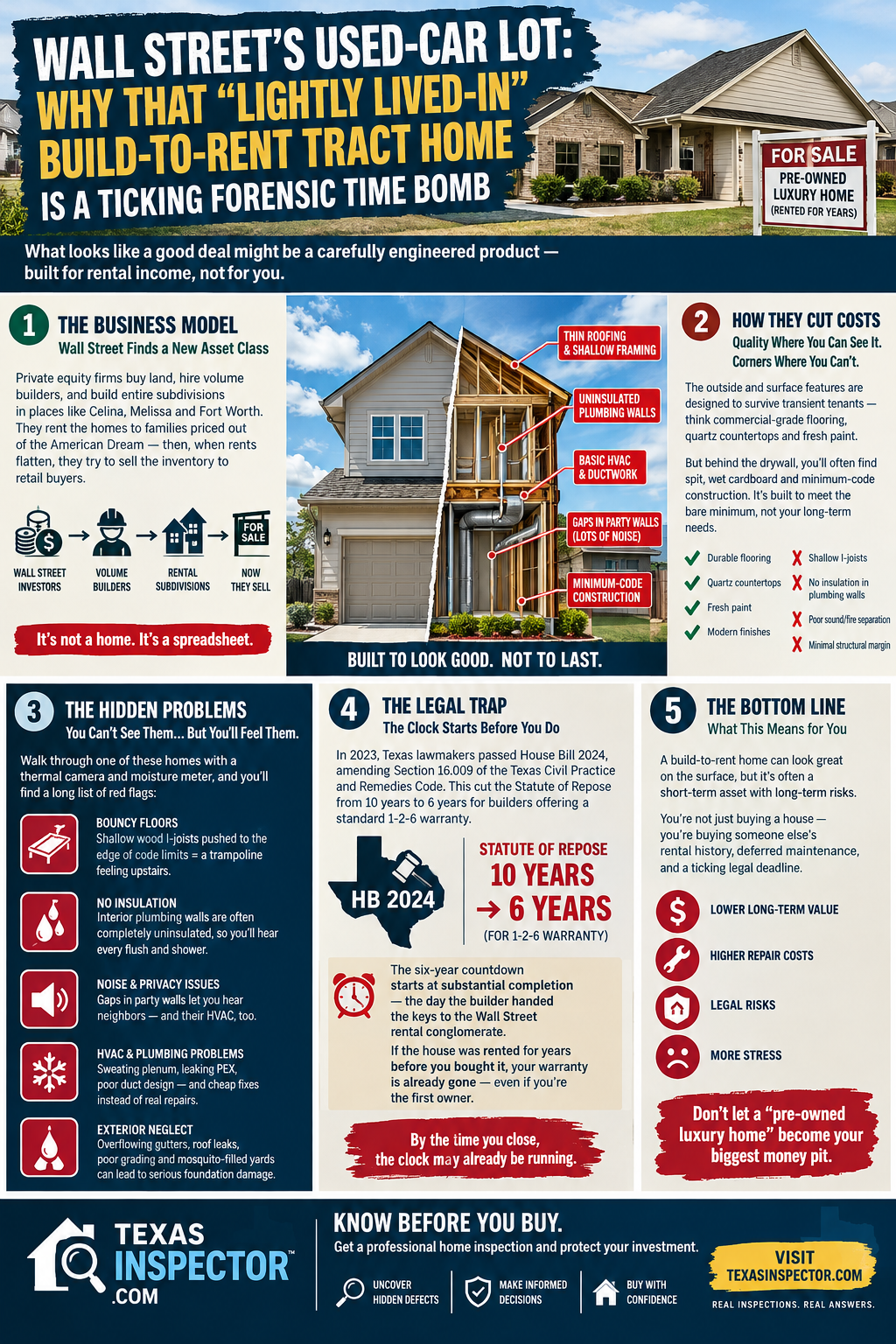
For the last few years, Dallas-Fort Worth has held the dubious crown as the Build-to-Rent capital of America. Private equity bros in Midtown Manhattan realized they could skip the middleman, hire volume tract builders to throw up entire disposable subdivisions in Celina, Melissa, and Fort Worth, and milk monthly rent out of families priced out of the American Dream. Now that DFW rents have flattened out in 2026, nearly two-thirds of landlords are begging for tenants with move-in concessions, and the federal ROAD to Housing Act has changed the institutional game, the spreadsheets have spoken. It is time to dump the inventory. So these corporate slumlords are rolling five gallons of Agreeable Gray over the water stains, calling their battered rental pods “pre-owned luxury homes,” and unloading them onto desperate retail buyers. And if you think a hedge fund algorithm paid a production builder extra money to put quality framing behind drywall it never intended to own past year five, you are probably the same guy who thinks a ten-dollar rubber soaker hose from Home Depot will keep eight thousand tons of heaving North Texas clay from snapping your foundation in half.
Let us be crystal clear about how a Build-to-Rent subdivision is engineered from the dirt up. When a builder builds for an actual human homeowner, they at least have to pretend to care because an angry buyer might show up at the sales trailer screaming about buckled floors while another prospect is signing a contract. When the buyer is a private equity spreadsheet purchasing two hundred lots in bulk from a boardroom in New York, the value-engineering goes completely feral. Everything you can see and touch is selected to survive a transient tenant who hates the landlord—think commercial-grade plastic plank flooring that could survive a nuclear blast and indestructible quartz slabs. Meanwhile, everything hidden behind the painted drywall is built out of spit, wet cardboard, and minimum-code prayers.
Walk through one of these decommissioned rental pods with a thermal camera and a moisture meter and you will witness a masterclass in institutional sociopathy. Because the corporate buyer demanded rock-bottom cost per square foot, the floor systems use the cheapest, shallowest wood I-joists spanned to the absolute mathematical cliff of International Residential Code deflection limits. The result is a second-story bedroom that bounces like a carnival trampoline every time your golden retriever scratches its ear. The interior plumbing walls are completely uninsulated because insulation costs forty bucks a wall and does not show up on a Zillow listing, meaning every time somebody flushes a toilet upstairs, it sounds like a barrel going over Niagara Falls directly into your dining room. In the townhome and cottage-style BTR developments, the acoustic and fire separation in the party walls is treated like an optional suggestion, with gaping voids in the shaftliner panels so you can listen to your neighbor’s divorce proceedings in high-definition Dolby Atmos while breathing their unconditioned attic humidity.
Then there is the mechanical nightmare rotting in the closets and attics. Institutional landlords treat maintenance requests like a personal insult to their quarterly dividends. How do you think a Wall Street slumlord fixes a chronically sweating HVAC plenum or a weeping PEX manifold? They do not hire a licensed forensic plumber to trace the pressure drop or an engineer to recalculate static duct pressure. They dispatch a nineteen-dollar-an-hour maintenance guy in a dented van armed with a tube of silicone caulk, a can of Kilz, and a smartphone app that docks his pay if he spends more than twenty-two minutes on the property. For four straight years, while renters who did not own the place ignored overflowing gutters, roof leaks, and negative grading swales turning the side yard into a mosquito sanctuary against the post-tension slab, the structure quietly digested itself in the dark.
And that brings us to the legal guillotine waiting for your neck at the closing table, lovingly crafted by the Texas Legislature. Back in 2023, our developer-owned lawmakers in Austin passed House Bill 2024, amending Texas Civil Practice and Remedies Code Section 16.009 to slash the Statute of Repose from ten years down to six for any builder offering a standard 1-2-6 warranty—a piece of paper that already has roughly the same legal and financial value as a damp chili-dog napkin.
Pay attention to the sleight of hand that neither your commission-breath real estate agent nor the institutional seller’s disclosure packet will ever mention. Under Section 16.009, that six-year countdown to total builder immunity does not start the day you buy the house. It starts at substantial completion—the day the builder handed the master keys to the Wall Street rental conglomerate. If a private equity fund rented that house out for four and a half years to juice their internal rate of return before flipping it to your family, the one-year workmanship warranty is dead, the two-year mechanical warranty is decomposed, and you have eighteen months left on the clock before the original builder is permanently, legally untouchable for every latent structural defect buried inside that framing package. You are paying full retail price for a house with a salvage-title legal clock.
Of course, none of this legislative arson happens by accident. It happens because every two years, Texas voters march into the polling booth, pull the lever for the same bumper-sticker-spouting morons who campaign on “protecting Texas business from frivolous lawsuits,” and then act shocked when they find out the business those clowns were protecting was a Delaware LLC unloading a rotting tract house onto a Texas family with zero legal recourse. As long as you keep sending these developer-owned stooges back to Austin to gorge themselves on lobbyist ribeyes, you will keep getting the exact government service you voted for—a statutory middle finger wrapped in the Lone Star flag.
When the foundation finally shears or the unvented roof deck turns to compost in year seven, the original builder will point to Section 16.009 and laugh your lawyer out of the room, while the Wall Street fund that sold you the house will point to the “As-Is, Where-Is” institutional seller addendum buried on page forty-two of your closing packet. If you are gullible enough to buy a retired corporate rental without an invasive, head-to-toe forensic inspection first, you might as well sign their arbitration clause right now and let their corporate defense attorney pick out which shade of structural lipstick they are going to smear over your framing defects. Welcome to the North Texas housing market, where Wall Street harvests the equity, Austin buries the evidence, and you get left holding the mop.


