Archive for February, 2026

A recent Houston Chronicle report described a Texas military veteran who protested outside the headquarters of David Weekley Homes, alleging serious defects in his newly constructed home and unresolved warranty issues.
Regardless of where the ultimate facts land in that specific dispute, the larger lesson is not about one builder.
It is about risk.
When a homeowner-especially a veteran who served this country-feels compelled to stand outside a corporate office with a protest sign, something in the dispute resolution process has broken down.
New-construction buyers in Texas should pay attention.
New Home ≠ Perfect Home
There is a widespread assumption that “brand new” means:
- Fully compliant
- Properly supervised
- Carefully inspected
- Structurally sound
In reality, most production homes are built in compressed timelines using rotating subcontractor crews. High volume increases variability.
Even reputable, nationally recognized builders rely on dozens of independent trades working under scheduling pressure.
Defects are not rare. They are predictable.
Why Municipal Inspections Are Not Enough
In Texas, city inspectors enforce the locally adopted version of the International Residential Code. Their role is limited to verifying minimum code compliance at specific inspection stages.
They do not:
- Perform forensic moisture analysis
- Remove finishes
- Verify every manufacturer installation requirement
- Represent the homeowner
A green sticker from the city means the house passed a limited inspection at a moment in time.
It does not mean the home is defect-free.
The Types of Problems That Lead to Escalation
When disputes escalate to public protest, the issues are usually not cosmetic.
They often involve:
Improper flashing, drainage, or cladding details that allow moisture into wall systems.
Improper framing connections, settlement concerns, or load path deficiencies.
Improperly protected branch circuits, panelboard defects, or missing AFCI/GFCI protection.
Improper slope away from foundations leading to ponding and foundation risk.
These are not “punch list” items. They affect safety, durability, and long-term value.
Why Warranty Processes Sometimes Fail
Most production builders have structured warranty departments. When defects are reported:
- The builder inspects.
- The builder decides the scope.
- The builder chooses the repair method.
- The builder documents the resolution.
That structure is not inherently improper-but it is not independent.
If a homeowner believes the root cause is not being addressed, trust erodes quickly.
Under Texas Property Code Chapter 27 (Residential Construction Liability Act), homeowners must:
- Provide written notice of defects.
- Allow the builder to inspect.
- Allow the builder an opportunity to offer repairs.
If either side mishandles that process, conflict escalates.
Public protest is usually the last step-not the first.
What Buyers Should Do Instead of Waiting for Crisis
The lesson from this protest is not “avoid large builders.”
The lesson is “protect yourself early.”
- Inspect Before Drywall
This is the only time framing, plumbing routing, electrical runs, and structural components are visible.
- Inspect Before Closing
Do not rely on a final walkthrough alone.
- Inspect Before Warranty Expiration
Many defects manifest within the first year.
- Document Everything
Photographs. Dates. Written communication.
Technical documentation creates leverage. Emotion does not.
Systemic vs. Isolated Defects
When a dispute involves a production builder in a subdivision, two possibilities exist:
- The issue is isolated to one home.
- The issue reflects a repeated construction method across multiple homes.
If systemic, neighbors may be experiencing similar issues without knowing it.
That is when disputes gain traction-and sometimes media coverage.
The Larger Reality
The veteran in the Chronicle story felt unheard.
No homeowner-veteran or otherwise-should feel that public protest is the only avenue left.
But the reality is this:
- Construction is imperfect.
- Oversight varies.
- Documentation protects you.
- Independent inspection reduces escalation.
Your home is likely the largest investment you will ever make.
Treat it like one.
Let’s finish the job and say the quiet part out loud.
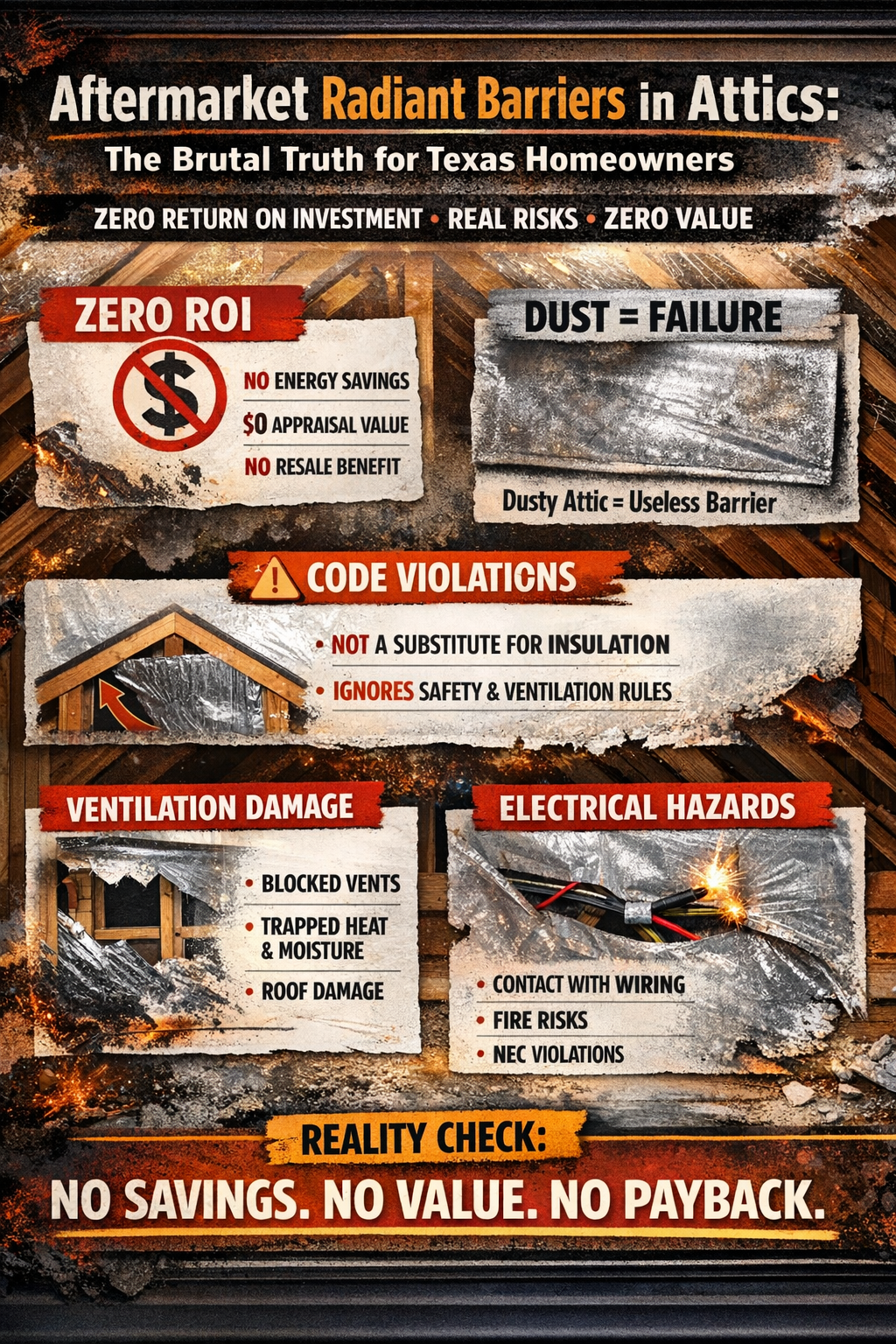
For the overwhelming majority of Texas homes, aftermarket radiant barriers installed in attics deliver effectively zero return on investment. Not “low.” Not “long-term.” Zero. And in many cases, the homeowner actually goes backward financially by introducing new defects that cost far more to correct than the barrier ever saves.
This isn’t theory. This is inspection reality.
Start With the Code (Because the Math Starts There)
Texas enforces the 2021 International Energy Conservation Code (IECC).
- IECC R402.1 & R402.2
Attic insulation R-values are mandatory (typically R-38 across most of Texas).
Radiant barriers do not reduce those requirements.
Radiant barriers do not replace insulation.
Translation:
You are paying for a product that earns you no code credit whatsoever.
No reduced insulation cost.
No compliance offset.
No performance substitution.
From a regulatory standpoint, the radiant barrier is dead weight.
ROI Requires Measurable, Durable Performance
Radiant barriers fail both tests.
- Any Energy Savings Are Marginal at Best
Even under ideal conditions, aftermarket radiant barriers may slightly reduce peak attic heat gain. That does not translate into meaningful, bankable utility savings once you factor in:
- Existing insulation (already doing the heavy lifting)
- Duct leakage and losses
- Air infiltration
- Thermostat behavior
- Seasonal variability
Tiny reductions in HVAC runtime do not justify four-figure installations.
- Performance Degrades Rapidly
Radiant barriers require:
- A clean reflective surface
- An adjacent air space
Texas attics are dusty. Period.
Once the foil loads up with dust-and it will-the reflectivity drops sharply. At that point, energy “savings” drop to statistical noise.
There is no maintenance plan.
There is no re-cleaning.
There is no performance warranty anyone actually enforces.
Your “investment” quietly dies in the dark.
Zero Appraisal Value. Zero Resale Credit.
Here’s the part no salesman will ever admit:
- Appraisers do not assign value to aftermarket radiant barriers
- Realtors do not list them as upgrades
- Buyers do not pay more for them
- Inspectors do not credit them toward performance compliance
They do not increase square footage.
They do not improve structural systems.
They do not reduce deferred maintenance.
From a resale standpoint, they are invisible-unless they caused a problem.
Negative ROI Is Common – And Inspectors See It All the Time
Aftermarket radiant barriers routinely create costs instead of savings.
Ventilation Damage
Foil blocks:
- Soffit intakes
- Ridge vents
- Gable vents
Result:
- Hotter attics
- Moisture accumulation
- Roof decking deterioration
- Shortened shingle life
Roof repairs erase decades of hypothetical energy savings.
Electrical Issues
Radiant barriers are conductive.
Improper installations:
- Contact NM wiring
- Create abrasion points
- Interfere with lighting clearances
Corrections required under the 2023 NEC are not cheap-and not optional.
Fire and Listing Concerns
Attic materials must meet flame spread and smoke development limits consistent with:
- IRC R302.10
- IRC R316 (where applicable)
Unlisted or undocumented foil products create liability exposure, not value.
The Sales Pitch vs. Reality
What homeowners are told:
- “It’ll pay for itself.”
- “You’ll see huge savings.”
- “Your attic will be dramatically cooler.”
- “This is a smart investment.”
What actually happens:
- Utility bills barely move
- Dust kills performance
- Ventilation gets compromised
- Inspection findings multiply
- Repair costs exceed savings
That’s not ROI. That’s a sunk cost with interest.
The Only Honest ROI Statement
For a typical Texas home with code-compliant insulation:
Aftermarket radiant barriers have no realistic path to payback.
They:
- Do not reduce required insulation
- Do not add appraised value
- Do not produce durable savings
- Do not improve resale
- Frequently create downstream repair costs
From a financial standpoint, they are money spent, not money invested.
The Bottom Line (No Soft Edges)
If your attic:
- Lacks insulation → fix insulation
- Leaks air → seal it
- Has bad ductwork → repair it
- Has poor ventilation → correct it
Every one of those items produces measurable, durable ROI.
Aftermarket radiant barriers do not.
In Texas, they are most often a zero-return product sold with absolute confidence, installed with casual disregard for ventilation and wiring, and defended with anecdotes instead of data.
That’s not building science.
That’s salesmanship.
Here’s the uncomfortable truth:
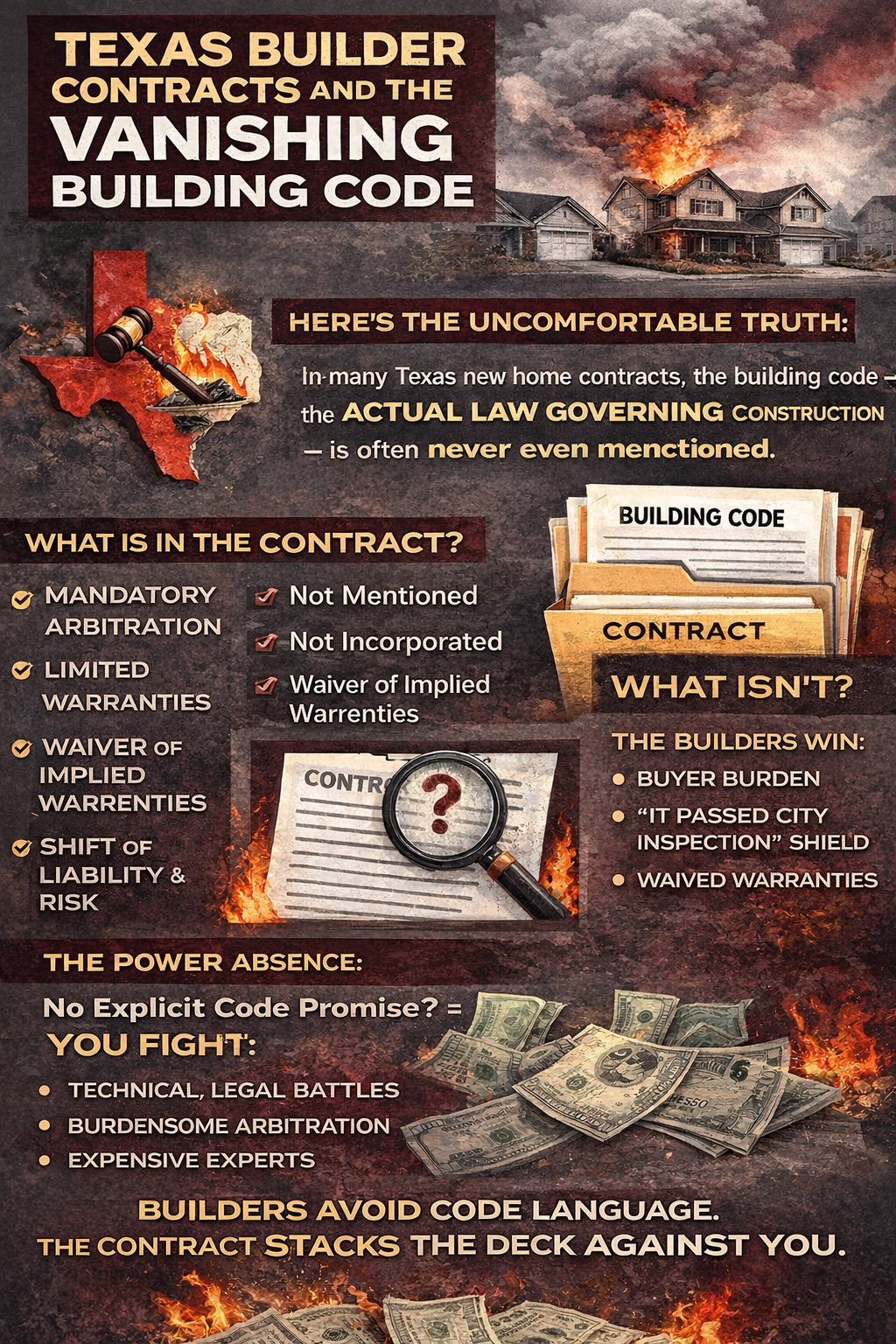
In many Texas new home sales contracts, the building code — the actual law governing construction — is never even mentioned.
Not incorporated.
Not referenced.
Not promised.
Gone.
The Law Exists. The Contract Pretends It Doesn’t.
In Texas, once a municipality adopts a building code under:
- Texas Local Government Code § 214.212 (municipal authority), or
- § 233.153 (county authority in certain areas),
that code is law.
For one- and two-family dwellings, that typically means:
- 2021 International Residential Code (IRC)
- 2021 International Energy Conservation Code (IECC)
- 2023 National Electrical Code (NEC), where adopted
These are not suggestions.
They are minimum legal requirements.
And yet—open up the typical Texas production builder contract and try to find a clear sentence stating:
“Builder shall construct the home in strict compliance with all applicable building codes.”
You won’t find it.
Not because it was forgotten.
Because it was avoided.
What the Contract Does Say
It will say:
- Arbitration is mandatory.
- Warranties are limited.
- Implied warranties are disclaimed to the maximum extent permitted.
- Liability is restricted.
- Delays are excused.
- Risk is shifted.
- You waive things.
- You initial things.
- You sign things.
But the single most important performance standard in residential construction?
Silence.
Why This Is Not an Accident
If the contract expressly incorporates the adopted building codes:
- Code violations become straightforward breach-of-contract claims.
- Enforcement becomes objective.
- “Substantial compliance” arguments get weaker.
- Homeowners have leverage.
If the contract does not incorporate the codes:
- The fight shifts to implied warranties.
- The builder argues “good and workmanlike.”
- The builder argues “it passed city inspection.”
- The burden becomes technical, expensive, and uphill.
That is not poor drafting.
That is risk management.
“It Passed Inspection” — The Favorite Shield
Municipal inspections are limited-scope regulatory checks.
They are not:
- Forensic reviews
- Performance certifications
- Structural audits
- Energy compliance verifications beyond spot checks
- Warranty guarantees
Inspectors do not open walls after drywall.
They do not re-engineer framing.
They do not redesign HVAC loads.
They do not certify long-term performance.
Passing inspection means one thing:
It was not red-tagged that day.
That is not the same as code compliance.
And it certainly is not the same as contractual compliance.
The Game
Here’s how it works:
- The law requires code compliance.
- The contract avoids promising code compliance.
- The warranty limits remedies.
- Arbitration restricts procedure.
- The buyer assumes “of course they have to build to code.”
That assumption is doing a lot of heavy lifting.
The Sentence That Should Be There
A contract that is serious about legal compliance would say:
“Builder shall construct the Home in strict accordance with all applicable federal, state, and local building, electrical, mechanical, plumbing, and energy codes adopted by the authority having jurisdiction as of the date of permit issuance.”
If that sentence is not there, ask yourself why.
If a builder is fully confident in strict code compliance, incorporating that obligation should be easy.
If it’s avoided, that tells you something.
This Is About Leverage
Before closing:
- You have negotiation leverage.
- You can demand inspections.
- You can demand documentation.
- You can request plan review.
After closing:
- You have warranty procedures.
- You have arbitration.
- You have experts.
- You have invoices.
Those are not the same thing.
Hard Truth
The building code is the minimum legal standard.
If the sales contract does not explicitly incorporate it as a contractual duty, you are relying on:
- Public enforcement,
- Limited warranties,
- And the hope that nothing was missed.
Hope is not a construction standard.
Bottom Line
If you are signing a Texas new home construction agreement and the document:
- Carefully limits liability,
- Carefully narrows warranties,
- Carefully requires arbitration,
- But does not clearly promise strict compliance with adopted building codes—
That omission is not accidental.
It is structural.
And you should treat it that way.
Texas and national elections are approaching.
Most campaign conversations focus on immigration, taxes, crime, and education.
Very little attention is paid to something that directly affects homeowners:
Consumer protection in residential construction.
If you own a home, are building one, or are purchasing new construction in Texas, the policies shaped by elected officials directly impact:
- Your warranty rights
- Your ability to bring a defect claim
- Contractor accountability
- Building code adoption and enforcement
- Insurance regulation
- Transparency in public oversight
This is not abstract politics. It is financial risk management.
Why Consumer Protection Matters in Residential Construction
Texas remains one of the fastest-growing housing markets in the country. Rapid expansion means:
- Accelerated build schedules
- High-volume production
- Heavy reliance on subcontractors
- Increased defect disputes
When defects arise, homeowners rely on the legal framework for protection.
That framework is not static.
It is shaped by elected officials.
Areas Directly Affected by Elections
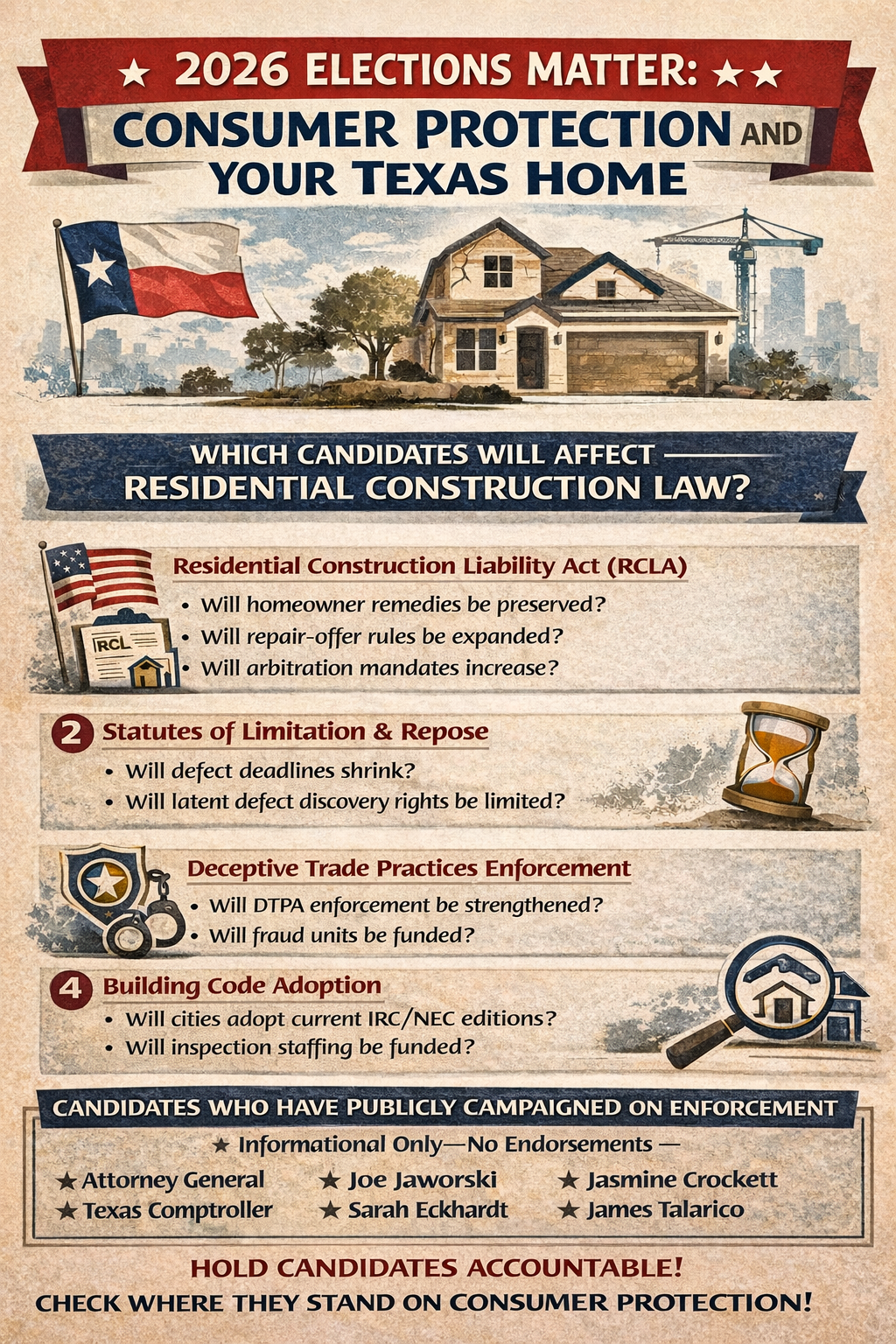
- The Texas Residential Construction Liability Act (RCLA)
Texas Property Code Chapter 27 governs:
- 60-day pre-suit notice requirements
- Builder inspection rights
- Repair-offer procedures
- Damage limitations
Legislators can modify these rules.
Changes that shorten deadlines, expand immunity, or restrict remedies reduce homeowner leverage.
Changes that preserve court access and transparency strengthen consumer protection.
- Statutes of Limitation & Repose
Texas Civil Practice & Remedies Code §16.009 establishes the statute of repose for construction claims.
Legislative changes here can:
- Shorten the time you have to file suit
- Limit latent defect discovery rights
- Expand protections for builders and designers
Time-bar changes affect every homeowner, whether they realize it or not.
- Attorney General Enforcement
The Texas Attorney General enforces the Deceptive Trade Practices Act (DTPA).
Candidates currently running for Attorney General who publicly emphasize enforcement, transparency, or accountability themes include:
- Joe Jaworski
- Nathan Johnson
- Tony Buzbee
These names are provided strictly for informational purposes. Voters should review each candidate’s official platform for specific enforcement positions.
The AG’s philosophy toward DTPA enforcement materially affects consumer protection.
- Fiscal Oversight & Transparency
The Texas Comptroller influences public accountability and auditing.
A current candidate who has emphasized transparency and fiscal oversight themes is:
Again, this is informational. Voters should review campaign materials directly.
Financial oversight affects regulatory funding, inspection staffing, and public enforcement capacity.
- Legislative Consumer Protections
Certain legislators have previously sponsored targeted consumer protection measures.
For example:
- Judith Zaffirini has sponsored solar industry consumer protection legislation requiring licensing and accountability measures.
Legislative records provide a clearer picture than campaign slogans.
- Federal Consumer Protection
Federal offices affected:
- Consumer Financial Protection Bureau policy
- Housing finance oversight
- National regulatory enforcement
Current U.S. Senate candidates from Texas who emphasize consumer accountability themes in campaign materials include:
- Jasmine Crockett
- James Talarico
Again, this is not an endorsement — only identification of publicly stated policy emphasis.
How Homeowners Should Evaluate Candidates
Rather than focusing on party affiliation, homeowners should ask:
- Do you support preserving homeowner access to court in defect disputes?
- Should RCLA remedies be expanded or restricted?
- Do you support shortening defect filing deadlines?
- Will you enforce DTPA protections aggressively?
- Do you support updating building codes to current standards?
- What is your position on insurance consumer protections?
Clear answers matter.
Silence on these issues is informative.
Follow the Money
Campaign finance disclosures reveal priorities.
If significant funding comes from:
- Large developer PACs
- Construction trade organizations
- Insurance lobbying groups
That may indicate a different regulatory philosophy than candidates supported by consumer advocacy organizations.
Voters can review campaign finance reports through the Texas Ethics Commission.
The Bottom Line
This is not partisan.
Consumer protection in residential construction is paramount.
Homeowners should be wary of:
- Candidates advocating shorter statutes of repose
- Expanded arbitration mandates
- Reduced regulatory oversight
- Weakening of DTPA enforcement
- Outdated building code adoption
Your home is likely the largest investment you will ever make.
The legal framework protecting that investment is shaped at the ballot box.
Vote accordingly — after reviewing the facts.

Artificial turf is marketed as “green,” “eco-friendly,” “maintenance-free,” and “smart.”
That is all bullshit.
What you are actually buying is a temporary plastic carpet installed as permanent construction, engineered for failure, hostile to drainage, hostile to heat control, hostile to biology, hostile to electrical safety, hostile to resale-and destined for a landfill inside of a decade.
Let’s stop pretending.
- Artificial Turf Is Not Landscaping – It’s Unpermitted Construction in Disguise
Grass is landscaping.
Artificial turf is site alteration.
It involves:
- Excavation
- Removal of organic soil
- Compacted aggregate bases
- Altered drainage paths
- Increased effective impervious cover
That puts it squarely under residential building and site requirements, whether the installer likes it or not.
Texas-adopted 2021 IRC doesn’t care about your aesthetic goals:
- R401.3 – Surface water must drain away from foundations
- R401.2 – Fill and compaction may not impair drainage
- R403.1.7 – Foundations must be protected from water accumulation
Artificial turf systems routinely violate the intent and the outcome of all three.
They don’t fail because homeowners misuse them.
They fail because they’re incompatible with residential drainage physics.
- Turf Installers Flatten Yards Because They’re Selling Instagram, Not Performance
Codes require slope.
Turf installers require flat.
That alone should tell you everything you need to know.
Flattening a yard:
- Eliminates positive drainage
- Encourages subsurface water retention
- Forces lateral water movement toward structures
- Creates chronic moisture zones under plastic
This is how you get:
- Foundation movement
- Fence post rot
- Retaining wall displacement
- Mosquito habitat beneath “maintenance-free” turf
And no, crushed stone underneath does not magically fix bad hydrology.
Water still has to leave the site. Turf prevents that.
- Artificial Turf Is a Heat Engine, Not a Ground Cover
Natural grass cools itself.
Artificial turf stores heat like asphalt.
Texas summer surface temperatures of 150°F–170°F are routine. That heat:
- Burns pets
- Makes yards unusable
- Re-radiates into walls, windows, and doors
- Increases HVAC cooling loads
- Accelerates material degradation
From an energy and environmental standpoint, turf is a localized urban heat island, installed deliberately, then defended with marketing buzzwords.
If you wanted hotter walls and higher electric bills, congratulations-you nailed it.
- Environmental Impact: Turf Is Plastic Pollution You Install on Purpose
This is where the “green” lie collapses completely.
Artificial turf is made of plastic.
Plastic does not disappear.
It breaks down into smaller plastic.
Microplastics
Turf sheds continuously due to:
- UV exposure
- Heat cycling
- Foot traffic
- Pets
Those particles migrate into:
- Soil
- Storm drains
- Creeks
- Watersheds
They do not biodegrade.
They accumulate.
Installing turf is not environmentally neutral-it is intentional microplastic deployment.
- Chemical Load: You’re Not Saving the Environment, You’re Poisoning It Slowly
Many turf systems contain:
- Plasticizers
- UV stabilizers
- Colorants
- Flame retardants
- Heavy-metal trace compounds in infill
During rain events, these compounds leach into runoff.
Natural grass does not do this.
Soil does not do this.
Turf replaces a living filter with a chemical shedding surface and then calls itself sustainable.
That’s not ignorance.
That’s marketing malpractice.
- Turf Breaks Electrical Safety by Making Defects Permanent
Artificial turf is commonly installed over:
- Landscape lighting
- Low-voltage wiring
- Irrigation controls
- Pool bonding grids
Once buried, those systems are:
- Inaccessible
- Uninspectable
- Non-compliant
Texas-adopted 2023 NEC doesn’t allow “out of sight, out of mind”:
- 300.5 – Burial depth and protection
- 110.26 – Required working clearances
- 680.26 – Equipotential bonding around pools
Turf doesn’t just hide electrical defects.
It enshrines them.
- Sanitation Failure Is Not a Maintenance Issue – It’s a Design Flaw
Soil processes waste.
Artificial turf hoards it.
- Pet urine concentrates beneath the mat
- Organic debris decomposes anaerobically
- Moisture is trapped without UV exposure
Result:
- Odor
- Bacterial growth
- Insects
- Rodents tunneling underneath
No amount of rinsing fixes this.
You replaced biology with plastic and expected hygiene.
That’s on you-and the salesperson who lied to you.
- The Lifespan Lie: Turf Is a Disposable Product Pretending to Be Permanent
Let’s do the math turf installers pray you never do.
Realistic Residential Lifespan in Texas
- 8–12 years
- Often less with pets, sun exposure, and foot traffic
Not 25 years.
Not “lifetime.”
Those numbers exist only on brochures.
What Actually Fails
- UV-embrittled fibers
- Infill loss and migration
- Seam separation
- Edge curl
- Base settlement
- Drainage degradation
At end of life, turf is not repaired.
It is ripped out and thrown away.
- End of Life = Landfill, Full Stop
Artificial turf is not meaningfully recyclable.
End-of-life reality:
- Plastic carpet → landfill
- Contaminated infill → landfill
- Compacted base → often removed and replaced
You didn’t install a green solution.
You installed future construction waste with a scheduled demolition date.
- Warranties Are Decorative Fiction
Manufacturer warranties exclude:
- Drainage failure
- Heat damage
- Odors
- Environmental contamination
- Improper installation
- Subgrade failure
In other words: everything that actually goes wrong.
Warranties exist to calm buyers, not protect them.
- Turf Is a Resale Red Flag, Not an Upgrade
Inspectors don’t “approve” turf.
They document its consequences.
During resale:
- Drainage defects surface
- Concealed electrical systems raise alarms
- Buyers question what’s hidden under plastic
Turf does not age gracefully.
It fails visibly and functionally.
The Brutal Truth
Artificial turf:
- Is plastic
- Traps heat
- Breaks drainage
- Sheds microplastics
- Hides electrical hazards
- Smells
- Attracts pests
- Fails inside a decade
- Ends in a landfill
It exists because:
- It photographs well
- It avoids mowing
- And most buyers don’t understand what they’re installing
If you still want it:
- Hire an engineer
- Pull permits
- Maintain slope
- Preserve electrical access
- Budget for full removal within 10 years
If that sounds insane, good.
That’s because burying plastic in your yard and calling it “green” always was.

Homeowners are constantly fed the same fairy tale:
“It’s just a fence. No permits. No rules. No problem.”
That line has financed more leaning, rotting, HOA-violating, tear-it-out-and-do-it-again fences than any hurricane ever has.
Let’s fix that.
- The City Still Runs the Show (Yes, Even for Fences)
Cities regulate fences through zoning ordinances, not vibes.
Translation:
- Your fence has a height limit
- It can’t go everywhere you want
- Corner lots don’t get special privileges
- Utility and drainage easements are not “suggestions”
When someone says “no permit required”, what they usually mean is:
“The city will wait until it’s built before telling you to remove it.”
- The HOA: The Boss You Forgot You Had
If you live in an HOA, congratulations-you have two governments.
HOAs routinely control:
- Fence height
- Fence style (board-on-board, side-by-side, etc.)
- Which side faces out
- Whether it can be stained-and what color
- How it returns to the house
Your fence can be:
- ✔ Totally legal per the city
- ✘ Still a violation per the HOA
And no, “but the city approved it” is not a defense. HOAs don’t care. Neither does the resale buyer.
- “The Code Doesn’t Cover Fences” – That’s Cute, But Wrong
It’s true that the building code doesn’t have a cozy little chapter titled “Wood Privacy Fences.”
That does not mean fences are unregulated.
The code still says:
- Structures must resist wind
- Posts must be properly supported
- Wood in the ground must not rot
- Cut ends of treated posts must be protected
When a fence leans, racks, or falls over, inspectors and engineers don’t shrug-they open the code.
- Ground Contact: Where Cheap Fences Go to Die
This is where most fences fail, and where most contractors get lazy.
What actually happens:
- Untreated cedar gets buried “because cedar is rot resistant”
- Posts get cut and shoved in the ground raw
- Holes are too shallow
- Concrete traps moisture like a sponge
Then, two to five years later:
- The fence starts leaning
- Posts snap off at grade
- The contractor vanishes
Stain does not resurrect buried wood. Ever.
- Stain Is Not Structural. Stop Pretending It Is.
Stain is great for:
- Making the fence look nice
- Slowing surface weathering
- Impressing the neighbors for about 18 months
Stain does not:
- Stop rot underground
- Fix shallow posts
- Prevent wind failure
- Upgrade untreated wood into compliant wood
If the structure is wrong, staining it is just embalming the problem.
- Digging Is Regulated (Yes, Even “Just Fence Posts”)
Fence installation requires digging. Digging in Texas triggers state law.
Skipping utility locates can lead to:
- Utility damage
- Forced fence removal
- “Why is this my problem?” conversations with the city
Putting posts in an easement is a great way to fund your fence twice.
- Why Fence Disasters Show Up Later
Fence problems rarely show up on Day One. They show up:
- After the first big wind event
- When the HOA does a compliance sweep
- During a home sale
- When the buyer’s inspector starts asking questions
At that point, the fix usually involves saws, concrete, and regret.
The Uncomfortable Truth
A wood fence is governed by:
- City zoning rules
- HOA rules (if applicable)
- Building-code performance requirements
- Mandatory ground-contact wood standards
- State excavation laws
A contractor who tells you “none of that applies” isn’t confident-they’re counting on you not finding out until it’s too late.
One Question That Solves Most Fence Problems
Before you hire anyone, ask this:
“Explain exactly why this fence complies with the city, the HOA, and durability requirements.”
If the answer includes:
- “We’ve always done it this way”
- “Nobody enforces that”
- “Cedar doesn’t rot”
- “Stain will protect it”
You already know how this ends.

If you are considering a patio cover or outdoor kitchen in Texas, understand this first:
These projects are where bad contractors go to hide.
They are sold as casual backyard upgrades. In reality, they are structural, electrical, gas, roofing, drainage, fire-exposure, and sometimes energy-code projects rolled into one—and they are routinely built by people who are qualified to do none of those things.
What follows is not theory. It is what shows up repeatedly when these projects are inspected after the damage is already done.
Patio Covers Are Structures — Pretending Otherwise Is Lying
The moment a patio cover is attached to your house or supported by posts bearing on the ground, it becomes a structural system governed by the adopted 2021 International Residential Code.
If a contractor tells you:
“It’s not structural”
“It’s just a shade cover”
“It doesn’t carry load”
They are lying.
Routine structural failures
• Ledger boards fastened into brick veneer instead of structural framing
• Roof ledgers attached to existing or aging roof systems instead of to engineered wall framing or designed beams
• Lag screws driven through roof coverings, decking, or fascia with no verification of load path
• Loads imposed on older roof framing never designed to carry additional dead load, live load, wind load, or uplift
• No footings, or footings poured wherever it was convenient
• Posts sitting on patios instead of foundations
• No uplift resistance
• No lateral bracing
• Attachments made blindly into post-tensioned slabs
• Connections improvised instead of designed
Attaching a patio cover ledger to an existing roof is one of the most dangerous and least understood defects in backyard construction. Roof systems—especially older ones—are not designed to receive new structural loads unless specifically engineered for that purpose. When contractors “hang” patio covers off roof framing, they create hidden overstress conditions that do not fail immediately—but fail predictably over time.
These are not cosmetic shortcuts. These are failure paths.
When patio covers pull away from houses, overload rafters, sag roofs, or collapse in high winds, this is why.
Permits Are Avoided on Purpose — and It Will Cost You in Taxes
Patio covers and outdoor kitchens are among the most frequently unpermitted residential projects in Texas. That is not accidental. It is deliberate.
Contractors avoid permits because inspections expose:
• Missing footings
• Unsafe attachments
• Noncompliant electrical work
• Untested gas piping
• Improper roof and ledger connections
But there is a second reason homeowners are rarely told—and it shows up later on the tax roll.
In Texas, permitted improvements create a paper trail. That record is routinely used by appraisal districts to reassess property value. When permits are pulled and finalized, structural additions and improvements become visible, discoverable, and assessable.
Contractors often frame this as:
“If we pull permits, your taxes will go up.”
That statement is misleading.
The improvement increases the value—not the permit.
When an unpermitted patio cover or outdoor kitchen is eventually discovered—through a sale, refinance, insurance claim, city complaint, or inspection—the appraisal district can:
• Add the improvement to the tax roll
• Increase the appraised value
• Apply the increase retroactively
• Assess back taxes
• Add penalties and interest
Avoiding permits does not avoid taxes. It delays them—often with penalties—and transfers all risk to the homeowner.
Outdoor Electrical Work Is a Safety Disaster
Outdoor kitchens almost always involve new electrical circuits. This is where things become immediately dangerous.
What is routinely found
• No GFCI protection where required
• No AFCI protection where required
• Indoor devices installed outdoors
• Underground wiring buried too shallow
• No weather-resistant covers
• Metal appliances not bonded
• Splices hidden where they cannot be inspected
Electricity and outdoor moisture do not tolerate shortcuts.
Gas Piping Is Treated Like a DIY Project — Until It Isn’t
Outdoor grills, burners, and pizza ovens are frequently tied into gas systems by people who should not be touching gas piping.
Typical failures
• Improper or prohibited connectors
• No accessible shutoff valves
• Unsupported piping
• No pressure testing
• Gas lines concealed where leaks go undetected
Gas failures do not give warnings. They give consequences.
Drainage Is Ignored Until the House Pays the Price
Patio covers change roof runoff patterns. Contractors routinely ignore this because the damage is delayed.
- Roof water dumped at the foundation
• Flatwork sloped toward the house
• Exterior walls kept wet
• Foundations move
• Interior finishes are damaged
Then everyone pretends the patio cover had nothing to do with it.
Fire Clearances Are Treated as Optional
Outdoor kitchens are often built directly under wood framing or tight to combustible posts, beams, and walls.
Clearances are ignored.
Heat shielding is skipped.
Manufacturer instructions are dismissed.
Those instructions are enforceable. Ignoring them is a violation whether anyone inspected the job or not.
The Deck Guide Excuse
When contractors want to sound legitimate, they often say:
“It was built to the AWC deck guide.”
What they don’t tell you:
• DCA-6 is not a building code
• The current edition is based on the 2015 IRC, not the 2021 IRC
• It applies only to limited prescriptive conditions
• It does not automatically apply to patio covers
• It does not replace permits, inspections, or engineering
Selective citation is not compliance.
“We Can Enclose It Later” Is a Trap
Once a patio cover is enclosed—even partially—it can trigger:
• Insulation requirements
• Air-sealing requirements
• Energy documentation
• HVAC design issues
At that point, the structure is no longer defensible without major rework.
Trade Licensing Is Routinely Ignored
Landscapers frame structures.
Carpenters run electrical wiring.
“Outdoor kitchen” companies install gas piping.
When something fails, accountability disappears.
Final Warning
If a contractor tells you:
• Permits aren’t necessary
• Roof attachment is “no problem”
• Engineering is overkill
• “Everyone does it this way”
Understand this:
You are being set up to absorb all risk, all liability, and eventually all cost—including higher taxes.
Patio covers and outdoor kitchens are regulated construction projects governed by the 2021 IRC, electrical codes, fuel-gas provisions, and enforceable manufacturer instructions.
Ignore that reality—and you will pay for it later.

Homeowners are routinely told that dirty air ducts are poisoning their air, damaging their HVAC system, and quietly draining their wallet. The solution, conveniently, is an expensive duct-cleaning service marketed with scary photos, allergy buzzwords, and urgent warnings.
None of it holds up.
The uncomfortable truth is this: residential duct cleaning is almost never necessary, provides no measurable benefit in normal homes, and survives almost entirely on fear-based marketing — not engineering, not manufacturer requirements, and not building science.
The Only Thing HVAC Manufacturers Actually Care About
If duct contamination were a real, routine problem, HVAC manufacturers would say so clearly and repeatedly. They don’t.
Manufacturers such as Carrier, Trane, Lennox, Goodman, and Rheem all emphasize one maintenance item above all others:
Inspect the air filter monthly.
Replace it when dirty.
In most occupied homes: about every 30 days.
That instruction appears over and over in owner manuals and installation literature — because dirty filters cause real mechanical damage.
Duct cleaning does not.
Why “Change the Filter Every 30 Days” Is the Rule
Most homes use 1-inch disposable filters. They are thin, inexpensive, and designed to load quickly. In a real house — people breathing, pets shedding, cooking, doors opening, and long Texas cooling seasons — those filters clog fast.
When a filter loads up:
- Airflow drops
- Static pressure rises
- Blowers strain
- Evaporator coils lose capacity
- Furnaces overheat
- Systems fail early
Manufacturers know this because they see the failures. Dirty filters are one of the most common causes of HVAC breakdowns and denied warranty claims.
That is why filter maintenance is mandatory language.
That is why duct cleaning is not mentioned.
The “90-Day” and “Once-a-Year” Filter Lie
You will hear claims that filters only need replacement every 90 days — or even once a year. Those claims come from marketing, not engineering.
Longer intervals are allowed only under narrow, ideal conditions:
- Thick 2–4 inch media filters
- No pets
- No smoking
- Low dust
- Low occupancy
- Well-sealed duct systems
Even then, manufacturers still say inspect monthly.
They do not say:
- Ignore the filter
- Let it clog
- Replace it annually
Those ideas come from:
- Filter subscription services
- Indoor-air-quality product sellers
- Duct-cleaning sales scripts
Not from manufacturers.
What Manufacturers Very Intentionally Do Not Require
Read HVAC manuals carefully and you’ll notice what is missing:
- No required duct-cleaning schedule
- No claim that dirty ducts damage normal systems
- No claim that duct cleaning improves efficiency
- No claim that duct cleaning improves health
- No claim that duct cleaning substitutes for filtration
If dirty ducts were a real, ongoing problem, manufacturers would mandate cleaning the same way they mandate filter maintenance.
They don’t — because dirty ducts are not the problem.
Why Duct Cleaning Has to Be Sold With Fear
When filters are changed as required:
- Dust is captured at the return
- Very little particulate reaches the ducts
- Duct interiors remain largely inert
That leaves duct-cleaning companies with nothing concrete to fix.
So instead they sell:
- Mold panic
- Allergy anxiety
- Shock photos
- “Before and after” theater
- Vague health claims
They are not correcting a defect.
They are manufacturing concern and billing for reassurance.
The Bottom Line
- Monthly filter changes are normal
- Dirty filters cause real, documented damage
- Clean filters protect air quality and equipment
- Duct cleaning does neither
If someone is pushing duct cleaning instead of filter maintenance, they are inventing a problem — not solving one.
That’s the scam.

Replacement windows are real products.
They are not imaginary.
They are not illegal.
What is bullshit is how they’re sold to DFW homeowners—as an “investment,” an “upgrade,” or a way to “save money.”
That claim collapses the moment you do basic math and understand how houses actually fail.
Let’s Strip Away the Sales Pitch
Replacement windows do not have an exterior mounting flange.
That flange is what allows a window to be properly tied into the wall’s water-management system.
No flange means:
- No reliable integration with the wall’s water barrier
- Flashing that depends on caulk
- Drainage that depends on hope
- Failure that happens quietly, behind the wall
Caulk is not waterproofing.
It is a temporary sealant with a known lifespan.
When it fails—and it will—water goes straight into the wall.
That damage doesn’t show up during the warranty period.
That’s the point.
What Replacement Windows Actually Cost in DFW
This is where the scam becomes undeniable.
In the Dallas–Fort Worth area, installed replacement windows typically cost:
$900–$1,350 per window
(often more once “upgrades” are added)
A completely normal house ends up here:
- 12 windows: $10,800 – $16,200
- 15 windows: $13,500 – $20,250
- 20 windows: $18,000 – $27,000
That’s not a “home improvement.”
That’s a major financial hit.
The Energy-Savings Lie (Do the Math)
Assume a typical DFW household:
$3,000 per year in combined electricity and gas
Even using optimistic energy-savings claims of 7%–15%:
- $210 – $450 per year saved
Now compare:
- $13,500 ÷ $450 = 30 years
- $20,250 ÷ $210 = 96 years
That’s the payback period.
And that assumes:
- Perfect installation
- No added air leakage
- No moisture damage
- No real-world variability
In other words: conditions that do not exist.
Here’s the Kill Shot: The Windows Will Fail First
Modern windows are not built to last 30–96 years.
Not vinyl.
Not composite.
Not aluminum.
Not “premium.”
Real-world failure timelines:
- Insulated glass seals: 10–20 years
- Hardware and balances: often sooner
- Frames: Texas UV and heat degradation is brutal
- Gaskets and sealants: age regardless of price
So you are being sold a product that:
- Costs tens of thousands of dollars
- Takes multiple decades to “pay back”
- Will fail decades before that happens
You will replace the windows again long before they ever recover their cost.
That makes the “investment” argument objectively false.
The Part They Don’t Advertise: Interior Damage Is Your Problem
Read the contracts.
Most replacement window installers explicitly refuse to guarantee:
- Interior drywall condition
- Paint
- Trim
- Cracking caused by removal and insertion
So if walls crack, finishes break, or things shift?
That’s on you.
You’re paying a small fortune—and the installer won’t even stand behind the condition of your house when they’re done.
That alone should end the conversation.
The One Question That Ends the Sales Pitch
Ask this, and watch the room change:
“How will water that gets behind my siding or brick be redirected back outside after the new window is installed?”
If the answer includes:
- Caulk
- Foam
- Trim
- “It won’t get in”
- “We’ve never had a problem”
Stop.
Walk away.
You’re not buying better windows.
You’re buying deferred damage.
Bottom Line (Harsher, Because It Needs to Be)
Replacement windows:
- Cost tens of thousands of dollars
- Save a few hundred dollars a year at best
- Require 30–96 years to break even
- Will not last long enough to ever do so
- Are installed by contractors who won’t guarantee your interior walls
They are not an investment.
They are not an upgrade.
They are a consumption purchase sold as a financial strategy.
The math doesn’t work.
The materials don’t last.
And the risk is yours.


