
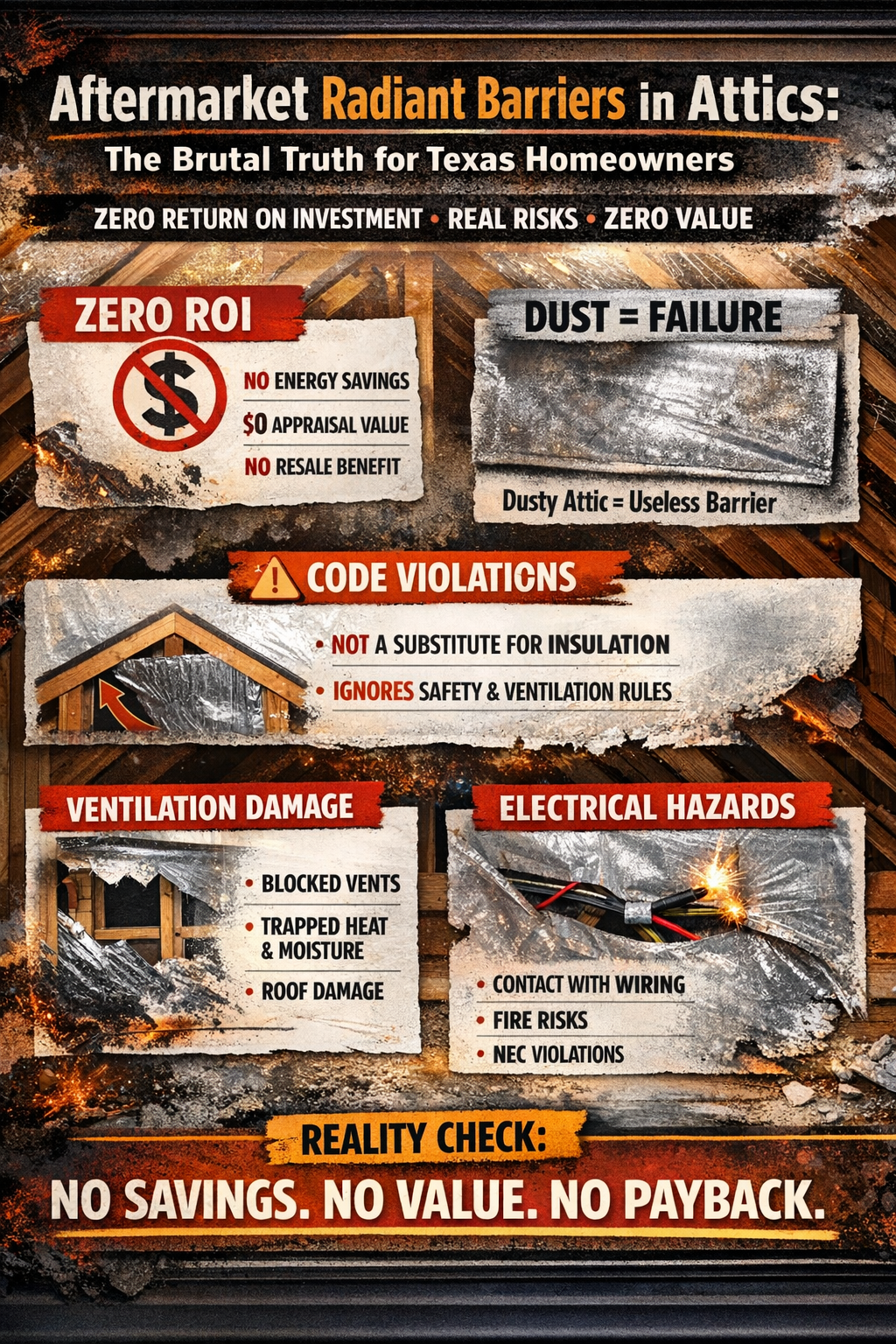
Let’s finish the job and say the quiet part out loud.
For the overwhelming majority of Texas homes, aftermarket radiant barriers installed in attics deliver effectively zero return on investment. Not “low.” Not “long-term.” Zero. And in many cases, the homeowner actually goes backward financially by introducing new defects that cost far more to correct than the barrier ever saves.
This isn’t theory. This is inspection reality.
Start With the Code (Because the Math Starts There)
Texas enforces the 2021 International Energy Conservation Code (IECC).
- IECC R402.1 & R402.2
Attic insulation R-values are mandatory (typically R-38 across most of Texas).
Radiant barriers do not reduce those requirements.
Radiant barriers do not replace insulation.
Translation:
You are paying for a product that earns you no code credit whatsoever.
No reduced insulation cost.
No compliance offset.
No performance substitution.
From a regulatory standpoint, the radiant barrier is dead weight.
ROI Requires Measurable, Durable Performance
Radiant barriers fail both tests.
- Any Energy Savings Are Marginal at Best
Even under ideal conditions, aftermarket radiant barriers may slightly reduce peak attic heat gain. That does not translate into meaningful, bankable utility savings once you factor in:
- Existing insulation (already doing the heavy lifting)
- Duct leakage and losses
- Air infiltration
- Thermostat behavior
- Seasonal variability
Tiny reductions in HVAC runtime do not justify four-figure installations.
- Performance Degrades Rapidly
Radiant barriers require:
- A clean reflective surface
- An adjacent air space
Texas attics are dusty. Period.
Once the foil loads up with dust-and it will-the reflectivity drops sharply. At that point, energy “savings” drop to statistical noise.
There is no maintenance plan.
There is no re-cleaning.
There is no performance warranty anyone actually enforces.
Your “investment” quietly dies in the dark.
Zero Appraisal Value. Zero Resale Credit.
Here’s the part no salesman will ever admit:
- Appraisers do not assign value to aftermarket radiant barriers
- Realtors do not list them as upgrades
- Buyers do not pay more for them
- Inspectors do not credit them toward performance compliance
They do not increase square footage.
They do not improve structural systems.
They do not reduce deferred maintenance.
From a resale standpoint, they are invisible-unless they caused a problem.
Negative ROI Is Common – And Inspectors See It All the Time
Aftermarket radiant barriers routinely create costs instead of savings.
Ventilation Damage
Foil blocks:
- Soffit intakes
- Ridge vents
- Gable vents
Result:
- Hotter attics
- Moisture accumulation
- Roof decking deterioration
- Shortened shingle life
Roof repairs erase decades of hypothetical energy savings.
Electrical Issues
Radiant barriers are conductive.
Improper installations:
- Contact NM wiring
- Create abrasion points
- Interfere with lighting clearances
Corrections required under the 2023 NEC are not cheap-and not optional.
Fire and Listing Concerns
Attic materials must meet flame spread and smoke development limits consistent with:
- IRC R302.10
- IRC R316 (where applicable)
Unlisted or undocumented foil products create liability exposure, not value.
The Sales Pitch vs. Reality
What homeowners are told:
- “It’ll pay for itself.”
- “You’ll see huge savings.”
- “Your attic will be dramatically cooler.”
- “This is a smart investment.”
What actually happens:
- Utility bills barely move
- Dust kills performance
- Ventilation gets compromised
- Inspection findings multiply
- Repair costs exceed savings
That’s not ROI. That’s a sunk cost with interest.
The Only Honest ROI Statement
For a typical Texas home with code-compliant insulation:
Aftermarket radiant barriers have no realistic path to payback.
They:
- Do not reduce required insulation
- Do not add appraised value
- Do not produce durable savings
- Do not improve resale
- Frequently create downstream repair costs
From a financial standpoint, they are money spent, not money invested.
The Bottom Line (No Soft Edges)
If your attic:
- Lacks insulation → fix insulation
- Leaks air → seal it
- Has bad ductwork → repair it
- Has poor ventilation → correct it
Every one of those items produces measurable, durable ROI.
Aftermarket radiant barriers do not.
In Texas, they are most often a zero-return product sold with absolute confidence, installed with casual disregard for ventilation and wiring, and defended with anecdotes instead of data.
That’s not building science.
That’s salesmanship.


