Archive for April, 2026
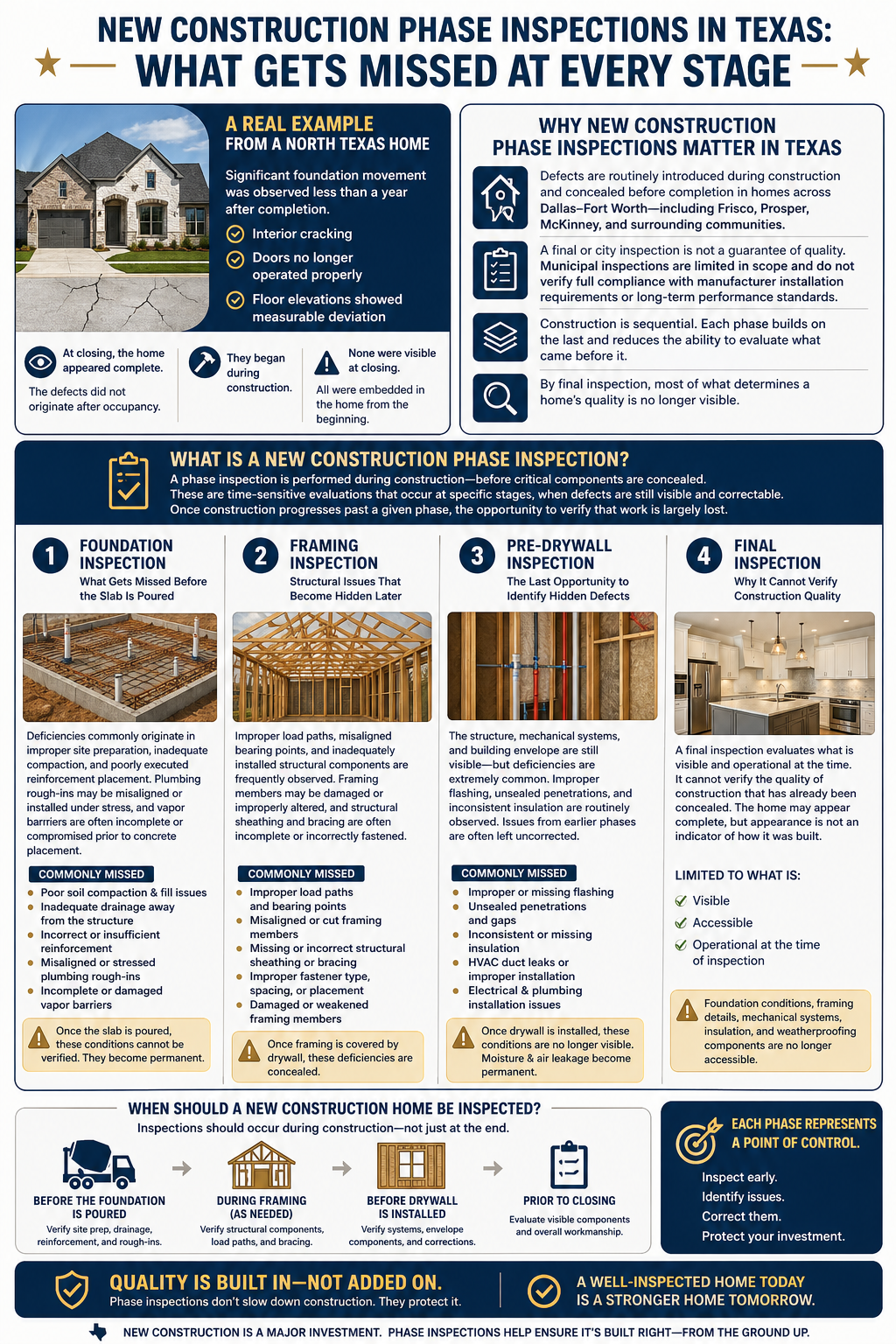
A Real Example from a North Texas Home
In a recently constructed home in North Texas, significant foundation movement was observed less than a year after completion. Interior cracking had developed, doors no longer operated properly, and floor elevations showed measurable deviation.
At closing, the home appeared complete. The finishes were clean, systems were operational, and no major concerns were identified during the final walkthrough.
The defects did not originate after occupancy.
They began during construction.
Site preparation had been insufficient. Drainage conditions were not properly established prior to the foundation pour. Reinforcement placement was inconsistent, and slab elevation provided minimal tolerance for water movement away from the structure.
None of these conditions were visible at closing.
All of them were embedded in the home from the beginning.
Why New Construction Phase Inspections Matter in Texas
The sheer number of deficiencies routinely missed at each stage of residential construction in Texas is staggering.
Across the Dallas–Fort Worth area—including Frisco, Prosper, McKinney, and surrounding communities—new construction homes regularly contain defects that are introduced during construction and concealed before completion.
A common assumption is that if a home passes a final inspection or a city inspection, it was built correctly. That assumption is often misplaced.
Municipal inspections, where they occur, are limited in scope. They are not comprehensive evaluations of construction quality, and they do not verify full compliance with manufacturer installation requirements or long-term performance standards.
Residential construction is sequential. Each phase builds on the last, and each phase reduces the ability to evaluate what came before it.
By the time a home reaches final inspection, most of what determines its quality is no longer visible.
What Is a New Construction Phase Inspection?
A new construction phase inspection is performed during construction—before critical components are concealed.
These inspections are not redundant. They are time-sensitive evaluations that occur at specific stages, when defects are still visible and correctable.
Once construction progresses past a given phase, the opportunity to verify that work is largely lost.
Foundation Inspection: What Gets Missed Before the Slab Is Poured
The foundation stage is one of the most critical phases of construction, yet it is rarely observed by buyers.
In new construction homes across North Texas, deficiencies commonly originate in improper site preparation, inadequate compaction, and poorly executed reinforcement placement. Plumbing rough-ins may be misaligned or installed under stress, and vapor barriers are often incomplete or compromised prior to concrete placement.
These conditions are frequently missed because the work occurs quickly, often within a narrow window, and inspections—where they occur—are limited in scope. In some areas, particularly unincorporated regions, there may be no meaningful Authority Having Jurisdiction overseeing residential construction at all.
Once the slab is poured, these conditions cannot be verified.
They become permanent.
Framing Inspection: Structural Issues That Become Hidden Later
The framing stage establishes the structural integrity of the home, but it is also where deviations from plans and standards commonly occur.
Improper load paths, misaligned bearing points, and inadequately installed structural components are frequently observed in new builds throughout the Dallas–Fort Worth area. Framing members may be damaged or improperly altered, and structural sheathing and bracing are often incomplete or incorrectly fastened.
These deficiencies are rarely evaluated in detail. Once framing is covered by drywall, they are concealed.
What remains are symptoms—cracking, movement, and misalignment—that appear later, often without clear attribution.
Pre-Drywall Inspection: The Last Opportunity to Identify Hidden Defects
The pre-drywall inspection is the most important phase for evaluating the home as a complete system.
At this stage, the structure, mechanical systems, and building envelope are still visible. However, deficiencies related to water management and air control are extremely common in Texas homes.
Improper flashing, unsealed penetrations, and inconsistent insulation are routinely observed. Issues identified in earlier phases are often left uncorrected.
This phase moves quickly, particularly in production building environments across North Texas. Once drywall is installed, these conditions are no longer visible.
Moisture intrusion pathways are concealed. Air leakage becomes permanent. Opportunities for correction are significantly reduced.
Final Inspection: Why It Cannot Verify Construction Quality
The final inspection is the most common inspection performed by buyers—and the most misunderstood.
A final inspection is valuable, but it is inherently limited. It evaluates what is visible and operational at the time of inspection. It cannot verify the quality of construction that has already been concealed.
By this stage, foundation conditions, framing details, mechanical systems, insulation, and weatherproofing components are no longer accessible.
The home may appear complete, but appearance is not an indicator of how it was built.
When Should a New Construction Home Be Inspected?
Inspections should occur during construction—not just at the end.
The most effective timing includes evaluation before the foundation is poured, before drywall is installed, and again prior to closing. Depending on the project, additional inspections during framing or system installation may also be appropriate.
Each phase represents a limited window.
Once that window closes, the ability to evaluate that work is significantly reduced.
What Gets Missed Most Often in New Construction Homes?
Across Texas, the same categories of deficiencies appear repeatedly.
Foundation preparation issues, framing defects, improper flashing, air sealing failures, and mechanical system installation problems are among the most common findings.
These are not rare conditions. They are recurring issues that develop during construction and are often concealed before they can be identified.
Can Defects Be Corrected After Closing?
Some can.
Most become more difficult to address.
Once a home is complete, access to underlying systems is limited. Corrections may require removal of finishes, disruption of occupancy, and negotiation with the builder under warranty conditions.
The most effective time to identify and correct deficiencies is during construction—before they are concealed and before closing reduces leverage.
Conclusion: What This Means for Buyers in Texas
The deficiencies that matter most in residential construction are not the ones visible at the end.
They are the ones missed along the way.
Each phase of construction presents a limited opportunity to evaluate work while it is still visible, verifiable, and correctable. Once that opportunity passes, the defect remains and the cost of resolution increases.
Most buyers assume that if a home passes inspection at the end, it was built correctly.
That assumption is often incorrect.
Because by the time construction is complete, you are no longer evaluating how the home was built.
You are living with the result.
Schedule a New Construction Phase Inspection in North Texas
If your home is currently under construction, it can still be evaluated—but timing is critical.
Texas Inspector performs new construction phase inspections throughout the Dallas–Fort Worth area, including Frisco, Prosper, McKinney, Plano, and surrounding communities.
Phase inspections are designed to identify deficiencies while they are still visible—before they become permanent conditions within the home.
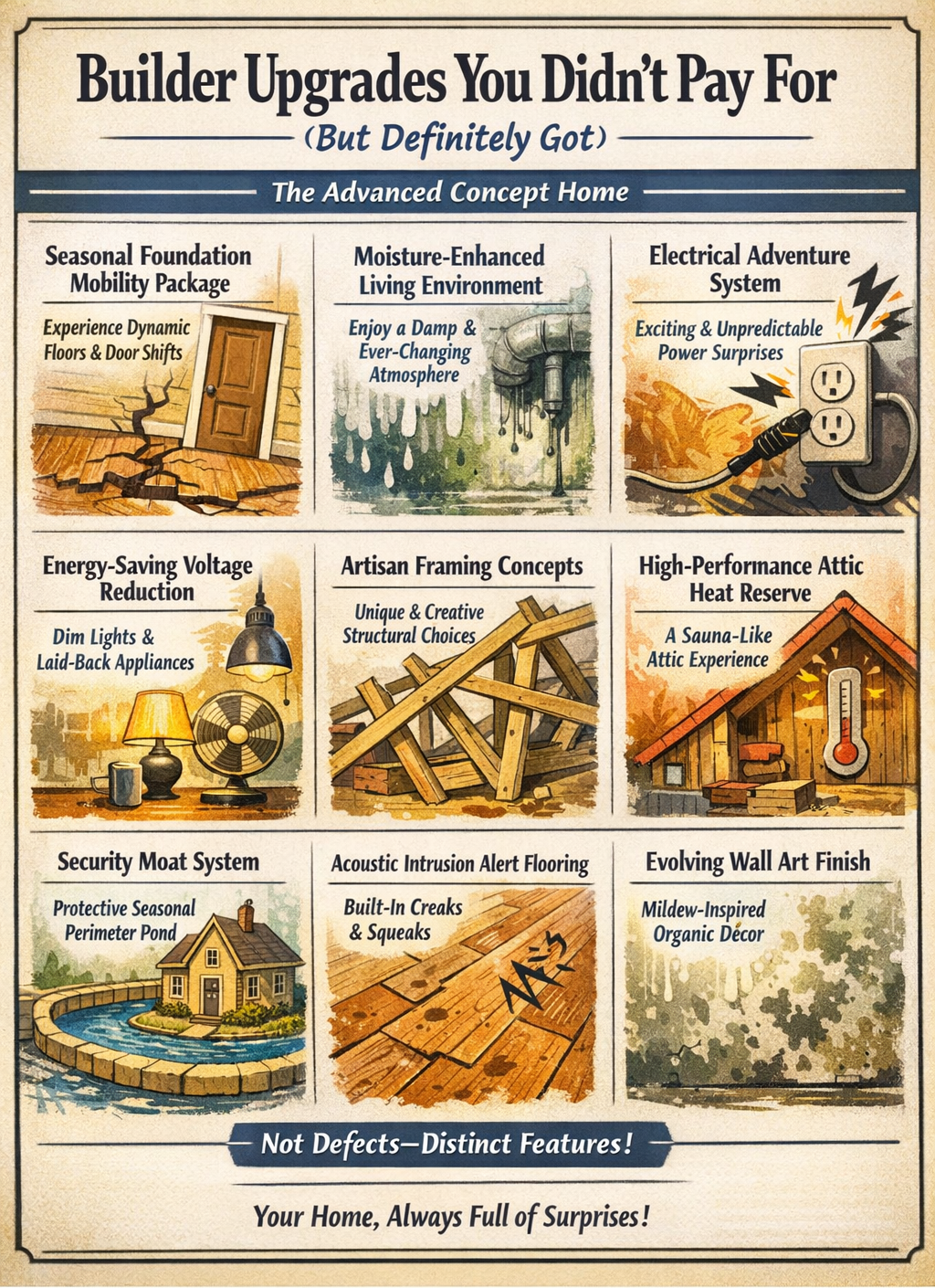
There was a time when people expected new homes to be square, plumb, dry, and functional, but that expectation has been quietly value-engineered out of the process.
Today’s homes are delivered with a full suite of forward-thinking, builder-included enhancements designed to create a more interactive, evolving living experience, and these aren’t defects—they’re features that simply haven’t been properly marketed yet. What you received wasn’t a flawed house; it was an advanced concept home that continues to develop long after closing.
Let’s take a look at what was included.
The Seasonal Foundation Mobility Package
Why anchor your home to something as limiting as stability when North Texas soils can provide continuous, real-time movement? Doors develop personality depending on the weather, floors gently guide you in subtle directions, and cracks appear and disappear like they’re testing your attention span.
The benefit is a responsive structure that reacts to its environment, creating a home that doesn’t just sit there but actively participates in daily life.
Moisture-Enhanced Living Environment
Perfectly dry interiors are sterile and uninspired, so modern plumbing installations introduce subtle, intermittent moisture exactly where it can be appreciated. Materials soften, air develops depth, and concealed spaces begin their own quiet transformation.
The benefit is a rich indoor ecosystem that evolves over time, offering texture, atmosphere, and a sense that the home is actively doing something behind the scenes.
The Electrical Adventure System
Predictable electrical systems remove all suspense from daily life, so today’s installations may include reversed polarity, selective grounding, and breakers that operate with a degree of independence. Consistency gives way to variability, and reliability becomes more of a suggestion.
The benefit is that every outlet and switch becomes an experience, adding just enough uncertainty to keep things interesting.
Energy-Saving Voltage Reduction Technology
Why deliver full voltage when you can thoughtfully reduce it across long runs, resistance, and optimistic conductor sizing? Lights dim slightly, appliances hesitate, and motors develop a strong work ethic.
The benefit is passive energy conservation through reduced performance, allowing the home to present itself as efficient while quietly lowering expectations.
Artisan Framing Concepts
Rigid adherence to engineered plans limits creativity, so framing today embraces interpretive load paths, selective fastener use, and notching that challenges conventional limits. The result reflects field decisions more than design intent.
The benefit is a one-of-a-kind structural system that expresses individuality, where the house develops its own ideas about how it wants to behave.
High-Performance Attic Heat Containment
Why vent heat out when you can preserve it, especially in a Texas climate that already provides a strong baseline? Attics now function as thermal reservoirs, retaining heat with impressive consistency while your HVAC system rises to the occasion.
The benefit is a fully immersive climate experience that extends throughout the home, ensuring the outdoors is never completely left behind.
Secondary Roof System (Spray Foam Edition)
Why rely on a single roofing system when you can install a backup directly underneath? Spray foam applied to the underside of roof decking creates a fully adhered secondary barrier that captures any water that makes it past the primary roof.
The benefit is redundancy, allowing moisture to be retained and appreciated within the assembly rather than escaping prematurely.
Perimeter Water Retention and Security Moat System
Traditional drainage moves water away from the home, but a more progressive approach allows it to collect around the foundation, forming a seasonal perimeter moat. Flat or negative grading ensures water remains engaged with the structure after even modest rainfall.
The benefit is added security through inconvenience, as access to the home becomes a more deliberate effort, while the standing water creates ideal conditions for mosquito activity that offers repeated exposure opportunities for residents.
Exterior Wall Moisture Access
Weather barriers can be restrictive, so modern installations often allow water to bypass these limitations and interact directly with framing and sheathing. Separation between interior and exterior becomes more of a guideline than a rule.
The benefit is an open system where the home remains connected to its environment rather than isolated from it.
Fastener Efficiency Initiative
Excess fasteners create rigidity, and rigidity limits expression, so reducing nails, screws, and anchors allows assemblies to move and adapt over time. Components are no longer forced into compliance but are free to respond to conditions.
The benefit is a structure that remains flexible, both physically and philosophically, with parts that evolve instead of remaining fixed.
Acoustic Intrusion Alert Flooring System
Silent floors offer no feedback and no protection, so strategic fastener spacing and optimistic subfloor installation ensure that every step produces a distinct creak or pop. Movement becomes fully audible and impossible to ignore.
The benefit is a built-in security system that guarantees no one moves unnoticed, including the homeowner.
Interactive Wall Art Growth System (Flat Paint Upgrade)
Traditional finishes remain static, but flat paint in kitchens and bathrooms provides an ideal surface for moisture retention and gradual visual development. With time and humidity, walls begin to display organic patterns and tonal variation.
The benefit is a living art installation that evolves daily, creating a home that decorates itself without input.
Fit-and-Finish Variability Package
Perfect alignment is predictable, so cabinets drift, tile lines explore, and trim gaps invite interpretation. Precision is replaced with variation, and uniformity gives way to individuality.
The benefit is a visually dynamic environment where every space offers something slightly different.
The Big Picture
This isn’t about defects; it’s about being ahead of the curve, because while much of the industry is still focused on outdated ideas like code compliance, manufacturer instructions, and systems performing as intended, forward-thinking Texas builders have moved on to something far more ambitious. They are not interested in doing things the right way when they can do things the next way, and they are certainly not interested in being slowed down by convention, physics, or oversight.
Stable foundations, dry interiors, and predictable systems represent yesterday’s thinking, while today’s homes shift, leak, creak, dim, and grow things in real time, creating a fully interactive ownership experience. What some might call defects are better understood as innovation without the drag of quality control, where the research and development phase begins after closing, and the homeowner becomes part of the process, whether they intended to or not.
Some industries test prototypes in controlled environments, but here they are built at scale, sold with confidence, and occupied immediately, which is about as forward-thinking as it gets.
Closing Thought
If you prefer your home to remain stationary, dry, and functioning as designed, there is still an option available, although it is becoming increasingly unfashionable.
A thorough, independent inspection—performed at several phases during construction, once before closing and again before the warranty expires—remains the only reliable way to separate marketing from reality, assumptions from conditions, and features from actual defects.
Because eventually, the joke wears off, and what’s left is the substandard house.
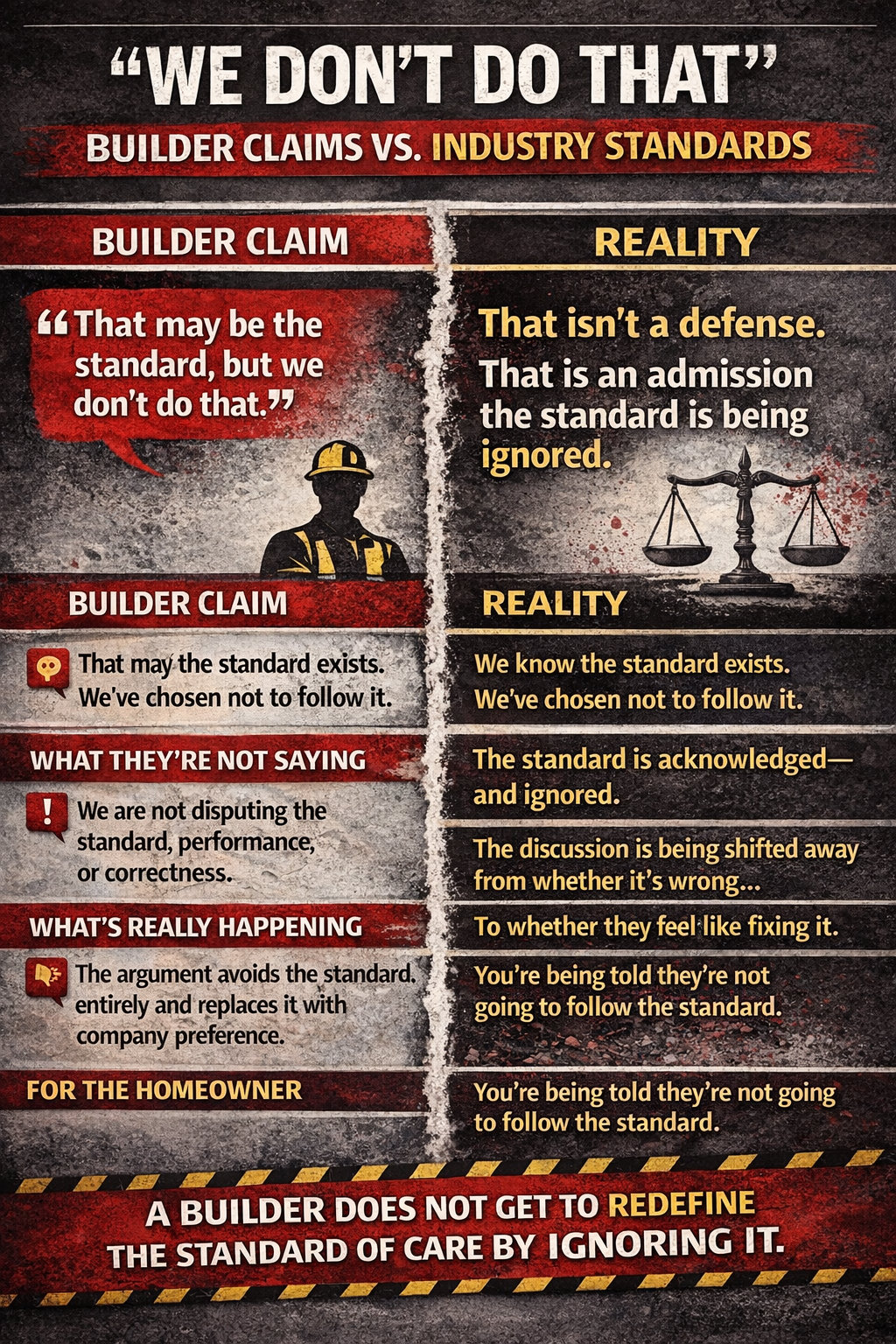
Yesterday, I received a call from a representative of a large national homebuilder regarding a report I prepared for one of my clients. The purpose of the call was not to identify an error in my report, not to point me to a conflicting manufacturer requirement, and not to offer any technical basis for why the reported conditions were acceptable. Instead, I was asked to explain to my client that, while the issues identified in my report may reflect industry standards, those standards were simply “not things they do.”
That is an extraordinary position, though probably not in the way they intended. It is one thing to argue that a condition complies with accepted practice. It is another to argue that the accepted practice exists but the builder has chosen not to follow it. That is not a rebuttal. It is not a defense. It is not even a particularly polished excuse. It is simply a corporate way of saying, “Yes, we know better, but this is how we do it anyway.”
There seems to be a growing belief in some corners of large-scale residential construction that size itself is a substitute for quality, and repetition is a substitute for correctness. Build enough houses, repeat the same details often enough, and eventually someone in the organization begins to mistake company habit for industry legitimacy. It does not work that way. An internal practice manual does not overrule accepted trade standards. A production shortcut does not become proper merely because it has been institutionalized. And a national footprint does not confer the authority to rewrite the rules of competent construction.
Industry standards are not random suggestions gathered from thin air. They come from established trade practice, manufacturer installation instructions, performance-based requirements, and, where applicable, building codes. They exist because buildings are supposed to shed water, resist movement, accommodate materials, and perform over time. These standards were not created to inconvenience builders. They were created because ignoring them predictably produces failure, damage, callbacks, and disputes of exactly the sort builders claim to be surprised by later.
What made the call especially revealing was the apparent assumption that I should help sell this explanation to my client, as though my role were to translate substandard work into more consumer-friendly language. That is not my job. I do not evaluate houses against the internal preferences of whichever builder happened to construct them. I evaluate conditions against recognized standards of care. If a builder’s answer to a deficiency is that they do not follow the standard, that does not diminish the report. It strengthens it.
Homeowners should pay very close attention whenever they hear a response like this, because “we don’t do that” is not a technical conclusion. It does not mean the condition is proper, durable, or likely to perform as intended. It does not mean the standard is debatable. It means the builder is effectively admitting that its own practices fall below what is commonly recognized as appropriate. That may be a candid answer, but it is hardly a reassuring one.
There is also something almost refreshing about the bluntness of it. Usually these conversations are wrapped in layers of polished language about variances, preferences, tolerances, and company protocols. This one, stripped to its essence, amounted to something much simpler: yes, there may be a recognized way to do it, but this builder has decided that recognized ways are for other people. That kind of honesty may be rare, but it is not the same thing as credibility.
The larger problem is that statements like this expose a mindset, not just a construction issue. When a builder treats accepted standards as optional whenever they conflict with speed, cost, or routine, the defect is no longer limited to a flashing detail, installation method, or workmanship oversight. The defect is in the culture. A company that responds to legitimate deficiencies by saying, in effect, “those standards are not part of our business model,” is saying far more than it probably should.
In the end, construction is judged by performance, not branding, market share, or self-created exemptions. A builder does not get its own private engineering reality just because it is large, well-known, or accustomed to getting away with bad answers. If the best response to an industry-standard defect is “we don’t do that,” then the report is not the problem. The work is. And if that truly is the company position, then at least the homeowner has been given one useful piece of information: the builder is willing to say out loud that its own practices are lower than the standard everyone else is expected to meet.


