Archive for May, 2026
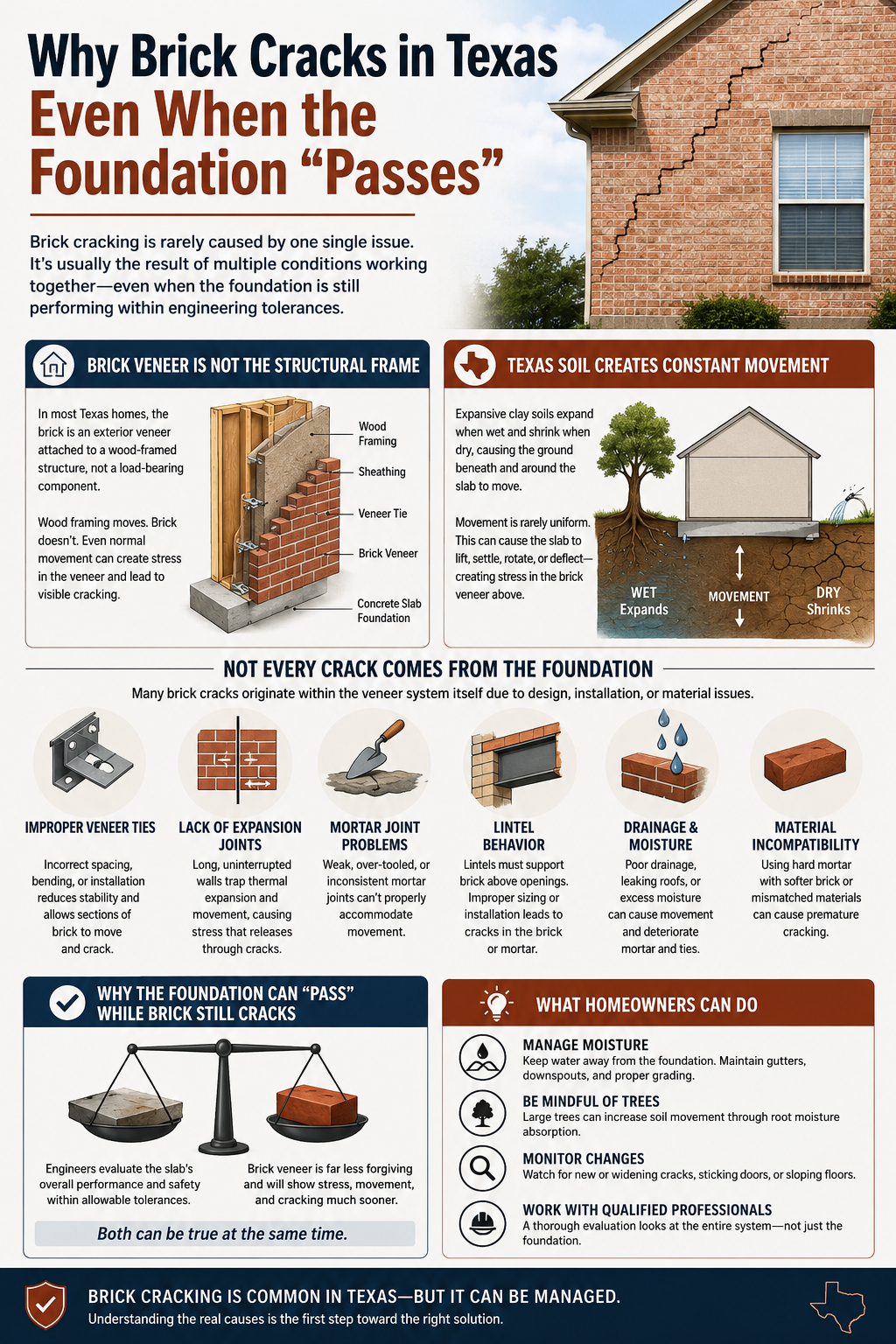
Brick cracking is one of the most misunderstood issues in residential construction, particularly in Texas. Homeowners see stair-step fractures spreading across masonry walls and immediately assume the foundation is failing. Builders often respond by dismissing the cracking as “normal settling” or insisting the foundation remains “within tolerance.” Neither explanation adequately describes what is actually occurring.
The reality is that brick cracking usually develops from multiple overlapping conditions rather than a single isolated defect. Soil movement, slab deflection, thermal expansion, framing shrinkage, drainage conditions, veneer restraint problems, lintel behavior, masonry installation deficiencies, and material incompatibility can all contribute to visible cracking patterns. In many cases, the foundation may technically satisfy engineering performance criteria while the veneer system simultaneously experiences meaningful stress and visible deterioration.
This disconnect exists because homeowners, builders, and even some inspectors often treat brick veneer as though it were the primary structure of the home. Modern brick veneer construction does not function that way. The veneer is a cladding system attached to an underlying wood-framed structure. Understanding that distinction is essential to understanding why cracking occurs.
Brick Veneer Is Not the Structural Frame
In most modern Texas homes, the brick exterior is not supporting the roof or carrying the structural loads of the house. The primary structural system is typically dimensional lumber or engineered wood framing supported by a concrete slab foundation. The brick exists as an exterior veneer tied back to the framing with metal anchors while resting on a ledge at the slab perimeter.
This matters because brick behaves very differently than wood and concrete. Masonry is rigid and brittle. Wood framing expands, contracts, shrinks, and flexes with changes in temperature and moisture content. Concrete slabs move as soil conditions change beneath them. Brick veneer sits on the outside of this constantly shifting structural assembly and absorbs stress from multiple directions simultaneously.
Because masonry handles compression well but tolerates tension poorly, it often becomes the first visible component to reveal movement inside the building system. Small amounts of slab rotation or framing movement that may not significantly affect structural safety can still create visible distress within the veneer.
This is one reason brick cracks frequently appear before homeowners notice interior symptoms such as drywall separation, sloping floors, or sticking doors. The veneer acts as an exterior stress indicator for movement occurring elsewhere within the structure.
Texas Soil Creates Constant Movement Cycles
The expansive clay soils common throughout North Texas create some of the most aggressive movement conditions in residential construction. These soils expand dramatically when wet and contract substantially during dry periods. As moisture levels fluctuate, the soil beneath and around the slab changes volume continuously.
The movement rarely occurs uniformly. Soil near the slab perimeter may dry faster than soil beneath the interior of the structure, particularly during drought conditions. Trees, inconsistent irrigation, poor drainage, excessive surface runoff, and extreme summer heat can intensify these moisture differentials. Portions of the slab may settle, lift, rotate, or deflect slightly as soil conditions change beneath different sections of the structure.
Many homeowners assume foundations either “pass” or “fail” as though structural behavior were binary. In reality, concrete slabs routinely experience measurable movement without reaching the threshold of structural failure. Engineers evaluating slabs often focus on overall performance, allowable tolerances, and the structure’s ability to continue functioning safely rather than expecting zero movement.
Brick veneer, however, is far less forgiving than the slab beneath it. Even moderate differential movement can create enough tension to crack mortar joints, separate brick courses, or create fractures near openings and corners.
This is why homeowners are often frustrated when an engineer states the slab remains within acceptable tolerances while visible cracking continues appearing throughout the masonry. Both observations may be technically accurate at the same time.
Not Every Brick Crack Originates from Foundation Movement
One of the biggest mistakes in residential construction diagnostics is the tendency to blame every brick crack on the foundation. In reality, many veneer failures originate within the masonry system itself.
Brick veneer is a managed assembly requiring proper restraint, support, spacing, drainage, and movement accommodation. If those components are installed incorrectly, the veneer can crack even when slab movement remains relatively minor.
Insufficient or improperly installed brick ties are one of the most common contributors. Veneer ties secure the masonry to the framing while allowing limited differential movement between materials. When ties are spaced improperly, omitted entirely, excessively bent, fastened poorly, or embedded incorrectly into mortar joints, sections of veneer lose stability and become more vulnerable to displacement and cracking.
Large uninterrupted wall expanses create additional problems. Brick expands thermally over time, and long wall sections require properly designed expansion joints to relieve accumulated stress. Many production homes either lack adequate expansion joints or place them improperly. As thermal expansion and structural movement accumulate within restrained wall sections, the stress often releases through visible cracking.
Mortar quality also plays a significant role. Mortar mixed improperly or cured inconsistently may shrink excessively, lose bond strength, or deteriorate prematurely. Weak mortar joints often become the path of least resistance for stress within the veneer assembly.
In newer homes, framing shrinkage behind the veneer can further complicate the situation. Lumber installed with elevated moisture content shrinks as it dries, particularly during the first several years after construction. Differential shrinkage between framing components can transfer stress into the relatively rigid brick veneer, especially near openings and structural transitions.
Improper shelf angles, missing movement joints, inadequate control joints, and poor veneer support geometry can also contribute to distress patterns that are frequently mistaken for foundation-related movement.
The visible crack pattern may therefore reflect several overlapping mechanisms occurring simultaneously rather than a single isolated problem.
Openings and Lintels Create Major Stress Concentrations
Windows, doors, and garage openings are among the most common locations for brick cracking because they interrupt the continuity of the veneer system and concentrate structural stress into relatively small areas.
Brick above these openings must be supported by steel lintels. These lintels carry the weight of the masonry and transfer the load into the adjacent wall sections. The problem is that steel and masonry behave very differently under changing environmental conditions.
Steel expands and contracts substantially with temperature changes. In Texas, where exterior masonry surfaces experience intense solar exposure, lintels undergo constant thermal cycling. South- and west-facing walls are particularly vulnerable because the steel repeatedly heats and cools while restrained by relatively rigid masonry.
As this movement accumulates, cracks often develop diagonally from the corners of windows and doors or appear as stair-step fractures immediately above the lintel line. These patterns are commonly blamed on the foundation even when the primary driver is thermal expansion and differential movement within the veneer support system itself.
Deflection is another major issue. Lintels that are undersized, improperly installed, insufficiently supported, or overloaded can sag slightly under the weight of the masonry above. Even relatively minor deflection can transfer substantial stress into surrounding brick courses.
Garage door openings are particularly vulnerable because they often support large uninterrupted spans of masonry while experiencing substantial thermal loading. Long garage lintels frequently develop cracking at the corners, especially when expansion stresses combine with minor slab movement or framing deflection.
Corrosion can worsen the problem considerably. When flashing details are missing or improperly installed, water may collect around steel lintels. As corrosion develops, the steel expands. Rust occupies significantly more volume than the original steel, which can create outward pressure against mortar joints and surrounding brick veneer. The resulting cracks are often misidentified as evidence of foundation settlement when the actual mechanism originates at the deteriorating lintel itself.
Improper bearing conditions also contribute to veneer distress. Lintels require adequate support at each end to distribute loads correctly into adjacent wall sections. Inadequate bearing concentrates stress near the ends of the lintel and frequently produces cracking near opening corners.
Drainage Problems Quietly Accelerate Veneer Distress
Drainage conditions are one of the most underestimated contributors to brick cracking in Texas homes. Many homeowners focus exclusively on the crack itself without understanding how moisture conditions around the slab influence structural movement.
Poor grading, negative drainage, short downspout discharge locations, trapped water along fence lines, excessive irrigation near the foundation perimeter, and hardscape runoff concentration can all create unstable moisture conditions beneath the slab. Large differences in soil moisture content across the footprint of the structure produce differential expansion and contraction within the supporting soils.
Over time, these recurring moisture cycles place continuous stress on the slab and veneer system. Seasonal movement patterns become more pronounced, and previously repaired cracks often reappear because the underlying movement mechanism remains unresolved.
Drainage defects inside the wall cavity can also contribute directly to veneer deterioration. Brick veneer systems are not waterproof barriers. They are water-managed systems designed to allow moisture intrusion while safely redirecting water back out of the assembly. Improper flashing installation, clogged weep systems, inadequate cavity clearances, mortar bridging, or missing drainage components can trap moisture within the wall system.
As moisture accumulates inside the assembly, metal ties may corrode, mortar can weaken, and veneer stability may deteriorate over time. The resulting cracking may have little to do with foundation performance and far more to do with chronic moisture exposure inside the wall system itself.
Crack Patterns Matter More Than Crack Existence
The mere presence of a crack reveals relatively little by itself. The location, orientation, width, progression, and associated symptoms are far more important diagnostically.
Stair-step cracking through mortar joints commonly reflects differential movement because mortar joints are typically weaker than the brick units themselves. Vertical cracking may indicate thermal expansion stress, shrinkage behavior, or isolated movement patterns. Horizontal cracking can suggest more significant structural displacement, veneer instability, or restraint-related stress. Cracks radiating from windows and doors often reflect concentrated stress around openings, lintel movement, or framing interaction.
Bulging veneer, outward displacement, recurring separation near corners, or progressive cracking near openings may indicate deficiencies within the veneer support system itself rather than slab-related movement alone.
The relationship between symptoms matters as well. A small isolated crack that remains stable for years carries different implications than progressive cracking accompanied by interior drywall separation, sticking doors, measurable slab elevation changes, or repeated cosmetic repairs.
One of the most misleading aspects of veneer distress is that cosmetic appearance does not always correlate directly with structural severity. Some visually dramatic cracks remain relatively stable, while subtle recurring cracks may indicate active movement conditions that continue worsening over time.
Cosmetic Repairs Frequently Ignore the Underlying Cause
Many masonry repairs focus on concealment rather than movement control. Mortar joints are patched, surfaces are caulked, and veneer is cosmetically blended without addressing the mechanisms producing the stress.
These repairs often fail because the underlying conditions remain unchanged. Slab movement continues, drainage deficiencies remain active, restrained wall sections continue accumulating stress, deteriorating lintels remain in service, or deficient wall components inside the assembly remain uncorrected. The veneer simply cracks again in the same location or nearby.
This does not mean all brick cracking represents catastrophic structural failure. Some level of cosmetic distress is expected in structures built on expansive soils exposed to large environmental fluctuations. The critical issue is whether the movement appears stable and manageable or progressive and increasingly destructive over time.
The problem with simplistic explanations such as “all houses crack” is that they ignore the difference between predictable cosmetic movement and ongoing systemic distress. Brick veneer cracking exists in the gray area between harmless cosmetic imperfection and meaningful structural deterioration. Determining where a particular structure falls within that spectrum requires understanding how the entire building system interacts rather than focusing on a single symptom in isolation.
For the last several years, DFW builders got spoiled by a market where buyers behaved like contestants in a survival game show. People waived inspections, ignored obvious defects, panic-signed contracts, and convinced themselves that paying obscene amounts of money for rapidly assembled houses with gray vinyl flooring and decorative words like “luxury” and “executive” attached to the listing somehow counted as making a sound financial decision. Builders became completely addicted to that environment because buyers stopped scrutinizing construction quality and started treating basic competence like an optional bonus feature.
Now the market is shifting, and builders are discovering that buyers become significantly less cooperative when monthly payments start resembling hostage demands.
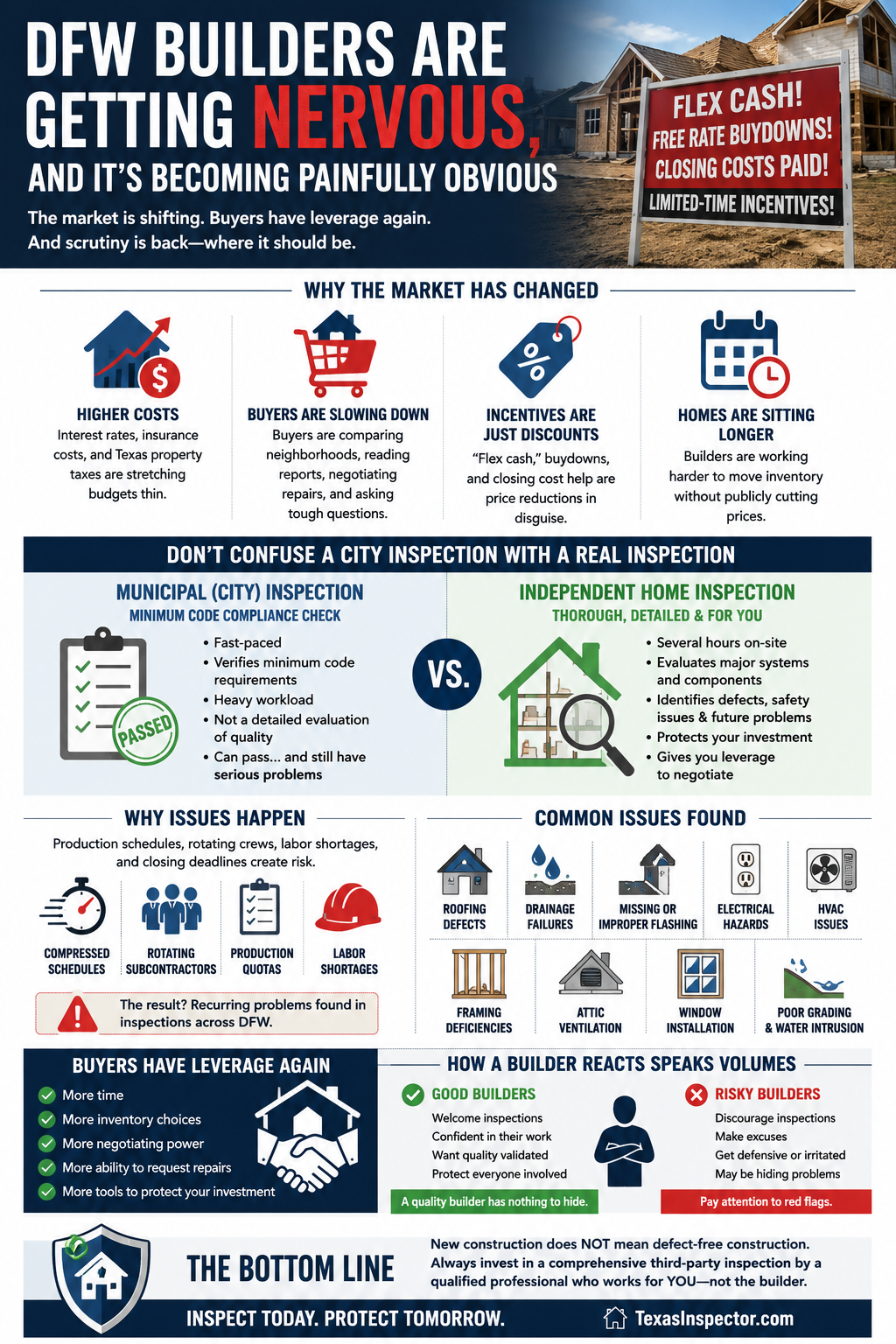
Interest rates remain painful, affordability is getting hammered, insurance costs are climbing, and Texas property taxes continue their long-running campaign against disposable income. Buyers are slowing down long enough to actually evaluate what they’re purchasing, which creates a serious problem for production builders who spent the last several years prioritizing speed above literally everything else. Suddenly buyers are comparing neighborhoods, reading inspection reports, negotiating repairs, and asking uncomfortable questions instead of sprinting into contracts like somebody just announced the apocalypse was coming for available inventory in Frisco.
That’s why every subdivision in North Texas suddenly looks like a liquidation sale at a failing furniture store. Everywhere you turn there are giant screaming banners advertising “FLEX CASH,” “FREE RATE BUYDOWNS,” “CLOSING COSTS PAID,” and “LIMITED-TIME INCENTIVES,” which is hilarious because every single one of those things is just a price reduction wearing a fake mustache and pretending to be something more sophisticated. Builders refuse to publicly slash prices because they don’t want to damage comps or make the subdivision look weak, so instead they bury the discount under layers of marketing language and hope buyers are too distracted by the free refrigerator to notice the house has been sitting unsold longer than a Facebook Marketplace treadmill.
But nothing reveals builder anxiety faster than the growing effort to steer buyers away from third-party inspections, because that’s where the polished sales pitch starts breaking apart under even minimal scrutiny. More buyers are hearing the same carefully rehearsed lines about how inspections are unnecessary on new construction because the home already passed city inspection, the superintendent walks every property personally, the builder has a robust quality-control process, and everything is covered under warranty anyway. The entire pitch depends on buyers not understanding the gigantic difference between a municipal code inspection and a comprehensive independent inspection.
Municipal inspections are generally fast-paced compliance checks intended to determine whether a property broadly satisfies minimum code requirements under significant workload pressure. Minimum code is not the same thing as exceptional workmanship, meticulous construction quality, or “someone actually gave a damn while building this house.” A city inspector is not spending four hours inside your future home tracing electrical defects, evaluating attic ventilation performance, inspecting roof installation details, documenting framing deficiencies, or analyzing drainage behavior after a North Texas thunderstorm dumps three inches of water into the backyard. Production builders absolutely love when buyers confuse “passed inspection” with “built well,” because those two concepts are nowhere near interchangeable.
Meanwhile these homes are being assembled under compressed schedules with labor shortages, rotating subcontractors, production quotas, and enough deadline pressure to make an Amazon fulfillment center feel emotionally balanced. Entire crews are sprinting from house to house trying to keep closings on schedule while sales offices continue advertising “luxury lifestyle communities” with the confidence of somebody selling counterfeit designer handbags out of a storage unit. Then everybody acts shocked when independent inspectors continue finding the same recurring problems: roofing defects, drainage failures, missing flashing, unsafe electrical work, HVAC performance issues, framing deficiencies, attic ventilation problems, improperly installed windows, and grading setups that convert backyards into mosquito hatcheries every time DFW gets a decent thunderstorm.
The real issue for builders is that buyers finally have leverage again, and leverage creates scrutiny. During the frenzy years, buyers ignored defects because they thought they had no alternative. Builders became accustomed to speed overruling quality concerns, and now that buyers are slowing down long enough to actually inspect the product, some builders are discovering that cosmetic upgrades stop looking impressive the moment somebody opens the attic hatch and realizes the workmanship resembles a group project assembled entirely by exhausted raccoons running on nicotine and gas-station energy drinks.
And honestly, the harder a builder pushes you to skip an independent inspection, the more aggressively you should insist on getting one, because competent builders do not fear third-party inspections. Builders who consistently produce quality work understand that another set of eyes validates their process and protects everyone involved. The builders who become defensive, irritated, dismissive, or visibly uncomfortable the moment an independent inspector enters the picture are usually telling you far more than they intended to, and smart buyers would be wise to pay very close attention to that reaction.
Texas has created one of the most deceptive consumer-protection illusions in the residential construction industry, perhaps inadvertently (you can decide). Every day, buyers are encouraged to believe that hiring a “licensed TREC inspector” for a new construction inspection means they are hiring someone qualified to determine whether a home is actually being built correctly. In many cases, that belief is completely detached from reality. The average consumer hears the word “licensed” and naturally assumes the State of Texas has verified that the inspector possesses substantial expertise in residential construction, structural systems, moisture management, flashing details, roofing installation, and modern building science. The public assumes these inspectors understand how homes are properly assembled because the state allows them to inspect homes under construction. In reality, the TREC license proves almost none of those things.
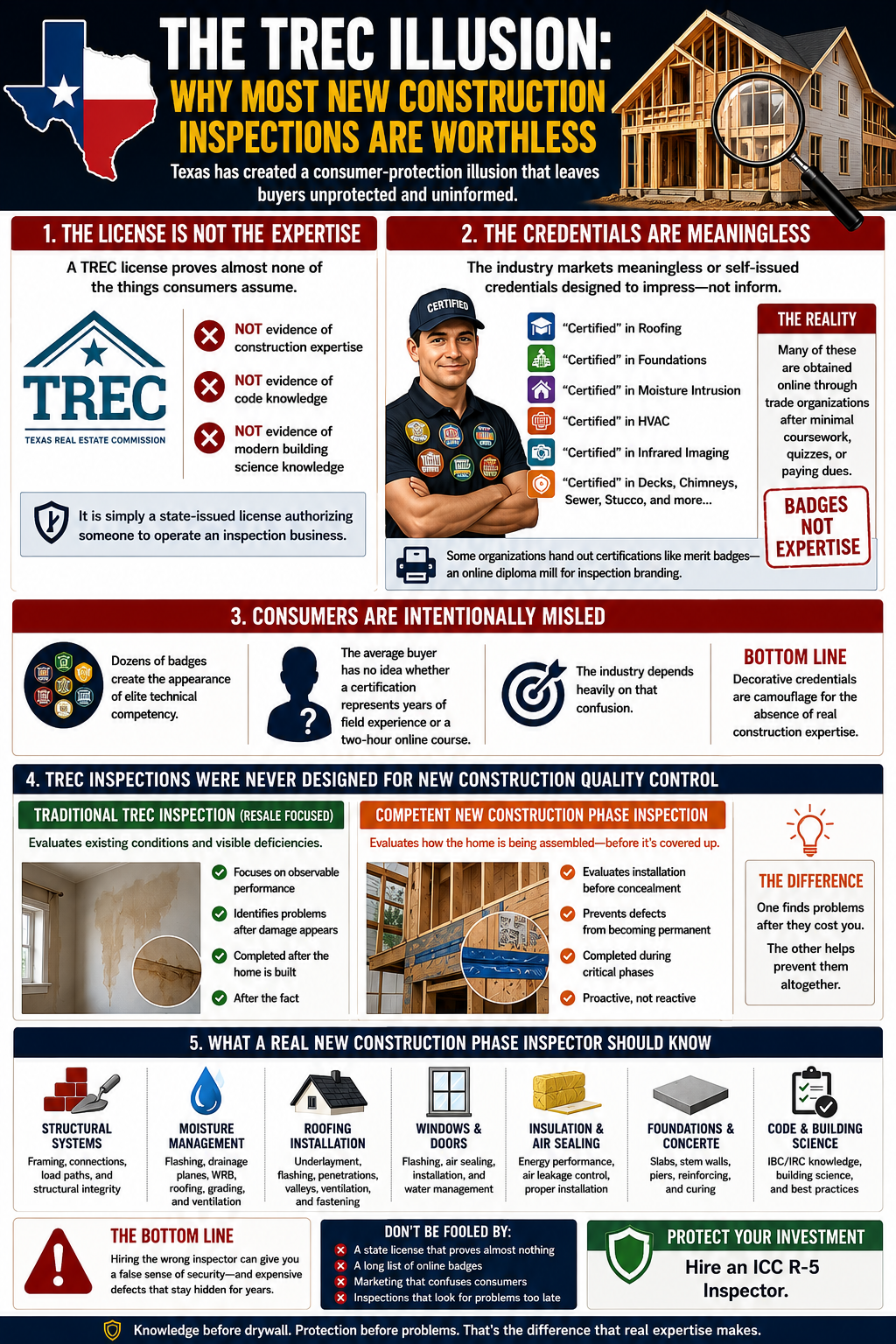
A TREC license is not evidence of construction expertise. It is not evidence of code knowledge. It is not evidence that the inspector understands modern residential building practices. It is simply a state-issued license authorizing someone to operate an inspection business under TREC’s real-estate-oriented inspection framework. Texas has allowed consumers to confuse a business license with actual technical competence, and that confusion benefits everyone except the buyer.
The deception does not stop with the state license itself. Much of the inspection industry has built an entire marketing ecosystem around meaningless or self-issued “credentials” specifically designed to impress consumers who have no idea how to evaluate actual construction expertise. Inspectors cover their websites with colorful certification badges, logos, seals, patches, and acronyms intended to create the appearance of elite technical competency. Many of these certifications are obtained through online trade organizations that will effectively certify a person in almost anything after completing minimal coursework, clicking through quizzes, or paying membership dues.
Consumers routinely encounter inspectors advertising themselves as “certified” in roofing, foundations, mold, stucco, HVAC, moisture intrusion, thermal imaging, sewer systems, energy efficiency, deck inspections, and virtually every other specialty imaginable. Some inspectors accumulate dozens upon dozens of these badges and display them like military decorations. The entire presentation is engineered to overwhelm the consumer with the appearance of authority. In many cases, the practical value of these certifications is somewhere between negligible and laughable.
Some inspector organizations have turned this into an industrialized marketing machine. An inspector can collect certifications the way a child collects merit badges at summer camp. One week they are “certified” in moisture intrusion. The next week they are “certified” in deck inspections. Then chimney inspections. Then infrared imaging. Then septic systems. Then structural issues. At some point the entire process starts resembling an online diploma mill for inspection branding rather than meaningful technical education.
Some of these organizations hand out certifications with such reckless enthusiasm that the entire industry has begun to resemble a Boy Scout sash for middle-aged men with laser printers. Inspectors accumulate endless online badges certifying them as roofing experts, structural consultants, moisture-intrusion specialists, forensic investigators, HVAC authorities, drainage analysts, and whatever other title sounds impressive enough to frighten consumers into assuming competence. In many cases, the process appears to involve little more than opening a laptop, clicking through a slideshow, answering a handful of obvious questions, and paying dues to an organization financially incentivized to certify as many people as possible. The result is an industry saturated with self-awarded acronyms and decorative clip-art credentials that often function less as evidence of expertise and more as camouflage for the absence of it. Consumers see fifty certification badges on a website and assume they are looking at a construction expert, when in reality they may simply be looking at someone with an internet connection, a printer, and a yearly membership subscription.
None of this means that every inspector holding these certifications is incompetent. Some inspectors pursue continuing education seriously and possess substantial real-world experience. The problem is that consumers are intentionally encouraged to mistake decorative credentials for genuine expertise. The average buyer has no idea whether a certification represents years of field experience and rigorous testing or a two-hour online course followed by a printable PDF certificate. The industry depends heavily on that confusion.
The deeper problem is that TREC inspections were never designed to function as true construction quality-control inspections. Traditional TREC inspections are resale-oriented visual evaluations intended to identify visible deficiencies and functional concerns in existing homes. They focus primarily on observable performance conditions at the time of the inspection. A proper new construction phase inspection is something entirely different. A competent phase inspector must evaluate whether the home is being assembled correctly before the defects become concealed forever behind drywall, roofing materials, brick veneer, stucco, insulation, and concrete.
That requires an entirely different level of technical knowledge than performing a resale walkthrough on a completed structure. A resale-oriented inspector may identify evidence of water intrusion after staining appears on drywall. A competent construction inspector understands whether the flashing systems, drainage planes, weather barriers, masonry interfaces, and roof-to-wall transitions were installed correctly before the first leak ever occurs. A resale-oriented inspector may report signs of structural movement after cracking develops. A competent construction inspector understands load paths, framing assemblies, fastening schedules, foundation reinforcement, and structural sequencing during the framing and foundation stages. One profession largely reacts to symptoms after failures emerge. The other identifies the causes before the house is closed up and the evidence disappears forever.
Texas has intentionally blurred those distinctions until the public no longer understands the difference. The state allows inspectors with wildly different levels of competence to operate under the exact same license designation while consumers are left assuming all “licensed inspectors” possess equivalent qualifications. In practice, one inspector may have decades of construction and code-enforcement experience while another may possess only superficial knowledge of residential building systems. The license itself tells the consumer almost nothing about which type of inspector they are hiring.
The most alarming part of this arrangement is that Texas does not require TREC inspectors to possess meaningful expertise in the residential building codes before marketing themselves as new construction inspectors. They are not required to demonstrate substantial competency in the International Residential Code, structural framing practices, flashing systems, roofing assemblies, drainage design, or modern building-science principles. Many have never built homes, supervised construction projects, or worked in any form of code enforcement, yet they are legally permitted to market themselves as qualified new construction inspectors to Texas consumers.
That is not consumer protection. It is regulatory theater designed to create the appearance of oversight without imposing the difficult standards that real construction oversight would require. The state gets to claim it regulates inspectors. Buyers get the comforting language of “licensed professionals.” Builders get an inspection environment where many inspectors lack the technical expertise necessary to identify serious latent construction defects before they become permanently concealed.
The obvious question is why Texas continues allowing this arrangement to exist. The answer becomes fairly clear once you examine the incentives involved. Large production builders have absolutely no interest in a system requiring highly trained, code-literate, independent construction inspectors. Competent phase inspectors create friction. They identify defects before concealment. They delay closings. They force repairs. They document systemic workmanship problems. They increase liability exposure and create expensive paper trails that builders would prefer never exist.
By contrast, loosely qualified resale-style inspectors are far less threatening because many simply do not possess the technical expertise necessary to recognize serious construction defects during active construction. From the standpoint of large-volume builders, that is an ideal arrangement. The buyer feels protected because an “independent licensed inspector” walked the property, while the actual level of technical scrutiny often remains shallow. The inspection becomes part of the sales process rather than a serious layer of construction oversight.
At the same time, TREC benefits from maintaining a broad inspection licensing structure. More inspectors mean more licenses, more fees, more continuing education revenue, and greater regulatory reach. The system allows the state to claim it regulates the inspection industry while carefully avoiding the politically difficult task of establishing rigorous construction-specific standards that would dramatically shrink the pool of eligible inspectors. Whether this arrangement resulted from direct coordination between TREC and the Texas Association of Builders or merely from aligned economic interests is almost irrelevant at this point. The practical outcome is unmistakable. Texas has created a regulatory environment where appearance matters more than competence, and where consumers are encouraged to trust credentials that often reveal very little about actual construction expertise.
The consequences are visible throughout the state. Improperly flashed windows disappear behind cladding systems. Structural deficiencies become buried behind drywall. Roofing defects remain hidden until leaks emerge years later. Foundation reinforcement errors vanish permanently beneath concrete. HVAC systems are installed improperly yet continue functioning just well enough to survive the builder warranty period. Buyers move into homes believing the construction was independently evaluated by a qualified expert when, in many cases, the inspection amounted to little more than a superficial walkthrough performed by someone with limited construction knowledge.
The cruel irony is that many buyers assume new homes require less inspection expertise than older homes. In reality, the opposite is true. Proper phase inspections require some of the highest levels of technical competency in the residential industry because the inspector must understand not only whether a system currently functions, but whether it was built correctly before the evidence disappears forever.
For that reason, buyers should stop asking whether an inspector is merely “licensed” and start asking whether the inspector possesses actual code and construction credentials. At a minimum, consumers seeking serious new construction inspections should be looking for an ICC Residential Combination Inspector certification, commonly referred to as the ICC R-5 designation. Unlike the superficial marketing certifications flooding the inspection industry, ICC certifications are directly tied to demonstrated competency in the residential building codes and actual construction disciplines. An ICC R-5 inspector has proven knowledge in residential building, electrical, plumbing, mechanical, and energy code requirements—the very systems that determine whether a home is being built correctly in the first place.
That distinction is enormous. A TREC license merely authorizes someone to operate a real estate inspection business. An ICC Residential Combination certification demonstrates actual technical competency in the codes governing residential construction. One is largely regulatory paperwork. The other is evidence of substantive construction knowledge.
This is precisely why buyers hiring inspectors for new construction phase inspections should seek out inspectors who possess substantial construction backgrounds combined with legitimate ICC code credentials, such as Texas Inspector. Unlike run-of-the-mill, resale-oriented inspectors performing checkbox-ticking flashlight tourism behind decorative certification badges and marketing gimmicks, an ICC R-5 inspector is evaluating the house through the lens of actual construction requirements, code compliance, structural integrity, and long-term building performance. That is the level of scrutiny buyers mistakenly believe they are already receiving when they hire an ordinary TREC inspector.
In reality, almost without exception, they are not.
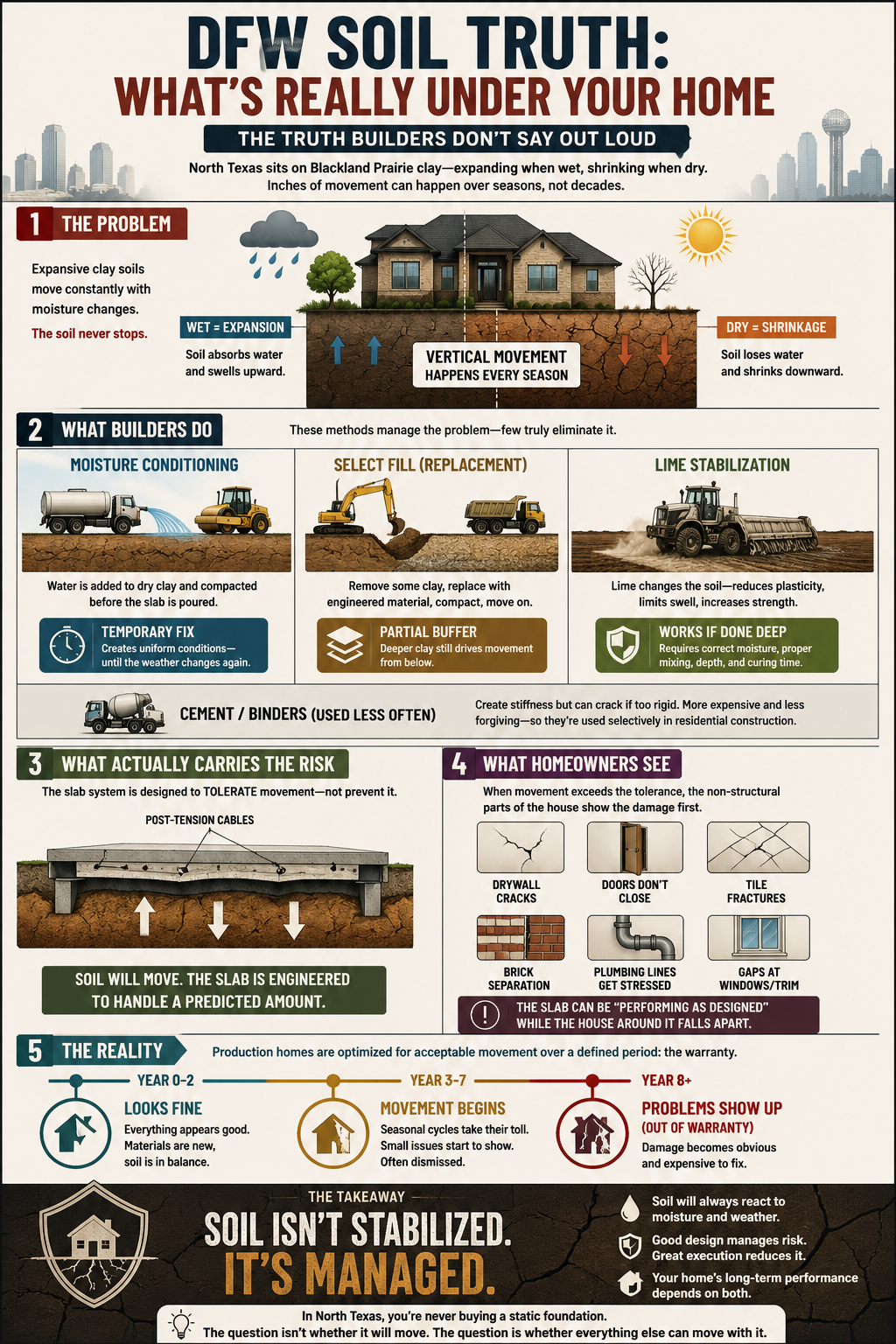
North Texas is built on dirt that wants to destroy houses. That is not an exaggeration. The Blackland Prairie clays under DFW expand when wet, shrink when dry, and do it relentlessly. Inches of vertical movement are not unusual. Not over decades—over seasons.
And yet, entire subdivisions go up as fast as crews can pour slabs.
So the real question isn’t what methods are used. The real question is this: how much of the problem is actually being solved, and how much is just being managed long enough to get past a warranty clock.
Because in production homebuilding, soil is not stabilized. It is negotiated with.
Most buyers assume something has been done to make the ground stable. Engineers assume their recommendations will be followed. Builders assume movement will stay within tolerance. Everyone is making assumptions. The soil is not.
Start with the most common move: moisture conditioning. Water gets added to dry clay, it gets compacted, and a slab goes on top. On paper, this creates uniform conditions. In reality, it creates a moment in time. The second weather cycles take over again, the soil goes right back to doing what it has always done. This is not stabilization. It is a temporary alignment of variables so construction can proceed.
Then there is select fill. Dig out some of the clay, bring in engineered material, compact it, move on. This works—up to a point. The problem is that the clay doesn’t stop where the excavation ends. If you remove two feet of active soil sitting on top of ten feet of highly reactive material, the system is still being driven by what’s underneath. In production environments, depth gets value-engineered. Every additional inch costs money. So what you get is not full isolation from expansive soil behavior. You get partial buffering.
Lime stabilization is where things start to look like actual engineering instead of damage control. When done correctly, lime changes the soil itself. It reduces plasticity, limits swell potential, and increases strength. This can work extremely well. Decades well. The catch is that it has to be done right—correct moisture, proper mixing, adequate depth, and time to cure. That last part alone conflicts with production schedules. And depth matters more than most people realize. Treat the top foot and you’ve improved the surface. Treat several feet and you’ve changed the system. Most production work lands somewhere in between, which means performance lands there too.
Cement and other binders show up less often in residential work, not because they don’t work, but because they are less forgiving and often more expensive. They create stiffness. Strength is not the problem in expansive soils—movement is. A system that is too rigid can crack rather than accommodate. So builders tend to default to methods that are cheaper and more tolerant of imperfect execution.
And then there is the part nobody markets as soil stabilization but is actually doing most of the work: the slab itself. Post-tension slabs, grade beams, reinforcement layouts—this is where the real strategy lives. Not stopping the soil from moving, but designing a structure that can survive it. The entire approach shifts from prevention to tolerance.
That sounds reasonable until you understand what “tolerance” actually means. It means the slab is designed around an expected amount of movement. Not zero. Not minimal. Expected. Engineers calculate how much differential movement the structure can absorb before it becomes a problem. That becomes the design target. If the soil behaves within that range, the house performs. If it doesn’t, everything that isn’t the structural slab starts to fail first.
And that is exactly what happens.
Drywall cracks. Brick separates. Tile fractures. Doors don’t close. Plumbing lines get stressed. None of these are considered structural failures, which is convenient, because they are the things homeowners actually see. The slab can technically be performing “as designed” while the house around it slowly tears itself out of alignment.
This is not a defect in the system. This is the system working exactly as intended.
Because production building is not optimized for zero movement. It is optimized for acceptable movement over a defined period of time. That period of time has a number attached to it: the warranty.
Once you see that clearly, everything else makes more sense. Soil reports are interpreted through cost. Stabilization depth is negotiated. Construction speed compresses curing times. Drainage is designed to meet minimum requirements, not eliminate risk. And homeowners inherit a structure that is fundamentally dependent on consistent moisture conditions in an environment that is anything but consistent.
Over time, the hierarchy becomes obvious. Deep treatment—whether through lime or full replacement—performs the best because it actually changes the system. Shallow treatment improves conditions but leaves deeper drivers untouched. Minimal preparation does almost nothing long term. But minimal preparation is fast, cheap, and usually good enough to get through inspections and early occupancy.
That is the uncomfortable reality. Most production homes in DFW are not sitting on stabilized soil in the way people think. They are sitting on managed risk, backed by structural design that assumes a certain level of ground movement and hopes reality stays within that envelope.
Sometimes it does. Sometimes it doesn’t.
The soil does not care either way.
If there is a single takeaway, it is this: in North Texas, you are never buying a static foundation. You are buying a system that is constantly reacting to moisture, weather, and site conditions. The question is not whether it will move. The question is whether everything built on top of it was designed, constructed, and maintained well enough to move with it without coming apart.
Most of the time, that answer depends less on the method that was chosen and more on how seriously the risk was taken when nobody was looking.
Planned Obsolescence—Whether Anyone Admits It or Not
No one in production homebuilding will stand up and say they are designing houses to fail. That is not how it is framed internally, and it is not how engineers write reports. But when you strip away the language and look at the incentives, the outcome starts to look uncomfortably close to planned obsolescence.
Not in the sense that a house is meant to collapse. That would be illegal and obvious. But in the sense that it is designed to perform adequately within a defined window, after which the risk shifts quietly onto the homeowner.
Everything in the system points in that direction. Soil treatment is often minimized to what is required to support the slab design assumptions. Slabs are engineered around expected movement ranges, not worst-case conditions. Drainage is built to pass inspection, not to eliminate long-term variability. Landscaping gets installed that will eventually alter moisture profiles. Irrigation systems introduce inconsistency. Trees get planted within influence zones that were never accounted for in the original design.
None of these decisions individually guarantee failure. Together, they create a system that is highly sensitive to time.
For the first few years, everything looks fine. The soil cycles haven’t fully expressed themselves. Moisture conditions are still relatively controlled. Materials are new and more tolerant of slight movement. By the time the full range of seasonal behavior shows up—drought, heavy rain cycles, differential moisture across the lot—the house is older, the warranty is gone, and the responsibility has shifted.
That is when the cracks start to become permanent instead of cosmetic.
From the builder’s perspective, the system worked. The home passed inspections. It met engineering requirements. It performed within the expected range during the period that mattered most contractually. From the homeowner’s perspective, the house is now revealing the true behavior of the soil that was never fully stabilized in the first place.
This is not a conspiracy. It is alignment of incentives.
Production builders are not rewarded for eliminating long-term soil movement. They are rewarded for controlling costs, maintaining schedules, and limiting warranty exposure. Deep stabilization, extended curing, aggressive moisture control, and conservative design margins all cost time and money. In a competitive market, those get trimmed until they meet an acceptable risk threshold.
And that threshold is rarely defined by what happens in year fifteen.
So what you end up with is not a defective product, but a time-dependent one. A structure that performs well enough early on, then gradually exposes the limitations of the decisions made beneath it. The soil keeps moving. The structure keeps responding. The finishes and systems in between take the damage.
Call it risk management, call it value engineering, call it standard practice. But from the outside, especially for someone dealing with the consequences years later, it looks a lot like something else.
It looks like a system designed to last just long enough to cover your builder’s ass.


