Archive for September, 2026

The Dallas-Fort Worth metroplex is currently overflowing with two things: absurd amounts of unearned home equity and a seemingly bottomless supply of gullible homeowners who genuinely believe a full kitchen overhaul, master bath remodel, and second-story addition can be executed flawlessly for thirty grand by a guy named “Chad” they met on Instagram. Welcome to the Golden Age of DFW remodeling fraud, where naive residents act shocked—shocked!—when the absolute lowest bidder turns out to be a career grifter who wrecks their house, steals their money, and vanishes into thin air.
If you think that sounds overly cynical, allow me to introduce you to Christopher and Raquelle Judge of Judge DFW LLC. As detailed in federal court filings from the U.S. Attorney’s Office for the Northern District of Texas and reported by local outlets like WFAA News, this dynamic duo managed to fleece over forty North Texas families out of nearly five million dollars. Their business model was magnificently simple: flash some pretty rendering software on social media, claim to be a licensed architect when you’re absolutely not, collect massive upfront checks, do just enough destructive demolition to render the house totally uninhabitable, and then divert the cash into luxury cars, private school tuition, and plastic surgery. While dozens of homeowners were forced to live in campers over the holidays, the Judges were literally getting cosmetic procedures using their clients’ framing budgets.
How does a disaster of this scale happen so routinely in our area? Because in the Great State of Texas, consumer protection in residential construction is an absolute joke. The state mandates strict state licensing for hairdressers, manicurists, and massage therapists, but if you want to tear out load-bearing walls and re-wire a 200-amp electrical panel, all you need is a leased F-150, a magnet logo for the door, and zero conscience. Texas requires precisely zero general contractor licensing at the state level. Any convicted felon or failed used-car salesman can wake up on Monday morning, declare themselves a “master craftsman,” and start taking deposit checks from eager suburbanites desperate for a bargain.
As I have pounded into readers’ heads for years regarding the infamous “vanishing building code,” the scam almost always starts right there on paper. Shady contractors deliberately wipe any reference to actual building standards—like the International Residential Code—clean out of their contracts. Instead, they write in warm, fuzzy, completely meaningless garbage promising that “work will be performed in a good and workmanlike manner.” What does “workmanlike” mean? It means whatever the guy holding the hammer claims it means on any given Tuesday. Without explicit, legally binding code requirements baked directly into the agreement, you have zero leverage when your brand-new shower drains backwards into your hallway closet.
The deception deepens before a single tool even touches your drywall. Most of these fly-by-night operators aren’t even registered as contractors in the cities where they operate, meaning they couldn’t legally pull a building permit if they tried. So what do they do? They put on their best trustworthy face and start spinning fairy tales to convince you that permits are a big, scary mistake. They’ll tell you that pulling a permit “just slows down the job with government bureaucracy” or, my personal favorite, “it will alert the county tax assessor and double your property taxes overnight.” It’s an absolute line of crap. What they are actually saying is: “Please don’t let anyone with a clipboard see the fire hazards I’m building in your new kitchen.”
And for the love of sanity, stop believing that a municipal building permit is your knight in shining armor. As I’ve explained in my guides on navigating Texas building codes, a city building inspector is not your personal concierge or quality assurance manager. They are overworked city employees who pull up to your driveway, glance out the window for forty-five seconds to make sure your house isn’t actively collapsing onto the sidewalk, drop off a green tag, and zoom off to their next thirty appointments. A city sign-off means you achieved the absolute bare minimum standard required by law to avoid immediate code enforcement—it does not mean your contractor installed your flashings correctly or built anything worth paying for.
When the project inevitably collapses into chaos, homeowners suddenly discover that the legal system is stacked entirely against them. Bad contractors love hiding behind Chapter 27 of the Texas Property Code—the infamous Residential Construction Liability Act—and mandatory arbitration clauses buried in their boilerplate contracts. These clauses are designed to trap you in an endless, soul-crushing cycle of legal notices, cure periods, and private arbitration fees that will drain your remaining life savings before you ever get a day in court. By the time you realize you’ve been taken, the contractor has already dissolved their LLC, formed a brand-new one under a slightly different name, and bought another jet ski or just moved to another state to start the scamming anew.
This shameless grift reaches a fever pitch every time a hail cell rolls through DFW. Within twenty-four hours, a swarm of out-of-state storm-chasers descends upon your neighborhood offering to “absorb,” “waive,” or “rebate” your insurance deductible. The Texas Department of Insurance warns people about this constantly, because it explicitly violates Section 27.02 of the Texas Business and Commerce Code. When you sign up for this little scheme, you aren’t beating the system; you are committing insurance fraud, setting yourself up to have your policy canceled, and handing your roof over to a crew whose idea of quality control is a bucket of tar and a prayer.
If you actually want to survive a remodeling project in North Texas without losing your home or your sanity, stop being so gullible. Stop falling for the lowest bid, because cheap labor is always astronomically expensive in the long run. Demand a contract that explicitly binds the contractor to current adopted municipal codes, not vague promises of “quality.” Never, under any circumstances, hand over massive cash deposits upfront. Tie every single payment draw directly to written sign-offs from an independent, ICC R5-certified third-party inspector who works for you, not the builder. Verify that the contractor is registered with your city, demand proof of active general liability insurance, and have a competent construction attorney review every line of the contract before you sign it. Otherwise, don’t be surprised when your “dream remodel” turns into a starring role on the local evening news.
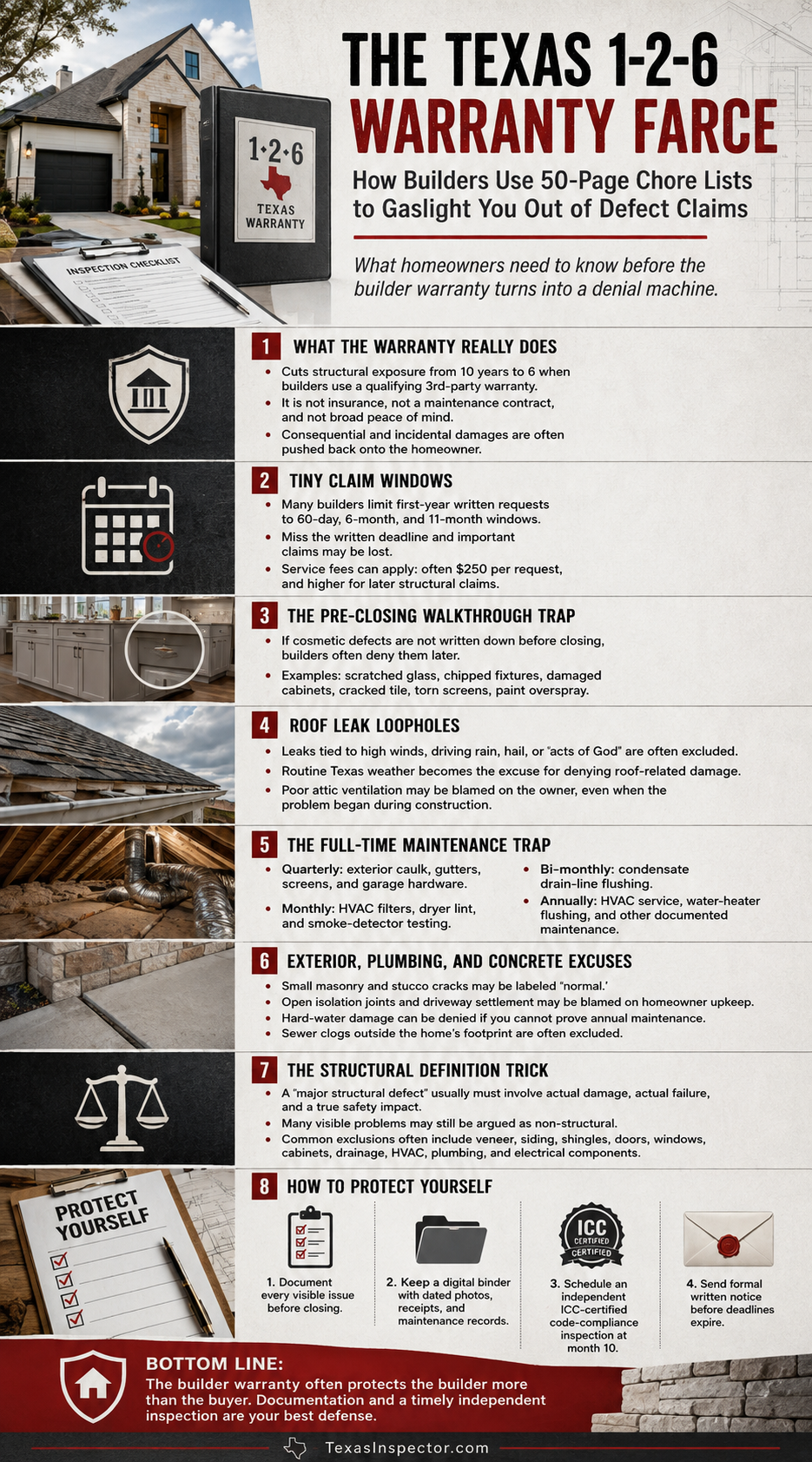
Congratulations on purchasing a brand-new production home in Texas! At closing, the builder’s representative proudly hands you a leatherette binder containing an express third-party warranty. Sales reps frame this as total peace of mind, but in reality, Texas House Bill 2024 allowed volume builders to shrink their statutory structural liability window from ten years down to six under Texas Civil Practice and Remedies Code Section 16.009, provided they hand you this exact piece of paper. The fine print explicitly clarifies that this document is not an insurance policy, a maintenance agreement, or a service contract—it is essentially a formal declaration that the builder intends to fix as little as legally possible. By signing, you happily waive all common-law implied warranties, including basic habitability and good workmanship, while agreeing that any consequential or incidental damages are strictly your financial problem, capped at the original purchase price. To ensure you rarely get a dime of help, builders restrict formal service requests to exactly three brief windows during the entire first year: 60 days, 6 months, and 11 months post-closing. Miss submitting your written list during one of those tiny windows? Too bad. Should your builder default on year-one or year-two repairs, the third-party warranty administrator will gladly step in—after you hand over a mandatory two-hundred-and-fifty-dollar service fee per request. That fee doubles to five hundred dollars per request for structural claims in years three through ten. Naturally, all of this conditional protection instantly vanishes if you fail to execute every absurd chore demanded by their homeowner maintenance manual.
The Cosmetic Trap of the Pre-Closing Walkthrough List
The warranty manual sets its first trap before you even receive your keys by mandating a signed, dated pre-closing walk-through inspection list. You might think this list is just a friendly checklist for minor paint touch-ups, but legally, it is an absolute boundary line. If a cosmetic or surface defect is not documented on that piece of paper prior to occupancy, the builder is legally absolved of fixing it forever. Did you fail to notice a scratched window pane, a clouded double-pane seal, or broken window glass? Congratulations, you own it. Did you miss a chipped plumbing fixture, a scratched chrome faucet, a gouged cabinet door, a delaminated laminate countertop, or a chipped ceramic floor tile? The warranty explicitly disclaims all of them unless they were written down before you moved in. Even concrete splatters on adjacent surfaces, torn screen mesh, paint splatters, overspray, and gouged resilient vinyl flooring are automatically written off as owner negligence if they were not recorded on that initial walk-through document.
The “Act of God” Roofing Farce
Roofing coverage is perhaps the most hilarious piece of legal comedy in the entire binder. Page twelve of the standard warranty book claims the builder will correct active roof leaks—but only those occurring under “normal conditions”. The fine print immediately clarifies that no action is required if the leak is caused by “high winds or driving rains”, while the broad exclusions section disclaims any loss or damage resulting from “acts of God or nature, windstorms, or hail”. In North Central Texas, spring supercells, 60-mph wind gusts, driving sideways rain, and severe hail storms happen every single year like clockwork. That is standard Texas weather. Yet, the builder’s legal contract defines “normal conditions” so hyper-narrowly that it essentially means a windless, 70-degree afternoon drizzle. The moment actual, routine Texas weather hits your roof—the exact weather the roof assembly was built to withstand—the builder instantly writes off the resulting ceiling leak as an un-warranted “Act of God” or driving rain event. Meanwhile, if shingles lift, curl, or cup, the warranty states zero builder action is required unless the cupping exceeds half an inch, at which point you are told to take it up with the shingle manufacturer. If shingles blow off, you carry the burden of proving the wind was below manufacturer speed specs. Up in the attic, International Residential Code Section R806 mandates continuous cross-ventilation. Subcontractors routinely blow loose insulation directly into the eaves, crushing soffit baffles and choking off intake airflow. During summer, attic temperatures soar past 140 degrees, baking shingles and warping ceiling framing. When you file a roof claim, the builder points to exclusions for dampness, condensation, or heat buildup caused by owner failure to maintain proper ventilation, blaming you for choked vents buried under insulation before drywall was even hung.
The Exterior Caulk Scam and Ridiculous Masonry Tolerances
The builder’s maintenance schedule demands that you perform quarterly inspections on all exterior window and door caulking, alongside quarterly inspections of your exterior drainage and gutters. You are also tasked with inspecting and cleaning brick weep holes semi-annually, inspecting door and window screens quarterly, and cleaning those screens semi-annually. Why is the builder so obsessed with your quarterly caulking inspection? Because subcontractors slather cheap acrylic latex painter’s caulk over damp OSB, unprimed fiber-cement board, and dirty brick veneer without using closed-cell backer rods to prevent three-sided adhesion failure. Under the brutal Texas sun, this cheap sealant cracks within months. When rainwater bypasses the split caulk and rots wall framing, the builder will not compensate you for missing window head flashings or unsealed weather barriers. Instead, they point to your failure to log a quarterly caulk inspection and declare that wall rot is excluded due to owner neglect. Siding separations under three-eighths of an inch are reclassified as routine owner maintenance. The brick veneer logic is even more absurd: while you are required to clean weep holes every six months, warranty performance standards explicitly declare that mortar and brick cracks up to a quarter-inch wide are routine owner maintenance requiring zero builder action. Stucco cracks up to an eighth of an inch are dismissed as hairline normalities. Your exterior masonry can literally split open, and the builder will legally reclassify it as your weekend chore until the brick falls off the house.
The Full-Time Indoor Chore Marathon and HVAC Traps
Step inside the house and your new homeownership journey transforms into a full-time, unpaid facilities management job. You are ordered to inspect and replace interior caulking in all wet areas semi-annually, clean your garbage disposal monthly, scrub faucet aerators bi-monthly, and inspect plumbing drains semi-annually. You must also clean dryer lint filters monthly, clean out the main dryer vent exhaust annually, clean the range hood fan filter quarterly, test smoke detectors monthly, inspect and clean fireplace flues annually, inspect metal front door finishes semi-annually, and—believe it or not—repaint the front door annually. You are even required to lubricate garage door hardware quarterly and conduct full garage door inspections semi-annually. On the HVAC side, the schedule demands monthly air filter replacements, bi-monthly condensate drain line flushes, and mandatory annual servicing by a licensed contractor. When an attic air handler built with an unlevel drain pan overflows, the builder’s inspector checks the condensate drain line for standing water. The moment they spot a trace of algae, the entire drywall damage claim is denied as deferred homeowner maintenance because you missed a bi-monthly vinegar flush. The warranty standards also state that cooling systems are only required to maintain 78 degrees indoors when outdoor temperatures hit 95 degrees, and room temperature variations up to 4 degrees are completely normal. When metal ductwork makes loud oil-canning ticking noises or GFCI outlets trip constantly, the warranty dismisses them as normal conditions. Because the warranty explicitly excludes all consequential damages, ruined hardwood floors, stained drywall, and ruined personal property are dumped entirely onto your personal home insurance policy.
Plumbing Exclusions, Unsealed Flatwork, and Foundation Excuses
Plumbing coverage is equally illusory. The maintenance schedule demands that homeowners flush their water heater annually. Production builders routinely mount sensitive tankless units directly onto raw municipal water lines in Texas cities where dissolved calcium carbonate regularly exceeds three hundred parts per million, completely omitting scale-inhibition filters or softeners. When hard mineral scale bakes onto the heating core and destroys it in year two, the builder demands your annual maintenance logs. If you cannot produce invoices proving annual flushing, the claim is denied for owner neglect. Pipe freezing is blamed on owner failure to winterize or maintain heat, and sewer clogs are only covered if the blockage occurs within the structure’s footprint—any clog past the exterior foundation wall is entirely your problem. The exact same liability shift occurs on concrete flatwork. American Concrete Institute standards ACI 302.1R and ACI 325.9R state that joints between flatwork and foundation slabs are isolation joints that must be sealed with flexible elastomeric sealant during construction. Builders leave these joints open, list joint sealing as owner upkeep, and let heavy rains wash out subgrade soil. When driveways drop, the builder claims open joints are homeowner neglect while hiding behind warranty standards that explicitly classify attached garage slab cracks or driveway settlement up to a quarter-inch vertical displacement as acceptable. For yard grading, standing water within 10 feet of the foundation is allowed to sit for 24 hours (48 hours in swales) before it is considered a defect, and settled soil around foundation backfill will only be filled by the builder a single time, provided the settlement exceeds 6 inches.
The Structural Definition Trick and Total Exclusions
The headline ten-year structural warranty sounds impressive until you read the legal definition of a Major Structural Defect in Section I.B.14. To qualify as a structural defect, three strict conditions must simultaneously occur: there must be actual physical damage to a specified load-bearing component, that component must actually fail, AND the failure must affect its load-bearing function to the degree that it materially affects the physical safety of the occupants. If your foundation cracks, twists framing, and jams every door in the house, but the roof has not collapsed onto your head, the builder can legally argue that occupant safety is not materially endangered. To make matters worse, the warranty explicitly lists components that are contractually deemed NOT to have structural defect potential. This exclusion list includes non-load-bearing walls, drywall, plaster, subflooring, flooring, brick veneer, stucco, stone, exterior siding, roof shingles, tar paper, roof sheathing, HVAC systems, plumbing systems, electrical systems, doors, windows, trim, cabinets, hardware, insulation, paint, stain, and both interior and exterior drainage systems. Furthermore, structural coverage completely excludes attached decks, patios, porches, stoops, porch roofs, chimneys, and garage floors after the very first year.
Outsmarting the Builder Paper Trail
Defeating this contractual setup requires treating your homeowner maintenance manual as an adversarial legal compliance file from the moment you receive the keys. Site supervisor verbal assurances carry zero legal weight under Texas Property Code Chapter 27. Skip casual walkthroughs and hire an independent, ICC-certified building code consultant who actually understands structural framing, ACI concrete standards, and IRC building codes. Have them perform a comprehensive code-compliance inspection at month ten—right before your 11-month builder claim submission deadline closes forever. Keep a dedicated digital binder packed with dated receipts for every single HVAC filter, bi-monthly condensate flush photo, annual licensed HVAC service invoice, water heater flush log, and photo of sealed isolation joints. When defects emerge, skip the polite phone calls and send formal, written notices detailing specific code non-compliance items via certified mail with return receipt requested before statutory warranty deadlines expire.

If you still naively believe the biggest threat to your North Texas property insurance is a late-spring hailstorm, wake up. The real threat is floating 300 feet directly above your driveway—and sitting on its collective fat ass in plush leather chairs down at the Texas Department of Insurance (TDI) in Austin.
Over the past six years, Texas home insurance premiums have exploded by nearly 80 percent, giving North Texas the dubious honor of paying some of the most outrageous rates in the entire nation. How does an industry pull off this kind of daylight robbery? With the direct, enthusiastically rubber-stamped permission of TDI. Operating under the state’s cozy “file-and-use” regulatory system, TDI acts less like a public consumer watchdog and more like a high-dollar concierge service for insurance underwriters. Insurers submit absurd double-digit rate hikes, TDI nods along like a dashboard bobblehead, and homeowners get handed the tab.
Having systematically gouged regular Texans out of their hard-earned equity, insurance carriers have moved on to phase two of their cynical little game: dropping policyholders en masse before the next storm system rolls through. But why pay actual, competent field adjusters to walk a roof when you can fire them all and replace them with dirt-cheap satellite photography, fixed-wing passes, and third-party drone fleets running primitive, bottom-of-the-barrel AI algorithms?
Under Texas Insurance Code Chapter 551, carriers must give you 60 days of written notice before a non-renewal. Furthermore, under Texas House Bill 2067, they are legally obligated to provide the specific written explanation detailing why you are being dropped. But when those letters hit DFW mailboxes, the “reasons” almost never stem from real-world structural failure. They trace back to minor maintenance items that lazy homeowners neglected—or low-angle, two-dimensional aerial cameras that completely hallucinated damage out of thin air.
Granule Loss and De-bonding: The “Dark Patch” Hallucination
Aerial AI looks for basic color contrast shifts, roof shadows, or dark spots, automatically flagging those areas as catastrophic hail damage, unbonded shingles, or bare fiberglass matting. The ground reality? A brainless algorithm cannot tell the difference between functional asphalt erosion and harmless Gloeocapsa magma, the cosmetic black algae staining every third roof in humid North Texas. Furthermore, a satellite camera thousands of feet in the air cannot physically test for seal-strip adhesion. A roof flagged by a lazy underwriter as gearing toward structural collapse is frequently just an eight-year-old roof that needs a hundred-dollar zinc wash, not a $25,000 asphalt replacement.
Overhanging Tree Limbs: Phantom Branches on a Flat Plane
This is the single biggest victim of cheap, flat-plane satellite technology. Direct vertical overhead shots collapse three-dimensional space into a flat 2D picture. The result? A perfectly innocent tree canopy looks like it is physically crushing your roof deck. While tree branches actually scraping a roof violate basic standards of practice by providing a direct highway for roof rats and scrubbing off protective granules, top-down satellite views completely lack vertical depth perception. An oak branch floating six to eight feet cleanly above a ridge line appears to be scraping the shingles from an overhead camera. Without an in-person elevation assessment, carriers issue bogus non-renewals for phantom limbs that aren’t even touching the damn house.
Debris Accumulation: Marking a 15-Minute Task as a Structural Failure
Aerial scanners spot dark, clumped lines along roof valleys, dormers, and chimney crickets, instantly flagging fallen leaves and post-hail oak tassels as catastrophic moisture retention hazards. While trapped debris can back up water under counter-flashings over time, an automated drone marks a simple fifteen-minute maintenance task like sweeping a valley as an uninsurable structural defect.
Backyard Outbuildings: The Unpermitted Death-Trap Flag
As North Texas cities relax single-family zoning rules, backyards are filling up with cheap, unpermitted detached offices, casitas, and covered patios built by tailgate contractors. Aerial algorithms cross-reference building footprints against municipal tax maps. If a drone flags an unpermitted shed tapped illegally into the main house panel, or a patio cover tied improperly into the fascia without structural ledger framing, insurers drop the primary residence policy entirely due to unmanaged fire and wind-uplift hazards.
Low-Slope Ponding: Confusing Standing Water with Deck Rot
Satellite infrared and optical sensors regularly flag standing water on flat or low-slope roof sections forty-eight hours after a rain event, instantly declaring it active roof deflection or rotting decking. Meanwhile, improper perimeter grading—the undisputed king of slab foundation failures in North Texas clay—gets completely overlooked by the sky cameras until excessive vegetation growth signals moisture pooling near the grade.
How to Smash a Bogus Non-Renewal
If your carrier hits you with an automated non-renewal letter based on 2D satellite images claiming your roof has phantom tree limbs or non-existent damage, do not panic, and do not let a sleazy storm-chasing salesman scare you into signing a massive contract.
Force the Evidence: Demand the exact evidence package under Texas HB 2067. State law requires carriers to provide the specific written justification and source data. They regularly drop coverage using outdated aerial passes, low-resolution garbage, or photos of your neighbor’s property down the street.
Get Ground-Truth Photos: Take date-stamped, eye-level photographs showing the actual vertical clearance between your roof deck and the tree canopy. Prove the 2D flattening effect is a cheap, fraudulent lie.
Hire a Real Roofer, Not a Drone: An automated camera thousands of feet up cannot measure branch clearance, test shingle pliability, check step-flashing integration, or inspect attic decking for active leaks. A licensed, certified, reputable roofing contractor provides an unbiased, ground-truth evaluation of the structural system.
Nail Them with a Rebuttal: Submit a certified rebuttal package with ground photos and a professional evaluation report directly to the carrier’s underwriting appeals department. Then file a formal complaint with the Texas Department of Insurance—if for no other reason than to force TDI’s comfortably numb bureaucrats to actually open a file and force the carrier to manually review the evidence. This might (certainly will) be wasted time, but it could make you feel better.
Documented physical verification by a real human roofer forces the carrier to review the file manually or gives you the exact paperwork needed to secure coverage elsewhere in the private market before being forced into the state insurance pool. Don’t let a blind algorithm sitting alongside a toothless, captured state regulator judge your home’s structural integrity when an educated homeowner with ground-level proof can disprove a drone camera every single time.

There is nothing quite like walking into your shiny new home in the Dallas-Fort Worth metroplex. The paint smells fresh, the countertops are pristine, and you are riding high on that new-build optimism, assuming that because everything is brand new, you are fully protected for the next decade.
Wipe that smile off your face for just a second, because corporate fine print is waiting in the bushes to bite you.
Every year, homeowners call an HVAC technician, an appliance repairman, or a plumber in year six when their air conditioning condenser, garage opener, or water heater decides to die in the middle of a 105-degree Texas August. They expect the manufacturer’s extended warranty to cover the thousand-dollar replacement parts, only to be slapped with the reality that their equipment was never registered, meaning their coverage actually expired years ago.
The 60-Day Registration Trap
Major HVAC manufacturers—the big names like Trane, Lennox, and Carrier—love to boast about their shiny 10-year parts warranties on billboard ads. What they whisper in microscopic text at the bottom of the page is the catch: you only get that 10-year warranty if you register the equipment online within 60 days of closing.
If you miss that narrow window, the corporate gods automatically demote your protection down to a measly 5-year Base Limited Warranty. By failing to fill out a basic web form, you just forfeited five full years of parts coverage on equipment that costs a small fortune to repair or replace.
Who is Responsible? (The Builder’s Game of Pass the Buck)
If you think your builder or their subcontractors registered this stuff for you out of the goodness of their hearts, think again.
Builders care about their short-term 1-to-2-year workmanship warranty. Once that year is up, or once they hand you the keys at closing, they wash their hands of your mechanical equipment. The manufacturer’s warranty belongs to the end user—which means the legal and financial burden of pressing “Submit” on that registration form rests squarely on your shoulders.
Here is a critical detail most people mess up: the registration clock starts on your official Closing Date, not the date some subcontractor bolted the equipment to the wall months prior while the house was still framed studs.
The Indoor HVAC Mistake
Don’t make the rookie mistake of thinking registration is just for the big metal A/C box sitting in your flowerbed.
Your outdoor condenser is only one part of a matched HVAC system. You also have a gas furnace or electric air handler, along with an evaporator coil casing tucked away in your blazing-hot attic. Each of those components has its own separate model and serial number, and each one requires its own registration. If you only register the outdoor unit, your indoor attic equipment gets locked into that sad 5-year default warranty.
Water Heaters, Pool Gear, and Kitchen Appliances
The warranty registration game extends across your entire home, but the rules shift depending on the equipment sitting in front of you.
Tankless water heaters from brands like Rinnai and Navien typically come with a standard 12-to-15-year heat exchanger warranty right out of the box. However, registering them online within 30 to 90 days unlocks a crucial upgrade: it bumps your free labor warranty from a brief 1 year up to 5 years. More importantly, it forces the manufacturer to start counting your coverage from your actual closing date rather than the day the unit sat in a wholesale distributor’s warehouse. Standard tank water heaters require registration for the exact same reason—to prevent losing six months of coverage that elapsed while the home was under construction.
If your new build includes a pool, brands like Pentair, Hayward, and Jandy are even more ruthless, dropping your equipment coverage from three years down to a single year if you fail to register a matched system.
Then come your built-in kitchen appliances. Refrigerators, double ovens, dishwashers, and cooktops usually offer a standard 1-year limited warranty. Because builders purchase appliance packages in massive wholesale batches months before your house is completed, an unregistered dishwasher might have its warranty start on the day it left the warehouse floor. Registering your appliances immediately ties the start of that 1-year clock directly to your Closing Date so you get every single day of coverage you paid for, while ensuring you receive immediate notification if a critical safety recall is issued.
Smart Home Tech, Garage Openers, Laundry, and Sprinklers
The trap gets even broader when you look at the tech and convenience gear builders use to sweeten the deal.
Smart home packages featuring Ring doorbells, Nest or Ecobee thermostats, and smart deadbolts carry strict 1-year hardware warranties. If you do not create your owner account and upload your Closing Disclosure right away, the manufacturer considers the build date as day one. That means your 1-year doorbell warranty might actually be 90 days from expiring on the day you move in.
Garage door openers from LiftMaster, Genie, or Chamberlain often boast impressive 10-year or lifetime motor and belt warranties, but their internal circuit boards, wall buttons, and safety sensors are only covered for 1 to 3 years. Without online registration tying the unit to your closing date, the manufacturer defaults to the DOM stamp—the Date of Manufacture—stamped on the metal casing hanging from your garage ceiling.
If your builder provided a washer and dryer package, or if you brought in standalone appliances, pay close attention to the fine print from LG, Samsung, or Whirlpool. While the general appliance warranty is 1 year, these manufacturers often include 10-year limited parts warranties on direct-drive washer motors and digital inverter refrigerator compressors. To claim a replacement compressor in year seven, you must prove when your ownership began. Registering at move-in saves you from an ugly paper trail battle later.
Even your yard is on the clock. DFW builders routinely install smart sprinkler controllers like Rachio, Rain Bird, or Hunter to meet city water conservation requirements. These controllers carry 2-to-3-year warranties that require app setup and registration to anchor the start date to your closing day rather than the day the landscaping crew plugged it in.
Texas Law and Resale Value
Registering your gear isn’t just about protecting your own wallet today; it’s also about setting up your resale value tomorrow. Under Texas Business & Commerce Code Chapter 608, residential HVAC warranties automatically transfer to future buyers without transfer fees or administrative hurdles.
However, the law only transfers whatever warranty length is currently active. If you registered your system properly and sell the home in year five, the buyer inherits five full years of remaining coverage, which makes your listing look fantastic. If you forgot to register, that warranty is completely dead at year five, leaving the next owner with zero protection.
The Move-In Day Action Plan
Fixing this takes about 15 minutes between unpacking boxes, and you can pull it off without needing a complicated checklist.
First, grab your smartphone and go on a quick hunting expedition through your utility areas, garage, kitchen, yard, and attic. Take clear photos of the metal data plates displaying the model and serial numbers on your outdoor A/C condenser, attic furnace, evaporator coil casing, water heater, kitchen appliances, washer and dryer, garage door opener motor, sprinkler controller, and smart doorbell.
Next, grab your Closing Disclosure from your settlement stack so you have your official closing date ready to plug in as the installation date.
Finally, sit down at your computer, visit the registration page for each equipment manufacturer, type in the serial numbers, and download the PDF confirmation receipts directly to a dedicated home folder on your desktop.
Protect Your Investment
Protecting your home isn’t just about filling out web forms, though. Before your 1-year builder warranty expires and leaves you holding the bag for construction mistakes, you need to know what defects were left behind in your attic, roof, and foundation. Schedule your 11-Month Warranty Inspection with Texas Inspector today, and let us force the builder to fix their mistakes on their dime, not yours.


