
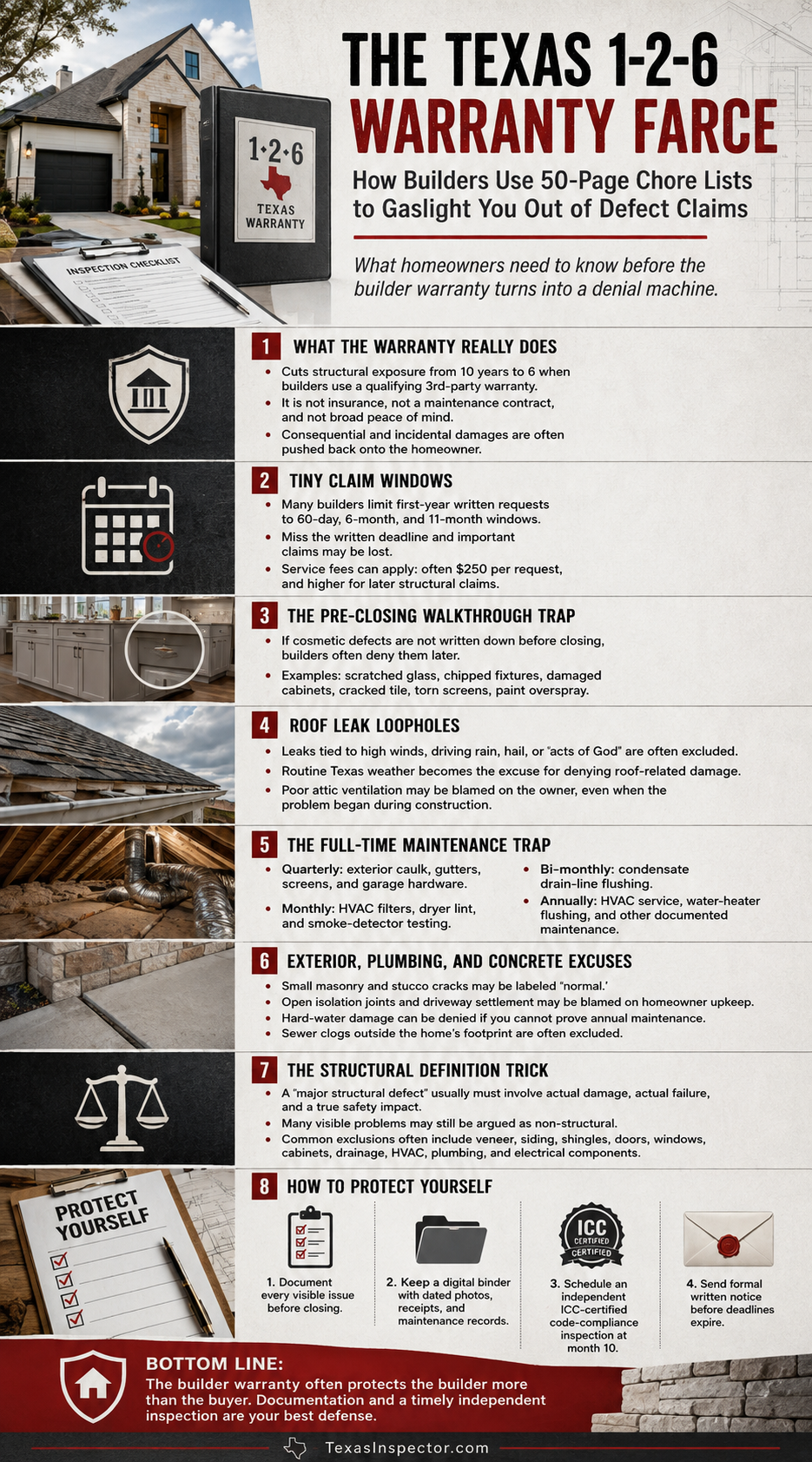
Congratulations on purchasing a brand-new production home in Texas! At closing, the builder’s representative proudly hands you a leatherette binder containing an express third-party warranty. Sales reps frame this as total peace of mind, but in reality, Texas House Bill 2024 allowed volume builders to shrink their statutory structural liability window from ten years down to six under Texas Civil Practice and Remedies Code Section 16.009, provided they hand you this exact piece of paper. The fine print explicitly clarifies that this document is not an insurance policy, a maintenance agreement, or a service contract—it is essentially a formal declaration that the builder intends to fix as little as legally possible. By signing, you happily waive all common-law implied warranties, including basic habitability and good workmanship, while agreeing that any consequential or incidental damages are strictly your financial problem, capped at the original purchase price. To ensure you rarely get a dime of help, builders restrict formal service requests to exactly three brief windows during the entire first year: 60 days, 6 months, and 11 months post-closing. Miss submitting your written list during one of those tiny windows? Too bad. Should your builder default on year-one or year-two repairs, the third-party warranty administrator will gladly step in—after you hand over a mandatory two-hundred-and-fifty-dollar service fee per request. That fee doubles to five hundred dollars per request for structural claims in years three through ten. Naturally, all of this conditional protection instantly vanishes if you fail to execute every absurd chore demanded by their homeowner maintenance manual.
The Cosmetic Trap of the Pre-Closing Walkthrough List
The warranty manual sets its first trap before you even receive your keys by mandating a signed, dated pre-closing walk-through inspection list. You might think this list is just a friendly checklist for minor paint touch-ups, but legally, it is an absolute boundary line. If a cosmetic or surface defect is not documented on that piece of paper prior to occupancy, the builder is legally absolved of fixing it forever. Did you fail to notice a scratched window pane, a clouded double-pane seal, or broken window glass? Congratulations, you own it. Did you miss a chipped plumbing fixture, a scratched chrome faucet, a gouged cabinet door, a delaminated laminate countertop, or a chipped ceramic floor tile? The warranty explicitly disclaims all of them unless they were written down before you moved in. Even concrete splatters on adjacent surfaces, torn screen mesh, paint splatters, overspray, and gouged resilient vinyl flooring are automatically written off as owner negligence if they were not recorded on that initial walk-through document.
The “Act of God” Roofing Farce
Roofing coverage is perhaps the most hilarious piece of legal comedy in the entire binder. Page twelve of the standard warranty book claims the builder will correct active roof leaks—but only those occurring under “normal conditions”. The fine print immediately clarifies that no action is required if the leak is caused by “high winds or driving rains”, while the broad exclusions section disclaims any loss or damage resulting from “acts of God or nature, windstorms, or hail”. In North Central Texas, spring supercells, 60-mph wind gusts, driving sideways rain, and severe hail storms happen every single year like clockwork. That is standard Texas weather. Yet, the builder’s legal contract defines “normal conditions” so hyper-narrowly that it essentially means a windless, 70-degree afternoon drizzle. The moment actual, routine Texas weather hits your roof—the exact weather the roof assembly was built to withstand—the builder instantly writes off the resulting ceiling leak as an un-warranted “Act of God” or driving rain event. Meanwhile, if shingles lift, curl, or cup, the warranty states zero builder action is required unless the cupping exceeds half an inch, at which point you are told to take it up with the shingle manufacturer. If shingles blow off, you carry the burden of proving the wind was below manufacturer speed specs. Up in the attic, International Residential Code Section R806 mandates continuous cross-ventilation. Subcontractors routinely blow loose insulation directly into the eaves, crushing soffit baffles and choking off intake airflow. During summer, attic temperatures soar past 140 degrees, baking shingles and warping ceiling framing. When you file a roof claim, the builder points to exclusions for dampness, condensation, or heat buildup caused by owner failure to maintain proper ventilation, blaming you for choked vents buried under insulation before drywall was even hung.
The Exterior Caulk Scam and Ridiculous Masonry Tolerances
The builder’s maintenance schedule demands that you perform quarterly inspections on all exterior window and door caulking, alongside quarterly inspections of your exterior drainage and gutters. You are also tasked with inspecting and cleaning brick weep holes semi-annually, inspecting door and window screens quarterly, and cleaning those screens semi-annually. Why is the builder so obsessed with your quarterly caulking inspection? Because subcontractors slather cheap acrylic latex painter’s caulk over damp OSB, unprimed fiber-cement board, and dirty brick veneer without using closed-cell backer rods to prevent three-sided adhesion failure. Under the brutal Texas sun, this cheap sealant cracks within months. When rainwater bypasses the split caulk and rots wall framing, the builder will not compensate you for missing window head flashings or unsealed weather barriers. Instead, they point to your failure to log a quarterly caulk inspection and declare that wall rot is excluded due to owner neglect. Siding separations under three-eighths of an inch are reclassified as routine owner maintenance. The brick veneer logic is even more absurd: while you are required to clean weep holes every six months, warranty performance standards explicitly declare that mortar and brick cracks up to a quarter-inch wide are routine owner maintenance requiring zero builder action. Stucco cracks up to an eighth of an inch are dismissed as hairline normalities. Your exterior masonry can literally split open, and the builder will legally reclassify it as your weekend chore until the brick falls off the house.
The Full-Time Indoor Chore Marathon and HVAC Traps
Step inside the house and your new homeownership journey transforms into a full-time, unpaid facilities management job. You are ordered to inspect and replace interior caulking in all wet areas semi-annually, clean your garbage disposal monthly, scrub faucet aerators bi-monthly, and inspect plumbing drains semi-annually. You must also clean dryer lint filters monthly, clean out the main dryer vent exhaust annually, clean the range hood fan filter quarterly, test smoke detectors monthly, inspect and clean fireplace flues annually, inspect metal front door finishes semi-annually, and—believe it or not—repaint the front door annually. You are even required to lubricate garage door hardware quarterly and conduct full garage door inspections semi-annually. On the HVAC side, the schedule demands monthly air filter replacements, bi-monthly condensate drain line flushes, and mandatory annual servicing by a licensed contractor. When an attic air handler built with an unlevel drain pan overflows, the builder’s inspector checks the condensate drain line for standing water. The moment they spot a trace of algae, the entire drywall damage claim is denied as deferred homeowner maintenance because you missed a bi-monthly vinegar flush. The warranty standards also state that cooling systems are only required to maintain 78 degrees indoors when outdoor temperatures hit 95 degrees, and room temperature variations up to 4 degrees are completely normal. When metal ductwork makes loud oil-canning ticking noises or GFCI outlets trip constantly, the warranty dismisses them as normal conditions. Because the warranty explicitly excludes all consequential damages, ruined hardwood floors, stained drywall, and ruined personal property are dumped entirely onto your personal home insurance policy.
Plumbing Exclusions, Unsealed Flatwork, and Foundation Excuses
Plumbing coverage is equally illusory. The maintenance schedule demands that homeowners flush their water heater annually. Production builders routinely mount sensitive tankless units directly onto raw municipal water lines in Texas cities where dissolved calcium carbonate regularly exceeds three hundred parts per million, completely omitting scale-inhibition filters or softeners. When hard mineral scale bakes onto the heating core and destroys it in year two, the builder demands your annual maintenance logs. If you cannot produce invoices proving annual flushing, the claim is denied for owner neglect. Pipe freezing is blamed on owner failure to winterize or maintain heat, and sewer clogs are only covered if the blockage occurs within the structure’s footprint—any clog past the exterior foundation wall is entirely your problem. The exact same liability shift occurs on concrete flatwork. American Concrete Institute standards ACI 302.1R and ACI 325.9R state that joints between flatwork and foundation slabs are isolation joints that must be sealed with flexible elastomeric sealant during construction. Builders leave these joints open, list joint sealing as owner upkeep, and let heavy rains wash out subgrade soil. When driveways drop, the builder claims open joints are homeowner neglect while hiding behind warranty standards that explicitly classify attached garage slab cracks or driveway settlement up to a quarter-inch vertical displacement as acceptable. For yard grading, standing water within 10 feet of the foundation is allowed to sit for 24 hours (48 hours in swales) before it is considered a defect, and settled soil around foundation backfill will only be filled by the builder a single time, provided the settlement exceeds 6 inches.
The Structural Definition Trick and Total Exclusions
The headline ten-year structural warranty sounds impressive until you read the legal definition of a Major Structural Defect in Section I.B.14. To qualify as a structural defect, three strict conditions must simultaneously occur: there must be actual physical damage to a specified load-bearing component, that component must actually fail, AND the failure must affect its load-bearing function to the degree that it materially affects the physical safety of the occupants. If your foundation cracks, twists framing, and jams every door in the house, but the roof has not collapsed onto your head, the builder can legally argue that occupant safety is not materially endangered. To make matters worse, the warranty explicitly lists components that are contractually deemed NOT to have structural defect potential. This exclusion list includes non-load-bearing walls, drywall, plaster, subflooring, flooring, brick veneer, stucco, stone, exterior siding, roof shingles, tar paper, roof sheathing, HVAC systems, plumbing systems, electrical systems, doors, windows, trim, cabinets, hardware, insulation, paint, stain, and both interior and exterior drainage systems. Furthermore, structural coverage completely excludes attached decks, patios, porches, stoops, porch roofs, chimneys, and garage floors after the very first year.
Outsmarting the Builder Paper Trail
Defeating this contractual setup requires treating your homeowner maintenance manual as an adversarial legal compliance file from the moment you receive the keys. Site supervisor verbal assurances carry zero legal weight under Texas Property Code Chapter 27. Skip casual walkthroughs and hire an independent, ICC-certified building code consultant who actually understands structural framing, ACI concrete standards, and IRC building codes. Have them perform a comprehensive code-compliance inspection at month ten—right before your 11-month builder claim submission deadline closes forever. Keep a dedicated digital binder packed with dated receipts for every single HVAC filter, bi-monthly condensate flush photo, annual licensed HVAC service invoice, water heater flush log, and photo of sealed isolation joints. When defects emerge, skip the polite phone calls and send formal, written notices detailing specific code non-compliance items via certified mail with return receipt requested before statutory warranty deadlines expire.


