Archive for June, 2026
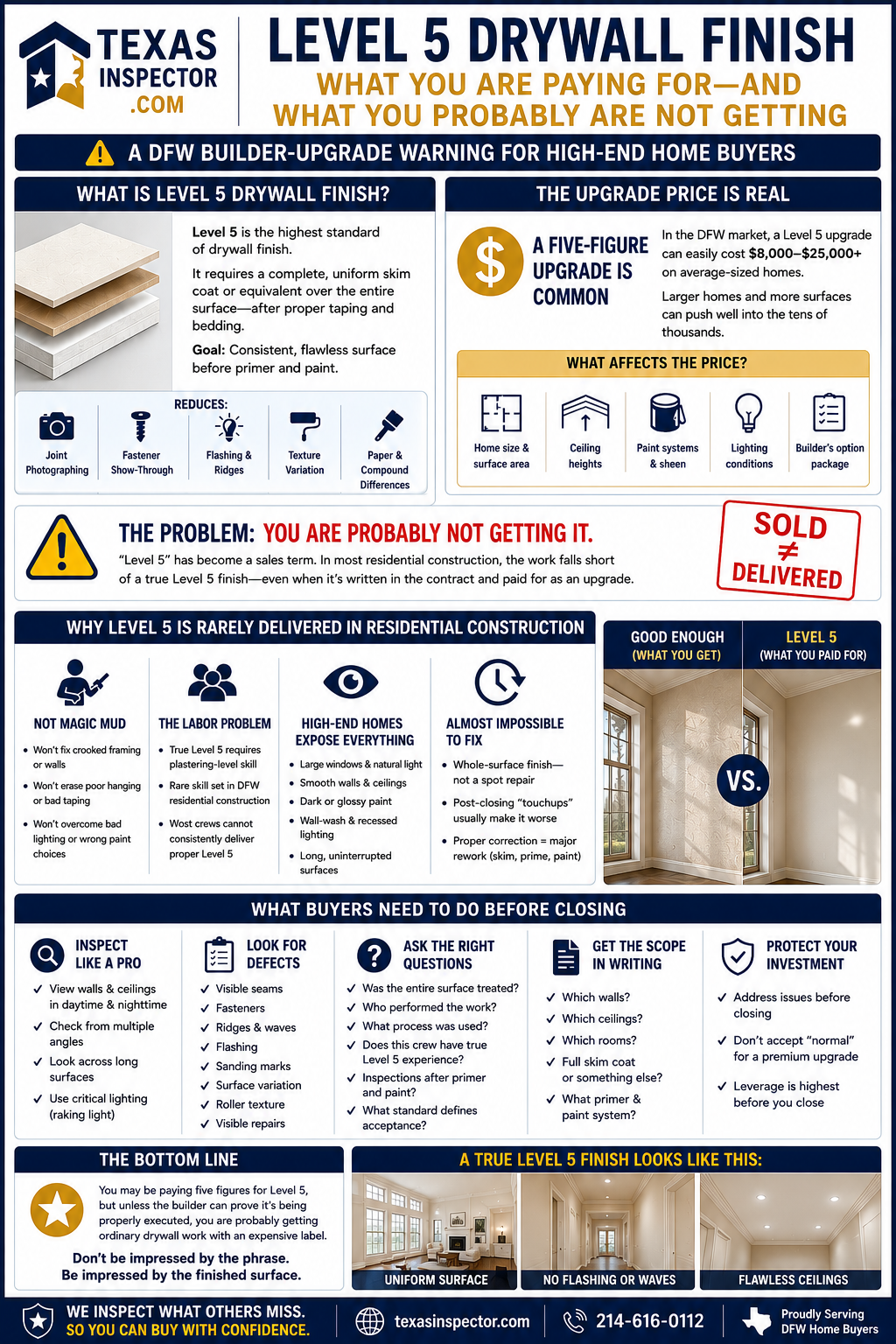
“Level 5 drywall finish” sounds expensive, technical, and impressive, which is exactly why it gets used in upper-end and high-end residential construction. Buyers hear it and think they are getting smooth, clean, premium walls and ceilings. Builders say it because it sounds like a luxury feature. Contracts include it, design centers sell it, and buyers pay for it. The problem is that in residential construction, you are probably not getting it. Not “maybe not,” and not “there could be a few minor workmanship issues.” You are probably not getting a proper Level 5 finish, even if your contract says you are.
That is not because Level 5 is a bad standard. Level 5 is a real drywall finish level with a real purpose. The problem is that almost nobody in the residential field is actually delivering it correctly. A true Level 5 finish is not “smooth walls,” standard tape and bed, extra sanding, a painter spraying a thick coat of primer, someone spot-floating a few bad seams, or a drywall crew saying, “Yeah, we did Level 5,” while doing the same basic work they do everywhere else. A proper Level 5 finish requires the drywall to be finished correctly first, then the entire surface must receive a uniform skim coat or equivalent surface treatment so the wall or ceiling has a consistent surface before primer and paint. The point is to reduce joint photographing, fastener show-through, flashing, texture variation, and visible differences between the drywall paper and joint compound.
That complete process is almost never delivered in residential construction. That is the part buyers need to understand before they get emotionally attached to the phrase. The words in the contract do not skim the walls. The sales presentation does not flatten the substrate. The design center upgrade does not create skilled labor. The invoice does not produce craftsmanship. Someone actually has to perform the work correctly, and that is where the wheels come off.
“Level 5” Has Become a Sales Term
In high-end residential construction, “Level 5” has become one of those phrases that sounds good in a contract and collapses in the field. The builder sells Level 5, the buyer pays for Level 5, and the field work almost never meets Level 5. What gets passed off as Level 5 is often partial treatment, spot treatment, inconsistent skim work, extra mud in the obvious places, primer used like body filler, patches after defects are noticed, and a little sanding here and there while everyone hopes the paint hides the crime scene.
It usually does not. The buyer ends up with visible seams, fasteners, ridges, waves, sanding marks, flashing, uneven sheen, roller texture, shadowing, and surface variation. Then comes the predictable builder response that “this is normal.” If a proper Level 5 finish was contracted for, that answer is not good enough. The question is not whether imperfect drywall exists in ordinary residential construction. Of course it does. The question is whether the buyer was sold and charged for Level 5.
The Upgrade Price Is Real, Even When the Finish Is Not
This is not some throw-in item that accidentally made its way into the brochure. In the DFW market, a Level 5 drywall upgrade in an upper-end home can easily become a five-figure option, and on larger homes it can push well into the tens of thousands of dollars depending on the size of the home, ceiling heights, wall and ceiling areas included, paint selections, lighting conditions, and how the builder packages its options. The exact number varies because builders do not all price it the same way, but the point is not complicated: buyers are often paying real money for a finish they are probably not actually receiving.
That is the part that should irritate buyers. This is not just a technical disagreement between drywall people. This is a paid upgrade, and in many cases it is a significant one. Some builders price it as a whole-house option. Some limit it to selected rooms. Some include ceilings, and some do not. Some bury it inside a “smooth wall,” “premium finish,” or “designer finish” package. Some use the phrase Level 5 loosely enough that the buyer may not even know what surfaces are actually supposed to receive the full treatment.
If the builder is charging $8,000, $15,000, $25,000, or more for a Level 5 upgrade, the buyer needs to know exactly what that money bought. Which walls? Which ceilings? Which rooms? Full skim coat or something else? What primer? What paint system? Who performs the work? Who inspects it? What standard determines acceptance? A buyer should not pay premium money for a finish that exists more clearly on the option sheet than it does on the actual wall.
Level 5 Is Not Magic Mud
Level 5 is often treated like a magic coating that can be thrown over ordinary residential drywall work and somehow turn it into a premium finish. That is nonsense. Level 5 does not fix bad framing, straighten bowed studs, flatten a crooked wall, erase poor drywall hanging, make a bad tape job disappear, solve bad lighting placement, rescue poor paint work, or overcome careless trade damage after the drywall finish is complete.
If the wall is crooked before the drywall is installed, the finished wall will still be crooked. If the drywall is hung poorly, the finish is already compromised. If the lighting rakes across the wall, every small defect becomes a billboard. If the paint has sheen or dark color, the wall gets even less forgiving. Level 5 can improve surface uniformity, but it cannot turn bad construction into good construction. This is why so many expensive homes still have cheap-looking walls: the builder sells the buyer a premium finish, but the underlying process never supports the result.
High-End Homes Make Bad Drywall Obvious
The irony is that Level 5 is most often discussed in homes where bad execution is easiest to see. Upper-end and high-end homes tend to have large windows, tall walls, smooth ceilings, long hallways, open floor plans, dark paint, glossy paint, wall-wash lighting, recessed lighting, stairwells, and large uninterrupted wall surfaces. That design style is unforgiving because a textured wall in a basic house can hide a lot of sins, but a smooth wall in a high-end house hides almost nothing.
Natural light across a long wall will expose waves. Recessed lights near a wall will expose ridges. Dark paint will expose flashing. Satin or eggshell paint will expose surface variation. Smooth ceilings will expose lazy sanding, inconsistent coating, bad patches, and every other shortcut that looked “good enough” before the lights and paint were finished. The cleaner the design, the more brutally it reveals the workmanship.
That is why the “good enough” drywall culture of ordinary residential construction does not work in a home where the buyer paid for premium smooth surfaces. If the builder wants to sell a high-end finish, the builder needs a high-end process and a high-end crew. Most do not have either.
The Labor Problem Nobody Wants to Admit
Here is the part that almost nobody wants to say out loud: proper Level 5 finishing requires a skill set that is rare in residential construction here. This is not regular drywall finishing with a fancier name. True Level 5 work is closer to plastering-level craftsmanship because it requires finishers who understand whole-surface uniformity, skim coat consistency, sanding discipline, surface preparation, primer compatibility, paint sheen, critical lighting, and how the wall will actually look after the house is finished.
That is not the normal residential drywall labor pool. We do not have a broad workforce of union plasterers doing this work in these houses, and we do not have enough highly trained finish contractors who can consistently deliver proper Level 5 work at scale. Unless the builder brings in the right crew from somewhere else or hires one of the very rare local crews that can actually do it, the odds are simple: the buyer is not getting a true Level 5 finish.
The contract may say Level 5. The upgrade sheet may say Level 5. The superintendent may say Level 5. The sales team may say Level 5. None of that matters if the people doing the work cannot actually produce it. In most residential construction, they cannot, and that is not being rude. That is the field reality.
Once It Is Done Wrong, It Is Nearly Impossible to Fix
The worst part is that a failed Level 5 finish is not easy to fix. In many cases, once it is done wrong, it is nearly impossible to correct properly without major rework. This is not like replacing a scratched appliance panel or adjusting a door. Level 5 is a whole-surface finish system, which means the wall or ceiling has to be treated as a complete surface. When the original work is wrong, the defect is not just one little spot. It is built into the finished surface.
That is why post-closing repairs are usually a joke. Someone comes back and sands a ridge, and then the sanding mark shows. Someone floats a joint, and then the patch flashes. Someone sprays primer, and then the sheen changes. Someone repaints one area, and then the roller texture does not match. Now the buyer has the original defect plus a visible repair. That is not correction. That is damage control.
Spot repairs are usually the wrong answer to a failed Level 5 finish because the problem is surface uniformity. You cannot create whole-surface uniformity by chasing defects one patch at a time. That is how walls turn into a quilt of repairs. A proper correction may require sanding, re-skimming the full surface, re-priming, and repainting under controlled conditions. In a finished or occupied home, that means dust, masking, moving furniture, protecting floors, disrupting the house, and hoping the same labor pool that failed the first time somehow gets it right the second time.
This is why the issue must be addressed before closing. Once the buyer closes, moves in, and the builder starts offering little touchups, the buyer has already lost most of the leverage. Everyone will want the buyer to accept “good enough,” but “good enough” is not what the buyer paid for.
“Normal” Is Not the Same as Contracted
Builders love the word “normal” when finish defects appear. Visible seams are called normal. Waves in the wall are called normal. Flashing, sanding marks, fastener locations, ridges under angled light, and visible patching are all called normal. That argument misses the point because the question is not whether these defects occur in ordinary residential drywall work. The question is whether the buyer was sold and charged for Level 5.
If Level 5 was contracted for, ordinary residential drywall appearance is not the standard. The builder does not get to sell a premium finish and then defend a basic finish as “normal.” That is the bait-and-switch buyers need to watch for. The sales side uses premium language, the field side delivers ordinary work, and the warranty side then tries to normalize the defects. That may be common, but it is not acceptable.
What Buyers Need to Do Before Closing
Buyers need to stop accepting “Level 5” as a magic phrase and start treating it like a deliverable. Look at the actual walls and ceilings under finished lighting, during the day, at night, from multiple angles, and across long surfaces. Pay close attention to large windows, stairwells, entries, great rooms, smooth ceilings, hallways, and any area with wall-wash lighting or dark paint. Look for seams, fasteners, ridges, waves, flashing, sanding marks, inconsistent sheen, roller texture, and visible repairs.
Ask whether the entire surface was treated, not just the bad spots. Ask who performed the work, what process was used, whether the crew has actually delivered true Level 5 finish on comparable homes, whether the surface was inspected after primer and after paint, and what standard the builder is using to accept or reject the work. Ask these questions before closing, because after closing the odds of getting a failed Level 5 finish properly corrected drop hard. The builder will want to minimize the issue, the repair crew will want to patch, the painter will want to blend, and everyone will want the buyer to accept less than what was sold.
Buyers also need to ask for the upgrade scope in writing. If the builder charged for Level 5, the buyer needs to know whether that means all walls, selected walls, ceilings, high-visibility areas, or only certain rooms. The buyer also needs to know whether the builder is promising a true Level 5 process or simply using the term as shorthand for “smooth wall finish.” Those are not the same thing, and the difference matters when real money is attached to the upgrade.
The Bottom Line
Level 5 drywall finish is real, and it matters in upper-end and high-end homes with smooth walls, critical lighting, large windows, dark paint, glossy paint, and large uninterrupted surfaces. The problem is that proper Level 5 finish in residential construction is a rarity. Most buyers who pay for Level 5 are not going to receive a true Level 5 finish unless the builder has the right crew, the right supervision, the right schedule, and the right quality-control process. That usually means unusually skilled labor, not the standard residential drywall pipeline.
The buyer needs to understand the risk plainly: you may be paying five figures for Level 5, but unless the builder can prove it is being properly executed, you are probably getting ordinary drywall work with an expensive label. Once that ordinary work is buried under primer and paint, fixing it is not simple, and it may never be made right without major whole-surface rework. Do not be impressed by the phrase “Level 5,” and do not be impressed by the price attached to it. Be impressed by the finished surface. If the walls still show joints, waves, ridges, flashing, sanding marks, surface variation, and visible repairs, then the label does not matter. You did not get Level 5. You bought Level 5, and got sold something else.
Many buyers assume that a high-end new house carries less construction risk than a lower-priced production house. That assumption is understandable. Expensive finishes, custom features, upgraded appliances, foam insulation, multiple HVAC systems, large window assemblies, smart controls, specialty lighting, outdoor living areas, and designer selections all create the appearance of quality. The finished product may look impressive, but appearance is not the same as performance.
A luxury new house is not automatically better built because it costs more. In many cases, it is harder to build correctly because it contains more systems, more trades, more penetrations, more manufacturer-specific installation requirements, and more places where one contractor’s work affects another contractor’s work. The central risk is not whether each feature was purchased or installed. The real question is whether the house was coordinated, inspected, and verified as a complete system during construction.
That is where many expensive new homes fail. They are not always failing because the materials are cheap or the design is basic. They often fail because complicated assemblies were treated as individual installed items instead of parts of an integrated structure. A high-end house can contain expensive components and still suffer from poor construction coordination.
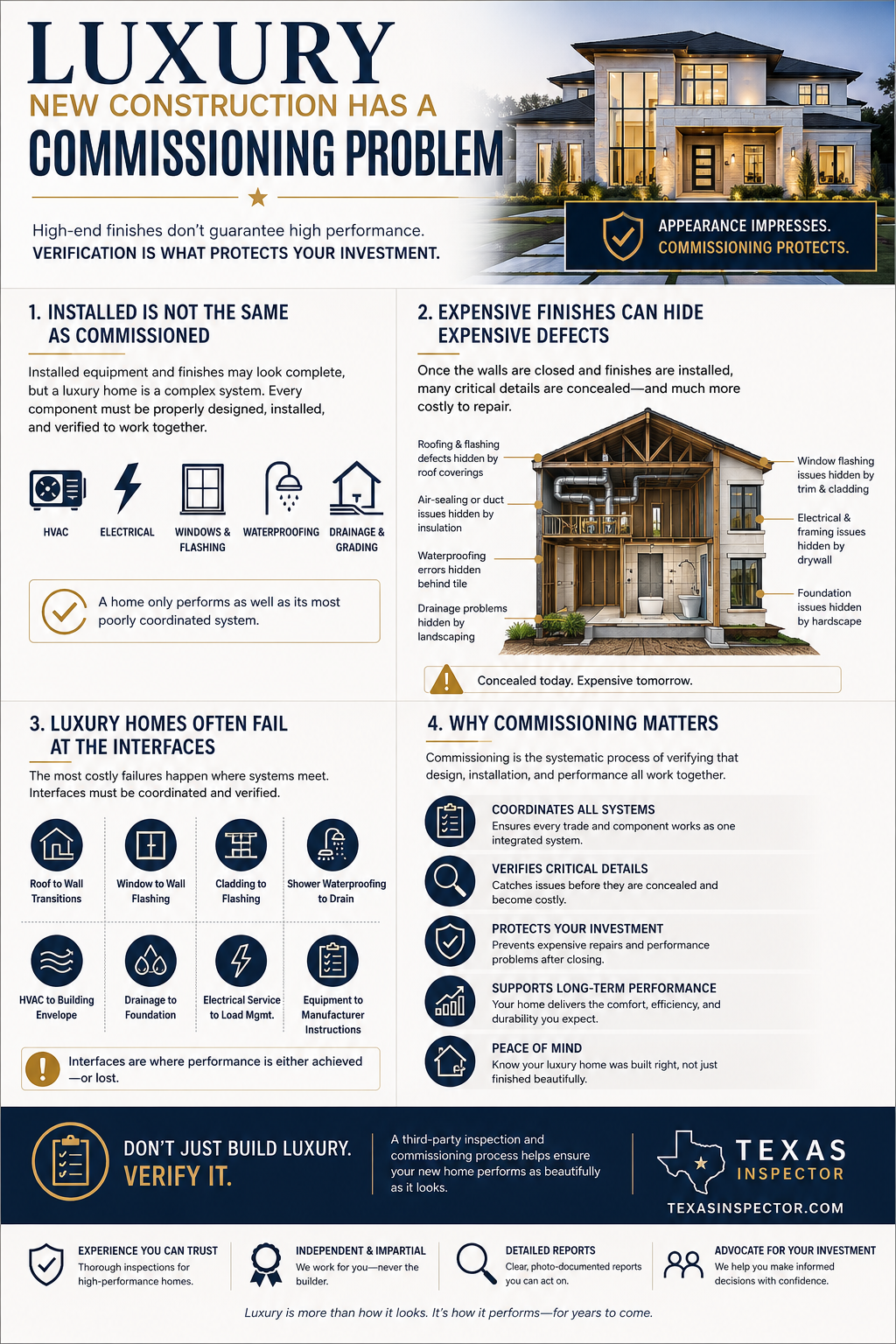
Installed Is Not the Same as Commissioned
Builders are usually very good at showing buyers installed products. The air-conditioning equipment is present. The generator is present. The smart panel is present. The spray foam is installed. The tankless water heaters are mounted. The shower tile is complete. The windows are in place. The exterior cladding looks finished. To the buyer walking through the house, those visible items can create the impression that the systems are complete and ready.
The problem is that installed does not mean verified. A complex house has to function as a coordinated assembly. HVAC equipment must be sized, ducted, drained, controlled, and commissioned correctly. Ventilation and humidity control must match the building envelope. Windows must be integrated with flashing and weather barriers. Roof penetrations must be coordinated with the roofing system. Shower waterproofing must be correct behind the tile, not merely attractive from the bathroom floor. Exterior grading and drainage must move water away from the foundation, not toward it. Electrical systems, load management, standby generators, appliance circuits, low-voltage wiring, and specialty equipment all have to work together.
This is why expensive new construction can be deceptive. The buyer sees equipment, finishes, and selections. The buyer usually does not see whether the installation details were verified before they were covered. By the time the home looks finished, many of the most important construction details are concealed behind drywall, insulation, tile, stone, brick, stucco, cabinetry, trim, or landscaping.
Expensive Finishes Can Hide Expensive Defects
The most serious construction defects are often concealed before the house looks impressive. Once drywall is installed, framing defects, mechanical conflicts, fireblocking defects, and electrical rough-in issues become harder to evaluate. Once insulation is installed, duct problems, air-sealing issues, and concealed penetrations may be hidden. Once exterior cladding is installed, flashing and weather-resistive barrier defects may no longer be visible. Once shower tile is installed, waterproofing errors are buried behind finished surfaces. Once grading, hardscape, and landscaping are complete, improper site drainage may appear intentional even if it directs water toward the structure.
This matters more, not less, in upper-end new construction. Expensive finishes can make defects harder to find and more expensive to correct. Large-format tile, custom trim, stone veneer, specialty roofing, expansive window and door systems, exterior masonry, outdoor kitchens, and complex elevations can all conceal construction details that should have been verified earlier. A buyer can walk through a beautiful house and miss the problems that will matter most after closing.
The cost of correcting these defects is also higher in a luxury home. Repairing a concealed waterproofing failure behind ordinary tile is disruptive. Repairing it behind expensive stone, custom glass, heated floors, or a steam-shower assembly can become substantially more complicated. Correcting a flashing defect after stucco, masonry, or specialty cladding is complete can require destructive work. Fixing HVAC design or ducting problems after foam insulation and finished ceilings are installed can be far more difficult than correcting them during rough construction.
Luxury Homes Often Fail at the Interfaces
In higher-end new construction, many of the most expensive failures occur at the interfaces between systems. The window itself may be expensive, but the window-to-wall flashing may be wrong. The roof covering may be upgraded, but the roof-to-wall transition may be vulnerable. The shower tile may be beautiful, but the waterproofing may be incomplete. The HVAC equipment may be high efficiency, but the duct system may be restrictive, poorly balanced, or mismatched to the house. Spray foam may improve air sealing, but it can also expose ventilation and humidity-control problems if the mechanical design was not coordinated with the tighter building envelope.
These are not cosmetic concerns. They are construction coordination problems. Luxury houses are full of transitions: roof to wall, wall to window, cladding to flashing, shower waterproofing to drain, HVAC to building envelope, drainage to foundation, electrical service to load management, and mechanical equipment to manufacturer instructions. The more complicated the house becomes, the more important those transitions become.
A common mistake is to evaluate high-end construction by the quality of the visible materials. That misses the larger issue. A well-built house is not defined only by what was selected in the design center or custom showroom. It is defined by how the assemblies were executed in the field, how the trades coordinated their work, and whether the critical details were inspected before they disappeared behind finished surfaces.
The Builder’s Process May Not Be Built for This Level of Complexity
Many builders manage construction by schedule and completion status. The trade is finished, the next trade is ready, drywall can start, cabinets can be installed, flooring can begin, and the closing date can be protected. That process moves the job forward, but it does not necessarily verify the work.
High-end construction requires more than trade completion. It requires quality control between phases. It requires documentation. It requires checking concealed work before it is covered. It requires confirming that manufacturer installation instructions were followed. It requires evaluating whether installed systems are compatible with one another. It requires catching problems while correction is still practical.
This is where construction-phase inspection is different from a final walk-through. A final walk-through often focuses on visible punch-list items: paint, trim, damaged finishes, cabinet adjustments, missing hardware, appliance installation, cleaning, and cosmetic defects. Those items matter, but they are not a substitute for evaluating the structure and systems while they are still visible. By the time a buyer reaches the final walk-through, many of the most important details have already been covered.
Common High-End New-Construction Risk Areas
Upper-end new houses often include features that demand more scrutiny than a conventional house. Multiple HVAC systems and zoning can create comfort problems if equipment, duct sizing, returns, controls, and balancing are not properly coordinated. Foam insulation and tighter envelopes can create humidity and ventilation concerns if the mechanical system was not designed and commissioned for the actual building. Large windows and doors require careful flashing, drainage, and weather-barrier integration. Complex rooflines create more vulnerable transitions. Stucco, stone, masonry, and specialty exterior systems require proper drainage planes, clearances, terminations, and water-management details.
Interior features can carry the same risks. Large showers, curbless showers, steam showers, freestanding tubs, wall-mounted fixtures, and specialty tile assemblies require careful waterproofing and plumbing coordination before finishes are installed. Generators, smart electrical panels, car chargers, outdoor kitchens, pool equipment, elevators, wine rooms, media rooms, and low-voltage systems add more opportunities for poor coordination. The more specialty systems a house has, the more important it becomes to verify not merely that they are present, but that they are properly installed and integrated.
A luxury house is not a simple house with better countertops. It is usually a more complicated structure with more ways to fail. The buyer’s risk increases when the builder treats that complexity as a collection of upgrades rather than as a set of systems requiring coordination and verification.
The Buyer Needs an Advocate During Construction
The buyer of an expensive new house should not wait until the house is complete to start asking whether it was built correctly. By that point, the builder controls much of the information, many defects are concealed, and the remaining visible issues may be mostly cosmetic. The buyer may be standing in a beautiful finished home without any practical way to evaluate the framing, flashing, rough mechanical work, waterproofing, insulation details, or concealed drainage conditions that will determine long-term performance.
Independent inspection during construction gives the buyer a different kind of protection. The purpose is not to admire finishes after completion. The purpose is to verify critical construction details before they are covered, identify coordination problems while they can still be corrected, and document defects before they become warranty disputes. That is especially important for buyers spending serious money on a new house because the cost of repair, disruption, and delay after move-in can be substantial.
A high price does not prove that the house was properly built. It may only prove that the house contains more expensive materials, more complicated systems, and more finished surfaces covering the work underneath. Luxury new construction needs more inspection, not less, because the stakes are higher and the systems are more complex.
The buyer should not assume that a premium builder, a custom design, expensive selections, or a beautiful finished product means the construction was properly coordinated during the build. The question is not whether the house looks impressive. The question is whether the construction behind the finishes was verified before it became concealed. That is the difference between buying an expensive new house and buying a well-built one.
When shopping for a new home, most buyers devote considerable attention to floor plans, countertops, flooring, appliances, and paint colors. Surprisingly few spend much time evaluating the exterior cladding, despite the fact that it represents one of the most visible, expensive, and long-lasting components of the home. That oversight is understandable. Most homebuyers assume that if a builder offers a particular exterior material, it must be roughly equivalent to the alternatives. Increasingly, however, builders are substituting concrete brick for traditional fired clay brick, and homeowners would be wise to understand the differences before assuming the two products are interchangeable.
At first glance, the distinction may seem insignificant. Both products are called brick. Both are installed by masons. Both can be manufactured in a wide variety of colors, textures, and architectural styles. To many buyers, they appear virtually identical from the curb. Yet beneath those superficial similarities lies a question that deserves serious consideration. If fired clay brick has successfully protected buildings for approximately 4,600 years, why are builders increasingly replacing it with concrete brick?
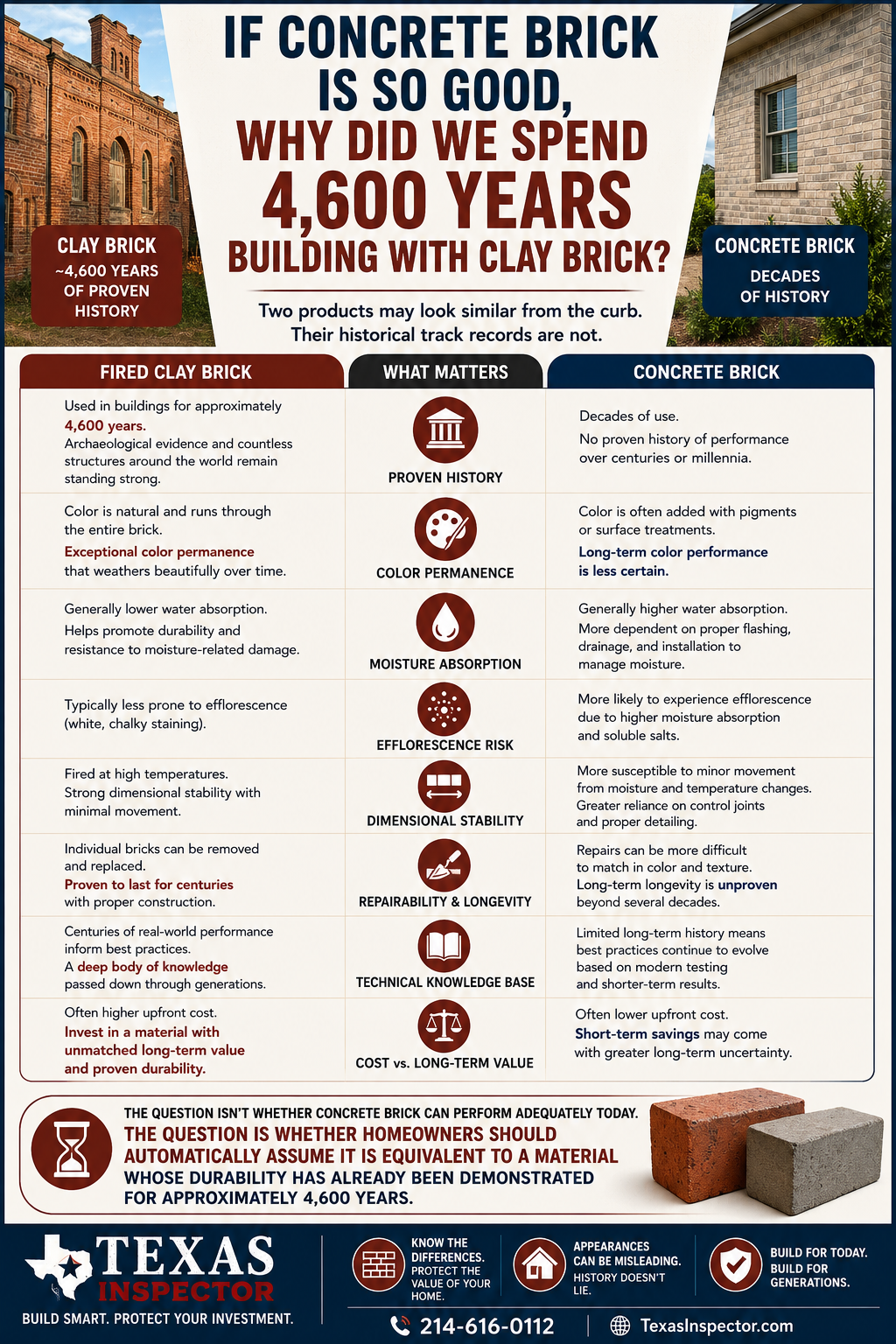
The answer is unlikely to be found in the historical performance record of the materials themselves. Fired clay brick is among the oldest and most thoroughly proven building materials known to man. Archaeologists have documented surviving fired brick masonry dating back thousands of years, and countless brick structures built centuries ago remain standing throughout Europe, Asia, the Middle East, and North America. The significance of this history is not merely that these structures are old. It is that they continue to perform their intended function despite centuries of weather exposure, temperature extremes, moisture, neglect, and the simple passage of time. Few building materials can point to a comparable body of evidence.
This matters because no laboratory test can fully duplicate what history has already demonstrated. Manufacturers frequently rely upon testing, specifications, certifications, and accelerated weathering programs to predict how materials may perform over time. Those tools are valuable, but they remain predictions. A material that has already survived hundreds or thousands of years requires no prediction. Its performance has already been demonstrated. The durability of fired clay brick is therefore not a theory, a projection, or a marketing claim. It is an established fact supported by overwhelming historical evidence.
Concrete brick does not possess a comparable record. That observation is not intended as a criticism of concrete brick, nor does it automatically mean that every concrete brick installation will perform poorly. Many concrete brick veneers will undoubtedly provide satisfactory service for decades. The problem is that decades and millennia are not the same thing. No manufacturer can point to a concrete brick wall that has successfully endured four thousand years of real-world exposure because the product has not existed long enough. Consequently, when builders or manufacturers suggest that concrete brick is equivalent to fired clay brick, homeowners are being asked to accept a proposition that cannot be supported by anything approaching the same depth of historical evidence.
The question then becomes obvious. If the substitution was not driven by a superior performance history, what motivated it? In most cases, the answer is likely economic. Concrete brick can often be manufactured and supplied at a lower cost than fired clay brick. For production builders constructing hundreds or thousands of homes each year, even modest reductions in material costs can produce substantial savings. From the builder’s perspective, the incentive is easy to understand. The more important question is whether the homeowner receives a corresponding benefit.
When evaluating exterior cladding materials, homeowners should look beyond initial appearance and consider long-term performance. Durability, moisture resistance, maintenance requirements, repairability, appearance over time, and historical performance are often far more important than the impression created on the day of closing.
One area where differences emerge is color permanence. Traditional fired clay brick generally derives its color from the clay itself and the firing process. The color extends throughout the body of the brick rather than existing merely as a surface treatment. Consequently, weathering, minor chips, and surface wear often have relatively little impact on the overall appearance. Concrete brick products frequently rely more heavily on pigments and manufactured coloration processes. While modern pigments can perform well, the long-term appearance of these systems remains dependent upon factors that have not been tested by centuries of real-world exposure.
Moisture management presents another consideration. Concrete masonry products generally exhibit higher moisture absorption characteristics than quality fired clay brick. Higher absorption does not automatically indicate poor performance, but it does increase the importance of proper flashing, drainage systems, expansion joints, and workmanship. Water intrusion has long been one of the leading causes of building deterioration, and materials that absorb greater quantities of moisture often place greater demands on the systems designed to manage that moisture.
Related to moisture absorption is the issue of efflorescence. Most homeowners have seen the white, chalky staining that sometimes appears on masonry surfaces. This condition occurs when water dissolves soluble salts within the masonry and transports them to the surface where they are deposited as the water evaporates. While efflorescence can occur on virtually any masonry material, concrete-based products generally contain greater quantities of cementitious materials and associated salts that may contribute to persistent staining issues. Homeowners faced with repeated staining problems often discover that cosmetic treatments address the symptom while leaving the underlying moisture source untouched.
Dimensional stability also deserves consideration. Fired clay brick is manufactured through a firing process that fundamentally changes the material. Concrete brick is manufactured through a curing process. Because of these differences, concrete masonry products may be more susceptible to drying shrinkage and movement-related concerns than fired clay brick. Proper design and installation can accommodate these characteristics, but they nevertheless represent another variable affecting long-term performance.
Repairability is frequently overlooked during the home-buying process. Exterior cladding should not be evaluated solely on how it looks on the day it is installed. Homeowners should consider how it will look after repairs are made years later. Because the color of fired clay brick typically extends throughout the body of the unit, repairs and replacements can often be accomplished with relatively little visual impact. Matching weathered concrete brick years after construction may prove more challenging, particularly where pigments, coatings, or proprietary coloration processes are involved.
Perhaps the most significant difference between the two materials is one that homeowners rarely consider. Fired clay brick is supported by an enormous body of accumulated knowledge developed over generations. Organizations such as the Brick Industry Association have published extensive libraries of technical guidance addressing virtually every aspect of brick masonry design and construction, including flashing details, moisture management, movement joints, mortar selection, crack control, cleaning procedures, maintenance practices, and long-term performance. These publications reflect decades of observation, testing, research, and lessons learned from real-world installations.
Concrete brick products are, of course, governed by applicable ASTM product standards and masonry construction standards published by The Masonry Society. However, the body of product-specific guidance available for concrete brick veneer is considerably smaller than the vast library that has developed around traditional clay brick masonry. This distinction is important because technical standards and guidance documents are often written in response to actual field experience. The existence of an extensive body of brick-specific knowledge reflects generations of study and refinement. Simply put, there are relatively few unanswered questions about how fired clay brick behaves because the industry has been studying it for centuries.
For homeowners, this difference should not be underestimated. When selecting an exterior cladding system, they are not merely choosing a material. They are also choosing the body of knowledge, research, technical guidance, and field experience that supports that material. In the case of fired clay brick, that support system is extraordinarily deep. It is backed not only by thousands of years of successful performance, but also by an extensive network of industry publications, standards, technical notes, and practical experience accumulated over generations.
None of this means that concrete brick cannot provide satisfactory service. It may eventually establish an impressive performance history of its own. The issue is not whether concrete brick can function adequately today. The issue is whether homeowners should automatically assume that it is equivalent to a material whose durability has already been demonstrated over more than four millennia. Such an assumption demands evidence, and evidence is precisely what fired clay brick possesses in overwhelming abundance.
Ultimately, the decision belongs to the homeowner. Builders are free to select the materials they prefer, and manufacturers are free to market their products. Homeowners, however, should approach exterior cladding decisions with the same scrutiny they would apply to roofing, plumbing, electrical systems, or structural components. Exterior walls are not merely decoration. They represent a long-term investment in durability, appearance, maintenance, and protection from the elements.
Before accepting claims that all brick products are essentially the same, homeowners should ask a simple question. If fired clay brick has already demonstrated its durability for approximately 4,600 years and is supported by one of the most extensive bodies of technical knowledge in the construction industry, what compelling evidence exists that a newer and often less expensive substitute will perform equally well over the long term? That question deserves an answer before the purchase contract is signed, not decades later when the consequences become apparent.


