
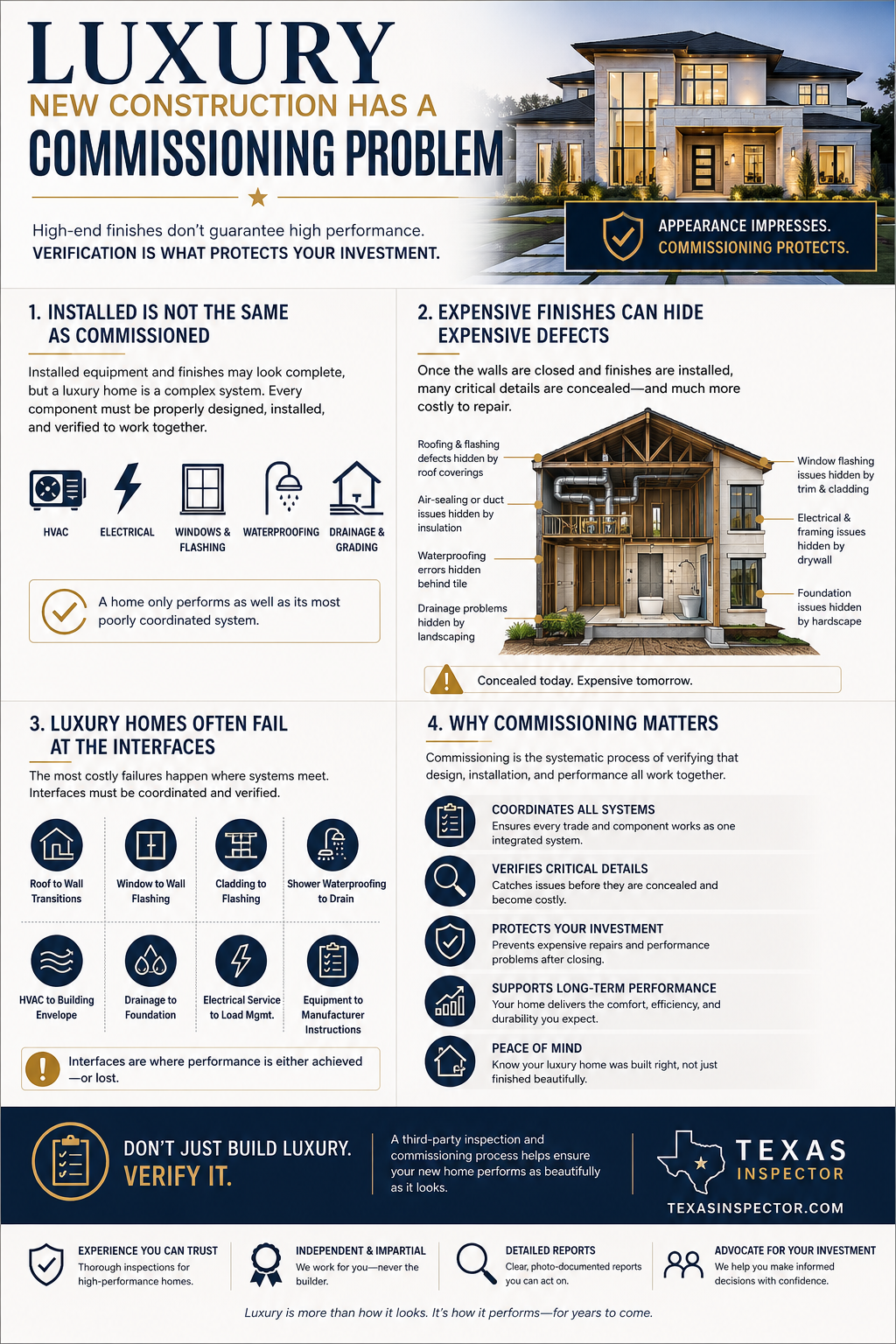
Many buyers assume that a high-end new house carries less construction risk than a lower-priced production house. That assumption is understandable. Expensive finishes, custom features, upgraded appliances, foam insulation, multiple HVAC systems, large window assemblies, smart controls, specialty lighting, outdoor living areas, and designer selections all create the appearance of quality. The finished product may look impressive, but appearance is not the same as performance.
A luxury new house is not automatically better built because it costs more. In many cases, it is harder to build correctly because it contains more systems, more trades, more penetrations, more manufacturer-specific installation requirements, and more places where one contractor’s work affects another contractor’s work. The central risk is not whether each feature was purchased or installed. The real question is whether the house was coordinated, inspected, and verified as a complete system during construction.
That is where many expensive new homes fail. They are not always failing because the materials are cheap or the design is basic. They often fail because complicated assemblies were treated as individual installed items instead of parts of an integrated structure. A high-end house can contain expensive components and still suffer from poor construction coordination.
Installed Is Not the Same as Commissioned
Builders are usually very good at showing buyers installed products. The air-conditioning equipment is present. The generator is present. The smart panel is present. The spray foam is installed. The tankless water heaters are mounted. The shower tile is complete. The windows are in place. The exterior cladding looks finished. To the buyer walking through the house, those visible items can create the impression that the systems are complete and ready.
The problem is that installed does not mean verified. A complex house has to function as a coordinated assembly. HVAC equipment must be sized, ducted, drained, controlled, and commissioned correctly. Ventilation and humidity control must match the building envelope. Windows must be integrated with flashing and weather barriers. Roof penetrations must be coordinated with the roofing system. Shower waterproofing must be correct behind the tile, not merely attractive from the bathroom floor. Exterior grading and drainage must move water away from the foundation, not toward it. Electrical systems, load management, standby generators, appliance circuits, low-voltage wiring, and specialty equipment all have to work together.
This is why expensive new construction can be deceptive. The buyer sees equipment, finishes, and selections. The buyer usually does not see whether the installation details were verified before they were covered. By the time the home looks finished, many of the most important construction details are concealed behind drywall, insulation, tile, stone, brick, stucco, cabinetry, trim, or landscaping.
Expensive Finishes Can Hide Expensive Defects
The most serious construction defects are often concealed before the house looks impressive. Once drywall is installed, framing defects, mechanical conflicts, fireblocking defects, and electrical rough-in issues become harder to evaluate. Once insulation is installed, duct problems, air-sealing issues, and concealed penetrations may be hidden. Once exterior cladding is installed, flashing and weather-resistive barrier defects may no longer be visible. Once shower tile is installed, waterproofing errors are buried behind finished surfaces. Once grading, hardscape, and landscaping are complete, improper site drainage may appear intentional even if it directs water toward the structure.
This matters more, not less, in upper-end new construction. Expensive finishes can make defects harder to find and more expensive to correct. Large-format tile, custom trim, stone veneer, specialty roofing, expansive window and door systems, exterior masonry, outdoor kitchens, and complex elevations can all conceal construction details that should have been verified earlier. A buyer can walk through a beautiful house and miss the problems that will matter most after closing.
The cost of correcting these defects is also higher in a luxury home. Repairing a concealed waterproofing failure behind ordinary tile is disruptive. Repairing it behind expensive stone, custom glass, heated floors, or a steam-shower assembly can become substantially more complicated. Correcting a flashing defect after stucco, masonry, or specialty cladding is complete can require destructive work. Fixing HVAC design or ducting problems after foam insulation and finished ceilings are installed can be far more difficult than correcting them during rough construction.
Luxury Homes Often Fail at the Interfaces
In higher-end new construction, many of the most expensive failures occur at the interfaces between systems. The window itself may be expensive, but the window-to-wall flashing may be wrong. The roof covering may be upgraded, but the roof-to-wall transition may be vulnerable. The shower tile may be beautiful, but the waterproofing may be incomplete. The HVAC equipment may be high efficiency, but the duct system may be restrictive, poorly balanced, or mismatched to the house. Spray foam may improve air sealing, but it can also expose ventilation and humidity-control problems if the mechanical design was not coordinated with the tighter building envelope.
These are not cosmetic concerns. They are construction coordination problems. Luxury houses are full of transitions: roof to wall, wall to window, cladding to flashing, shower waterproofing to drain, HVAC to building envelope, drainage to foundation, electrical service to load management, and mechanical equipment to manufacturer instructions. The more complicated the house becomes, the more important those transitions become.
A common mistake is to evaluate high-end construction by the quality of the visible materials. That misses the larger issue. A well-built house is not defined only by what was selected in the design center or custom showroom. It is defined by how the assemblies were executed in the field, how the trades coordinated their work, and whether the critical details were inspected before they disappeared behind finished surfaces.
The Builder’s Process May Not Be Built for This Level of Complexity
Many builders manage construction by schedule and completion status. The trade is finished, the next trade is ready, drywall can start, cabinets can be installed, flooring can begin, and the closing date can be protected. That process moves the job forward, but it does not necessarily verify the work.
High-end construction requires more than trade completion. It requires quality control between phases. It requires documentation. It requires checking concealed work before it is covered. It requires confirming that manufacturer installation instructions were followed. It requires evaluating whether installed systems are compatible with one another. It requires catching problems while correction is still practical.
This is where construction-phase inspection is different from a final walk-through. A final walk-through often focuses on visible punch-list items: paint, trim, damaged finishes, cabinet adjustments, missing hardware, appliance installation, cleaning, and cosmetic defects. Those items matter, but they are not a substitute for evaluating the structure and systems while they are still visible. By the time a buyer reaches the final walk-through, many of the most important details have already been covered.
Common High-End New-Construction Risk Areas
Upper-end new houses often include features that demand more scrutiny than a conventional house. Multiple HVAC systems and zoning can create comfort problems if equipment, duct sizing, returns, controls, and balancing are not properly coordinated. Foam insulation and tighter envelopes can create humidity and ventilation concerns if the mechanical system was not designed and commissioned for the actual building. Large windows and doors require careful flashing, drainage, and weather-barrier integration. Complex rooflines create more vulnerable transitions. Stucco, stone, masonry, and specialty exterior systems require proper drainage planes, clearances, terminations, and water-management details.
Interior features can carry the same risks. Large showers, curbless showers, steam showers, freestanding tubs, wall-mounted fixtures, and specialty tile assemblies require careful waterproofing and plumbing coordination before finishes are installed. Generators, smart electrical panels, car chargers, outdoor kitchens, pool equipment, elevators, wine rooms, media rooms, and low-voltage systems add more opportunities for poor coordination. The more specialty systems a house has, the more important it becomes to verify not merely that they are present, but that they are properly installed and integrated.
A luxury house is not a simple house with better countertops. It is usually a more complicated structure with more ways to fail. The buyer’s risk increases when the builder treats that complexity as a collection of upgrades rather than as a set of systems requiring coordination and verification.
The Buyer Needs an Advocate During Construction
The buyer of an expensive new house should not wait until the house is complete to start asking whether it was built correctly. By that point, the builder controls much of the information, many defects are concealed, and the remaining visible issues may be mostly cosmetic. The buyer may be standing in a beautiful finished home without any practical way to evaluate the framing, flashing, rough mechanical work, waterproofing, insulation details, or concealed drainage conditions that will determine long-term performance.
Independent inspection during construction gives the buyer a different kind of protection. The purpose is not to admire finishes after completion. The purpose is to verify critical construction details before they are covered, identify coordination problems while they can still be corrected, and document defects before they become warranty disputes. That is especially important for buyers spending serious money on a new house because the cost of repair, disruption, and delay after move-in can be substantial.
A high price does not prove that the house was properly built. It may only prove that the house contains more expensive materials, more complicated systems, and more finished surfaces covering the work underneath. Luxury new construction needs more inspection, not less, because the stakes are higher and the systems are more complex.
The buyer should not assume that a premium builder, a custom design, expensive selections, or a beautiful finished product means the construction was properly coordinated during the build. The question is not whether the house looks impressive. The question is whether the construction behind the finishes was verified before it became concealed. That is the difference between buying an expensive new house and buying a well-built one.


