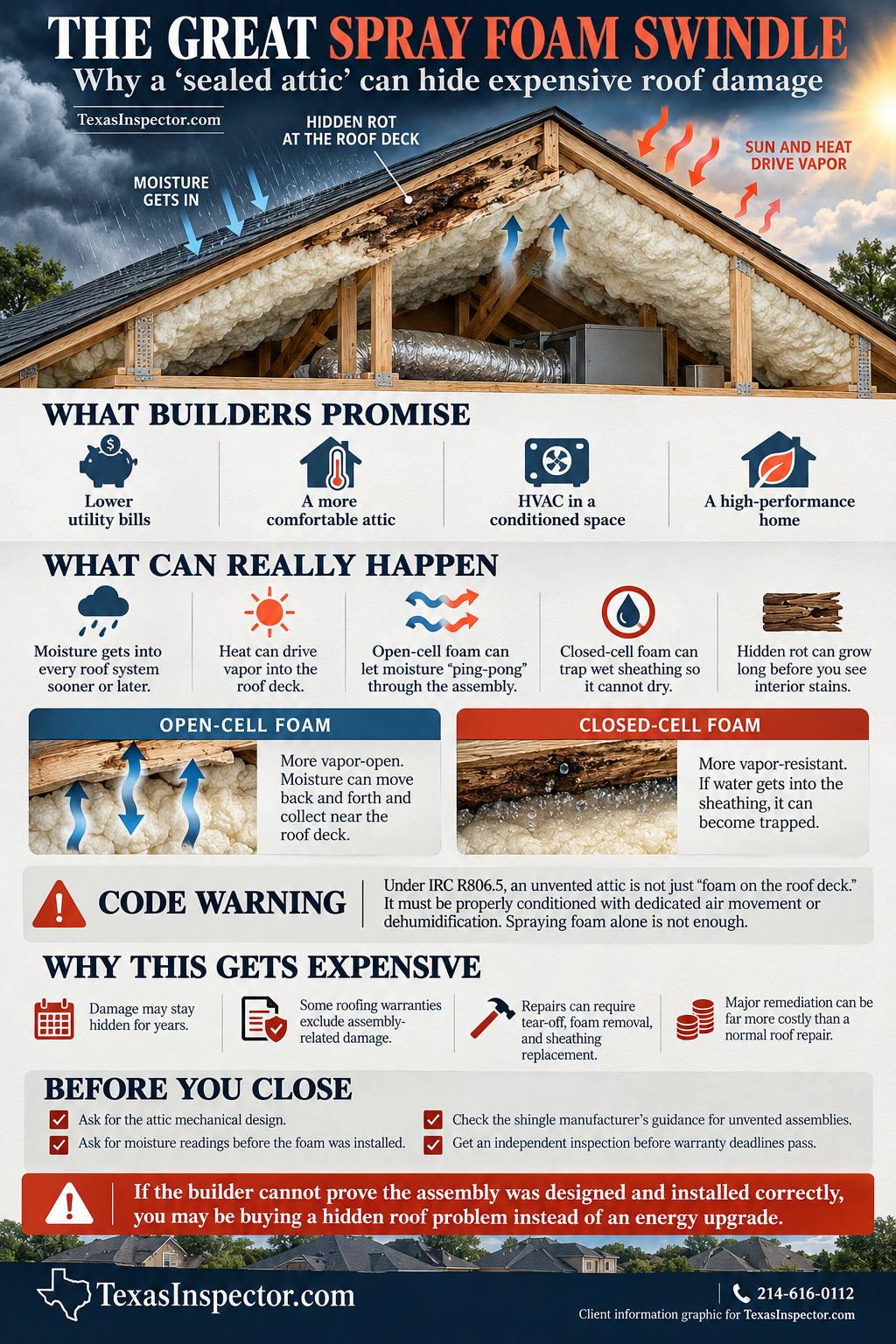
Walk into any production builder’s sales trailer in Frisco, Celina, or Prosper, and you will get the pitch before your boots even hit the vinyl plank: the sales agent in the branded polo will look you dead in the eye and brag about their “energy-engineered, sealed attic.” They will tell you that your HVAC system will live in an air-conditioned paradise, your electric bills will plummet by 40%, and you can store your antique furniture up there in 74-degree comfort. They will tap their finger on an Energy Star plaque like it is a certificate of divine infallibility.
What they will not show you is the forensic aftermath playing out across North Texas subdivisions: millions of square feet of cheap 7/16-inch oriented strand board (OSB) sheathing entombed beneath low-bid polyurethane, quietly dissolving into structural mush.
This is not a theoretical scenario. It is a documented building science crisis driven by code evasion, legislative liability slashing, and volume builders who slap high-performance chemical assemblies onto un-cured framing without understanding basic thermodynamics.
- The Physics of “Ping-Pong Water” and Solar Vapor Drive
Wood does not rot simply because it gets wet; wood rots because it is prevented from drying. For more than a century, traditional residential roofing survived brutal Texas summers through convective airflow. Outdoor air entered the continuous soffit vents, washed across the underside of the roof sheathing, picked up moisture, and exited the ridge. If an asphalt shingle failed, a valley flashing leaked, or a torrential May downpour forced wind-driven rain under the felt, the underside of the deck remained open to air. It dried out.
When a builder sprays foam directly to the underside of the roof deck, they eliminate that drying mechanism. They create an unvented roof assembly. In doing so, they trigger physical dynamics that most tract-home project managers cannot begin to comprehend.
The Solar Heat Engine
In the Dallas–Fort Worth metroplex, dark composite shingles routinely reach surface temperatures between 150°F and 170°F under July solar radiation. When moisture inevitably enters that roof system—via rain, morning dew, or internal atmospheric humidity—that thermal energy acts as a pump. It creates an inward vapor drive, pushing water vapor out of the shingles and underlayment directly into and through the wood sheathing.
The Open-Cell Trap: “Ping-Pong Water”
Volume builders in Climate Zone 3 overwhelmingly install open-cell spray polyurethane foam (ocSPF) because it is roughly half the material cost of closed-cell foam. Open-cell foam is a terrible vapor retarder; it has an open-sponge vapor permeance typically ranging from 15 to over 30 perms per inch.
Dr. Joseph Lstiburek, Ph.D., P.Eng., the principal of Building Science Corporation and widely regarded as the dean of North American building forensics, documented this exact mechanism in Building Science Insight 016: “Ping Pong Water and The Chemical Engineer”, as well as in BSI-077: “Cool Hand Luke Meets Attics”.
Lstiburek points to the fundamental laws of hygric buoyancy: water vapor has a molecular weight of 18, compared to dry air with an average molecular weight of 29. Moist air is lighter than dry air, meaning water vapor naturally rises to the apex of the roof. As Lstiburek demonstrates, during the heat of the day, solar radiation drives moisture out of the exterior sheathing through the vapor-permeable open-cell foam into the attic air. At night, when the roof cools down, the vapor drive reverses: that humid attic air migrates right back up to the cold roof deck, where it condenses against the wood:
“The moisture moves back and forth—ping ponging—between the roof sheathing and the attic space air… If we don’t do something about this—the moisture will hang out and cause trouble especially if we have low-density open-cell spray polyurethane (SPF) as our insulation system… You end up with sheathing rot and mold at the ridge.”
— Dr. Joseph Lstiburek, Building Science Corporation (BSI-077)
The Closed-Cell Dam
When builders use closed-cell spray foam (ccSPF) directly against OSB without exterior rigid insulation, they create the opposite trap: an impenetrable Class II vapor retarder (less than 1.0 perm at two inches) that adheres to the underside of the wood with incredible tensile strength.
If a roof penetration, nail pop, valley leak, or hail impact compromises the shingle surface, water enters the wood. The closed-cell foam prevents that water from ever drying toward the interior. The synthetic roof underlayment and asphalt shingles prevent it from drying toward the exterior. The OSB sits trapped in a zero-permeance sandwich, baking at 140°F. The wood resins hydrolyze, the strands separate, and the sheathing degrades into wet wood chips without a single drop of water ever dripping onto the attic floor to alert the homeowner.
- Code Evasion: IRC Section R806.5 and the Missing Mechanicals
Volume builders love to tell buyers that their homes are built “to code.” Yet the vast majority of spray-foamed homes constructed across North Texas violate the requirements established in the model building codes adopted by their respective municipalities.
Under the International Residential Code (IRC), Section R806.5 (Unvented attic and unvented enclosed rafter assemblies), an unvented attic is strictly regulated. The code does not simply state, “Shoot some foam on the wood and walk away.” It mandates specific, non-negotiable conditioning requirements:
- Mandatory Attic Conditioning:
Under IRC Section R806.5, unvented attics must be actively conditioned spaces. The code requires that the assembly meet one of several specific mechanical pathways:
-
- Supplied conditioned air delivered directly to the attic space at a minimum rate of 50 cubic feet per minute (CFM) per 1,000 square feet of ceiling area, with a return air path or duct back to the living space; or
-
- Continuous mechanical dehumidification dedicated to the unvented attic space capable of maintaining relative humidity at or below safe structural thresholds.
- The Field Reality:
Go into a volume build in a DFW master-planned community. Look up at the spray-foamed rafter bays. Now look for the dedicated 50 CFM supply run and return plenum. Look for the whole-house commercial-grade dehumidifier (such as a Santa Fe or Ultra-Aire unit).
You will not find them.
To the production builder, an “unvented attic” simply means they got to fire the ventilation subcontractor, delete the soffit baffles, delete the ridge vent cuts, pocket the labor savings, and leave the attic dead-air space without mechanical moisture removal. The high-tonnage variable-speed heat pump installed in that attic short-cycles, the humidity spikes to 75% in August, and the open-cell foam begins absorbing atmospheric vapor like a sponge.
- Substrate Moisture Limits (The Dry-In Lie):
Both the APA – The Engineered Wood Association and professional spray foam manufacturer application guidelines mandate that wood sheathing moisture content (MC) must be below 18% to 19% prior to any chemical application.
In Texas, production framing schedules do not wait for physics. A spring squall dumps four inches of rain over an exposed framing package in McKinney on a Tuesday afternoon. The OSB swells, edges pop, and the core moisture content sits at 24% to 28%. By Thursday morning, the chemical subcontractor’s rig is idling on the street. The applicators pull their hoses into the attic and spray expanding isocyanate and resin directly over saturated OSB. They seal gallons of free water directly inside the cellular matrix of the wood, locking in wood-rot fungi (Gloeophyllum trabeum) that thrive the moment attic temperatures cross 70°F.
- The Manufacturer Technical Bulletins: The Exclusion Smokescreen
When a homeowner notices that their roof deck is deflecting, shingles are buckling, or ridge lines are sagging like a swayback horse, their first instinct is to file a claim against the shingle manufacturer. That is when they run straight into the fine print of the roofing industry’s technical advisory bulletins.
The major shingle manufacturers long ago drafted specific legal barriers to insulate themselves from spray foam deck failures.
Consider GAF Technical Advisory Bulletin No. TAB-R-135, revised February 1, 2021, titled Under Deck Sprayed-In-Place Foam Insulation:
“Using sprayed-in-place insulation… May lead to condensation problems, mold growth, deck deterioration, damage of fiberglass asphalt shingles, and structural damage when not installed according to the manufacturer’s instructions and building code requirements…
Will Sprayed-In-Place Foam Insulation Void My Warranty?
No, the GAF Shingle Limited Warranty against manufacturing defects will remain in effect. However, any damage to the shingles attributable to using sprayed-in-place insulation directly applied to the roof deck or lack of ventilation is excluded from GAF’s responsibility under the terms of our Limited Warranty.”
— GAF Technical Services, Bulletin TAB-R-135
Read that language carefully. It is a corporate masterpiece. The manufacturer does not issue a blanket voiding of the warranty—because doing so would lose them tract-builder market share. Instead, they keep the warranty technically “in effect” for factory material defects (like missing granule surfacing), while specifically carving out any failure caused by the assembly itself.
When an independent forensic investigator cuts a core sample and discovers blistering asphalt, brittle fiberglass mats, or rotted sheathing caused by inward moisture accumulation or lack of ventilation, the shingle manufacturer denies the claim under TAB-R-135 with prejudice.
Owens Corning and CertainTeed issue similar bulletins: they will warrant their shingles against manufacturing defects over unvented decks, but the moment the deck rots or thermal load cooks the asphalt binder due to assembly design, the claim is kicked back to the general contractor.
- The Texas Legal Trap: HB 2024, § 16.009, and Chapter 27 RCLA
The reason Texas builders continue to install these non-code-compliant, high-risk roof assemblies with complete abandon comes down to a calculated legal balance sheet. The statutory cards in Texas are stacked against the buyer.
The 2023 Repose Ambush: Texas Civil Practice & Remedies Code § 16.009
Historically, Texas homeowners had a 10-year Statute of Repose under Texas Civil Practice and Remedies Code § 16.009 to discover and bring suit for latent construction defects. Latent defects are failures you cannot see without destructive testing—such as water trapped behind brick veneer or rot concealed behind expanding foam.
During the 88th Texas Legislative Session in 2023, the builder lobby secured passage of House Bill 2024 (HB 2024), which amended § 16.009. The statute slashed the repose period from 10 years down to 6 years for any builder that provides a standard written warranty package (1 year for workmanship and materials, 2 years for plumbing, electrical, and HVAC delivery systems, and 6 years for structural components).
This creates an insurmountable trap for the homeowner:
- Years 1–2: The home operates under the builder’s cosmetic warranty. The foam is fresh. The OSB is slowly absorbing trapped condensation, but the paint inside looks pristine.
- Years 3–5: The fungal decay accelerates. The strand-board glues degrade, and moisture cycles rot the wood. Because closed- or open-cell foam adheres directly to the bottom of the OSB, no water leaks through the drywall ceiling. The homeowner has no idea their roof is decomposing.
- Year 6: The roof deck turns to sponge. Shingles lose nail withdrawal resistance.
- Day 2,191 (Year 6 + 1 day): The Texas Statute of Repose slams shut. Under § 16.009, any claim against the builder for defective construction is barred forever, regardless of when the homeowner discovered the damage.
The Chapter 27 RCLA Runaround
Even if a homeowner discovers the rot within year 4 or 5, they must navigate the Texas Residential Construction Liability Act (RCLA), codified in Texas Property Code Chapter 27.
Under Chapter 27, the homeowner cannot simply file a lawsuit. They must issue a formal, detailed written notice by certified mail specifying the structural failure. The builder then has:
- 30 days to demand a physical inspection of the property;
- 45 days after the inspection to make a settlement offer or an offer of repair.
Under standard Texas production builder contracts, that process is chained to mandatory, binding arbitration clauses administered by private forums like the American Arbitration Association (AAA). The builder’s defense counsel uses the pre-suit inspection and arbitration discovery to run out the clock, burying the homeowner in engineering expenses, filing fees, and arbitration deposits that exceed the immediate cash value of a partial roof patch.
- The Forensic Reality: The $60,000 Tear-Off
When an inspector or structural engineer finally flags an unvented deck failure, the financial consequences are catastrophic compared to standard roofing repairs.
Loss of Diaphragm Shear
Oriented strand board relies on its core density and resin binding to provide lateral bracing and shear strength to the home’s engineered roof trusses. When sustained wood moisture content exceeds 20%, wood decay fungi actively digest the hemicellulose and cellulose structure. The panels swell, the internal phenol-formaldehyde or polymeric MDI (methylene diphenyl diisocyanate) adhesive fails, and the OSB delaminates.
When you pull a shingle off a decayed spray-foam roof, the roofing nails do not pull out; they lift straight through the rotted wood with zero withdrawal resistance. The structural diaphragm of the roof is gone.
Why You Cannot “Just Scrape It Off”
In a traditional vented attic, replacing water-damaged sheathing is straightforward: an exterior crew strips the shingles, un-nails the compromised 4×8 OSB sheets, drops in new panels, and re-shingles.
With direct-to-deck spray foam, that process is impossible:
- The polyurethane foam acts as a structural glue, bonding the underside of the OSB directly to the top chords of the roof trusses.
- You cannot easily peel the sheathing off without destroying the lumber chords of the pre-engineered trusses beneath it.
- Open-cell foam retains a gummy, fractured adhesive layer; closed-cell foam retains a hard plastic bond that requires mechanical grinding or high-pressure dry-ice blasting to remove.
If the moisture has migrated from the OSB into the framing lumber, the top chords of the trusses themselves rot out. Because altering a pre-engineered truss requires stamped engineering repairs from the original truss manufacturer—or complete structural truss replacement—the entire roof system must often be removed by crane.
The remediation cost for a 3,500-square-foot luxury suburban roof with failed spray foam routinely exceeds $50,000 to $80,000, including complete shingle tear-off, sheathing removal, truss sistering, chemical foam abatement, whole-house scaffolding, and complete re-framing.
The Pre-Closing Defense Checklist
If you are currently under contract for a new-construction home in Texas featuring a spray-foam unvented attic assembly, refuse to rely on verbal assurances from the superintendent. Demand hard, verifiable, written documentation before you sign closing documents:
- Verify IRC R806.5 Mechanical Compliance: Demand the mechanical HVAC design plans showing the dedicated, duct-connected attic supply (minimum 50 CFM per 1,000 sq. ft.) and return path, or the standalone, ducted dehumidification system designed specifically for the attic volume. If there is no air movement in that attic, it is non-compliant.
- Demand the Substrate Moisture Log: Request the written moisture meter readings taken by the insulation contractor immediately prior to foam application. If the wood was never metered, or if the readings exceeded 18% MC, that foam was shot over wet wood.
- Check Shingle Specifications: Check the exact manufacturer of the installed shingles (GAF, CertainTeed, Tamko, Owens Corning) against their current technical advisory bulletins for unvented roof decks. Ensure the builder filed the appropriate unvented system installation specifications to maintain manufacturing defect protection.
- Commission an Independent Destructive/Core Inspection: Hire an ICC-certified, independent residential code inspector to examine the ridge line, gable terminations, and hip transitions with a calibrated non-invasive moisture meter, thermal imaging, and physical test probes through the foam to verify core sheathing integrity before your one-year builder warranty expires.
Once the foam cures, the builder’s liability starts ticking down toward the six-year statutory limit. If you allow them to seal up the deck without verifying the building science, you are not buying an energy-efficient home. You are buying a countdown clock on your own roof structure.
If you actually believe the shiny marketing brochures handed out in pristine model homes, your new Texas subdivision is a sanctuary of precision engineering and artisanal craftsmanship. If you step into your attic or look behind your outdoor condensing unit with half a brain, however, you will quickly realize that corporate builders view modern building codes not as life-safety minimums, but as personal financial slights. Nowhere is this corporate spite more hazardous to your health and bank account than in how high-volume builders are botching the mandatory federal transition from legacy R-410A to low-GWP A2L refrigerants like R-454B and R-32.
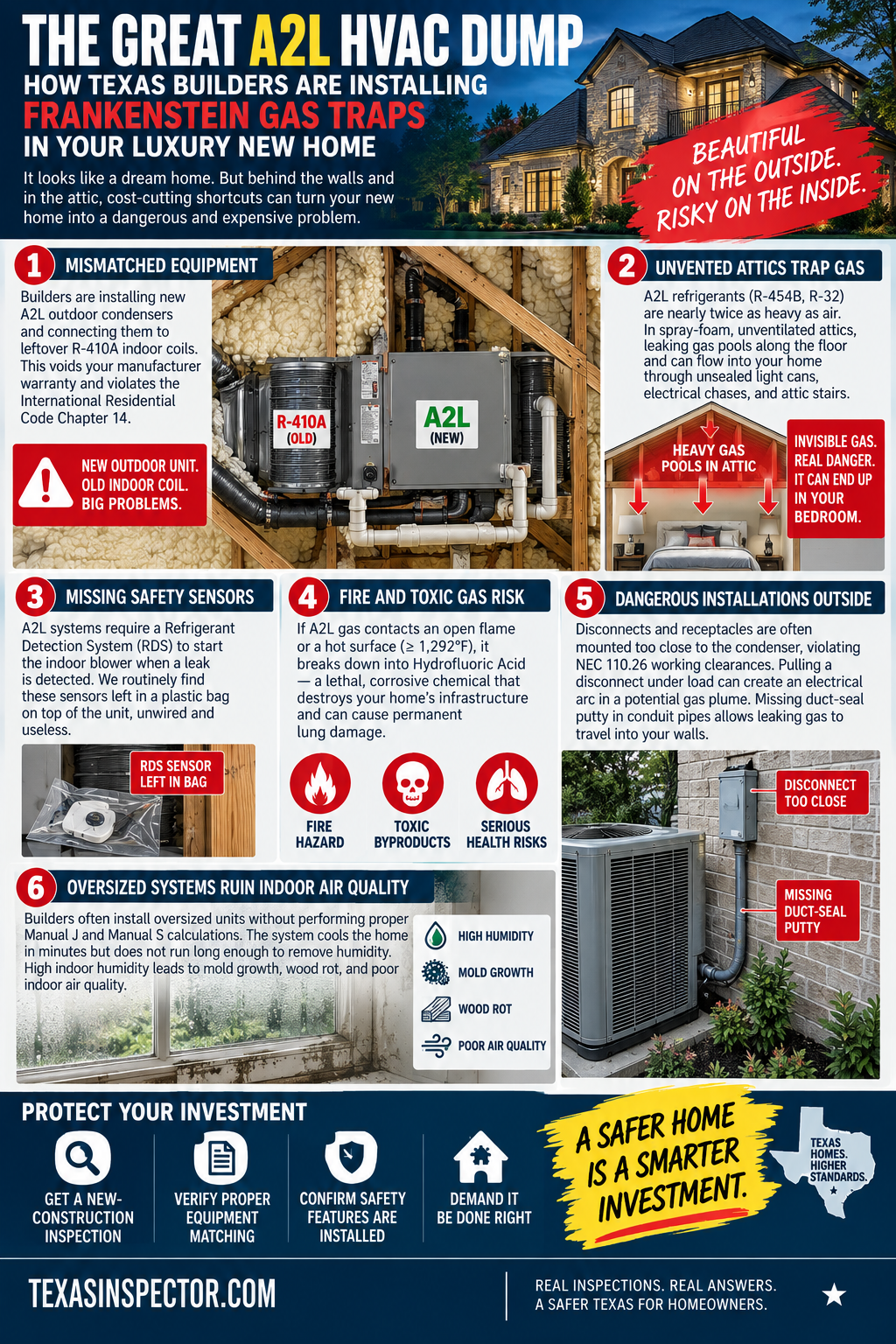
Federal bureaucrats envisioned the shift to A2L refrigerants as a clean step toward environmental salvation. Texas volume builders and the bargain-bin HVAC subcontractors they hired off a job board saw it as a terrifying, fire-sale panic over obsolete equipment. To avoid taking a financial loss on outdated inventory, builders across the state have turned half-million-dollar houses into glorified parts dumps. We routinely document Frankenstein mechanical setups where a brand-new A2L outdoor condenser is recklessly wired to a leftover, completely incompatible R-410A indoor coil hidden up in the attic. This penny-pinching trick voids your equipment warranty before the drywall dust settles, violates International Residential Code Chapter 14, and leaves you paying off an uncertified appliance for the duration of your thirty-year mortgage.
What makes this liquidation game truly special is the physical behavior of these new A2L gases. The industry delicately refers to them as mildly flammable, but in the real world, they are nearly twice as heavy as air, behaving almost identically to leaking propane. In modern Texas builds, where sales reps love to brag in their model homes about spray-foam-encapsulated, unventilated attics, a leaking coil becomes an invisible trap. The heavy gas cannot passively escape through non-existent soffit vents; it pools along the attic deck in concentrated, suffocating lakes. When lazy construction crews inevitably skip basic energy-code air-sealing around ceiling penetrations, that heavy gas follows gravity directly into your home, cascading through unsealed recessed light cans and wire chases to quietly fill your master bedroom while you sleep.
Building safety codes mandate that these units feature factory-installed Refrigerant Detection Systems designed to forcibly kick on the main indoor blower the second a leak occurs, whipping the floor-level gas up and diluting it throughout the entire house. Yet, during our inspections, we routinely find these life-saving sensors sitting in a clear plastic bag on top of the air handler, completely unwired because reading an installation manual is apparently asking too much. This laziness turns downright lethal when the builder crams that unvented air handler into an attic right next to an atmospheric gas water heater with an open flame. If leaking A2L gas contacts an open pilot light or a hot surface exceeding 1,292 degrees Fahrenheit, it does not just catch fire; it thermally decomposes into Hydrofluoric Acid, a hyper-corrosive chemical weapon that destroys your home’s infrastructure and causes permanent lung damage.
Step outside into the yard, and the careless hazards continue. Incompetent electrical crews regularly slap unsealed disconnect boxes and standard wall receptacles inches away from the outdoor condenser’s high-pressure service ports, violating National Electrical Code Section 110.26 working clearances and UL safety rules. Pulling an electrical plug or throwing an unsealed disconnect switch under load creates an electrical arc directly inside the potential gas plume of an outdoor leak, creating an instant flash-fire hazard. Worse yet, because lazy installers routinely forget to put duct-seal putty inside the conduit pipes, heavy leaking gas uses the hollow electrical pipe as a private highway, draining heavy refrigerant directly into your wall cavity.
Even if your builder accidentally manages not to set your house on fire or poison the air, they will almost certainly ruin your indoor humidity. Calculating proper HVAC sizing using region-specific Manual J and Manual S engineering load math is treated as a mythical fairytale inside model home sales offices. Subcontractors simply throw in oversized units to avoid hot-call complaints. An oversized A2L system cools your home in eight lightning-fast minutes and shuts off before extracting a single drop of moisture from the air. Your thermostat reads seventy degrees, but your indoor relative humidity quietly spikes past sixty-five percent. Within months, your luxury home turns into an artisanal mold farm where luxury vinyl floors buckle, ductwork sweats through the drywall, and black mold colonizes the dark cavities behind your baseboards.
Do not rely on municipal inspectors who spend four minutes on site, and certainly do not trust the builder’s smooth-talking warranty representative who tells you that moldy baseboards and sweating vents are simply part of a new home settling. Before you sign closing papers or let your 11-month builder warranty expire, insist on an independent inspection by an ICC R5 inspector. An ICC R5 Combination Residential Inspector possesses certified, multi-discipline mastery across building structural, mechanical, electrical, and plumbing codes. They are uniquely qualified to audit AHRI component matching, detect unsealed electrical arcing hazards within three feet of fuel sources, verify active RDS safety interlocks, and use thermal imaging to expose the latent envelope failures builders try to hide. Your health, your family’s safety, and your life savings depend on catching these Frankenstein systems before the builder skips town with your money.
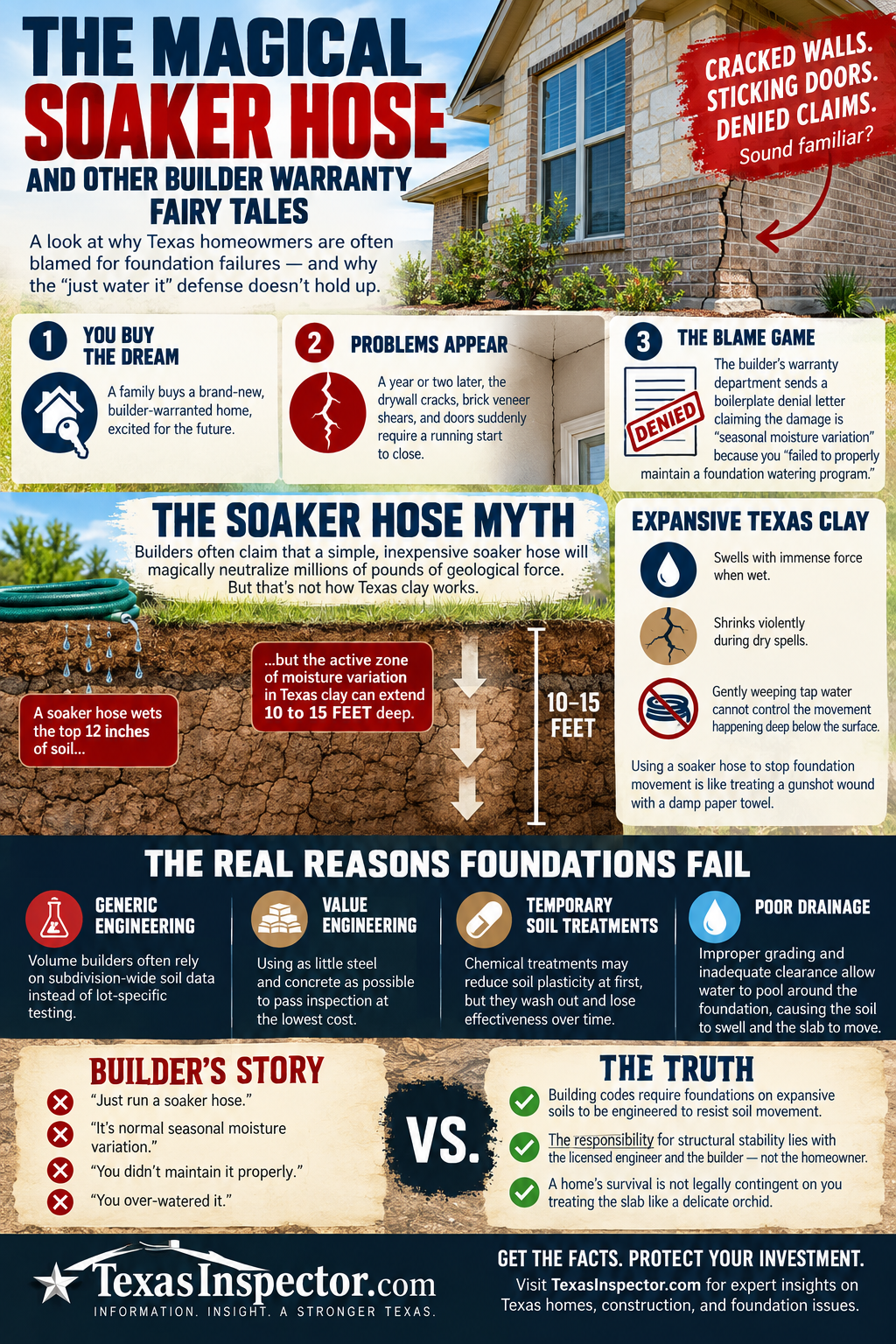
It is a predictably tragic comedy that plays out thousands of times across Texas the moment the rain stops. A family signs their life away for a brand-new, supposedly builder-warranted home, only to watch in horror a year or two later as their largest financial asset tears itself apart. The drywall fractures at the window corners, the brick veneer shears, and interior doors suddenly require a running start to close. Naturally, the naive buyer contacts the builder’s warranty department, expecting an actual structural repair. Instead, they receive a legally sanitized, boilerplate denial letter—likely pulled from a stack they keep next to the coffee machine—explaining that the massive edge heave destroying their house is merely “seasonal moisture variation.” The claim is denied, of course, because the occupant “failed to properly maintain a foundation watering program.” Ah, yes. The corporate builder’s favorite parlor trick: pinning the blame for a criminally thin, under-engineered post-tension slab squarely on the victim’s gardening habits.
To understand why this defense is scientifically laughable, you have to look at the reality of expansive Texas clay. This dirt acts like a massive geological sponge, swelling with immense force when wet and shrinking violently during dry spells. Yet, builders love to look buyers dead in the eye and tell them that running a fifteen-dollar plastic soaker hose from Home Depot around the perimeter of the house will magically neutralize millions of pounds of geological force. The hubris would be funny if it weren’t bankrupting families. During a severe Texas drought, the active zone of moisture variation can extend ten to fifteen feet below the surface. Gently weeping tap water onto the top twelve inches of dirt while the earth fractures fifteen feet down is the structural equivalent of treating a gunshot wound with a damp paper towel. Furthermore, both the International Residential Code and the Texas Engineering Practice Act explicitly require that foundations built on expansive soils be specifically designed to resist the movement of that soil. The law places the burden of structural stability squarely on the licensed engineer’s math and the builder’s execution. Nowhere in the building code does it state that a structure’s survival is legally contingent on an occupant treating a concrete slab like a delicate orchid that requires daily subterranean micromanagement.
The root cause of these catastrophic failures rarely has anything to do with a homeowner’s landscaping routine. It has everything to do with corporate “value engineering”—an industry euphemism for stripping out as much steel and concrete as humanly possible while keeping the house standing just long enough to pass a municipal inspection. Instead of paying for actual, lot-specific geotechnical soil testing, volume builders routinely rely on generic, subdivision-wide engineering data pulled from a zip code three towns over. When called out on these laughably shallow stiffening beams and widely spaced post-tension cables, builders will smugly pivot, claiming the soil was chemically pre-treated to reduce its plasticity. What they conveniently omit is that this chemical baptism is essentially a disappearing act. These treatments routinely wash out, degrade, and lose their effectiveness over time, acting as a cheap, temporary band-aid substituted for adequate concrete and steel. Once the chemical snake oil wears off, the foundation simply lacks the structural rigidity necessary to span the inevitable voids that form when the soil shrinks. Building on Texas clay is essentially building on a fluid, moving target. The foundation must be engineered from day one to withstand that movement, rather than built on a corporate gamble that the dirt will simply never dry out.
The true, breathtaking hypocrisy of the builder’s maintenance defense reveals itself when terrified buyers actually do try to water their foundations aggressively. If the soil heaves upward and cracks the slab in the opposite direction, builder defense experts will instantly pivot, clutch their pearls, and accuse the occupant of over-watering. It is a rigged game of Goldilocks where the dirt is never just right, and the builder is never, ever wrong. This also ignores the inconvenient fact that builders routinely fail to establish proper grading at the time of construction. When builders leave negative drainage or inadequate clearance from the grade to the brick ledge, surface water cannot naturally drain away from the foundation walls as strictly required by building codes. So, the water pools in the moat the builder generously provided, the soil swells, the foundation snaps, and the builder points the finger right back at the buyer for “poor drainage maintenance.”
Defeating this institutional gaslighting in a Residential Construction Liability Act claim requires methodical forensic unmasking of the builder’s initial shortcuts. Litigation attorneys and forensic experts must immediately demand the lot-specific geotechnical report to determine if the builder actually bothered to test the specific soil plasticity index and potential vertical rise for that exact address before pouring the concrete—spoiler alert: they probably didn’t, because why pay for science when you can just guess? Following that, a rigorous audit of the foundation design is necessary to compare the actual depth of the beams against what a legitimate, uncompromised structural engineer would have required. A proper forensic investigation will almost always uncover physical evidence of these initial code violations, revealing structural deficiencies that were baked into the cake long before the first drought ever arrived.
When cornered with actual math and code violations, builders will inevitably send out their own captive engineers—the very same rubber-stamp artists who blessed the inadequate subdivision plans to begin with—to write a report validating the denial. These reports are beautifully formatted exercises in corporate fiction, designed entirely to protect the builder’s bottom line while blaming the weather. But a properly engineered and adequately constructed post-tension slab in Texas is perfectly capable of surviving a long, brutal drought without tearing a house apart. When builders attempt to hide behind the soaker hose myth, buyers and their legal counsel must refuse to play their rigged game. Before allowing a warranty department to quietly drill a few cheap piers and slap some cosmetic mud on the drywall under the guise of a “goodwill repair”—a cynical, clock-killing tactic designed solely to keep you quiet until the statute of limitations runs out—the property must be evaluated by an independent, unbiased construction defect expert. True standard of care is established by rigorous building codes and engineering facts, not by the rehearsed, profit-protecting fairy tales of a warranty department.

Trying to find an unvarnished online review of a production homebuilder is like trying to find an honest politician or a load-bearing wall made of wet tissue paper: absolute fantasy. If you have ever wondered why every massive subdivision builder plowing over Texas farmland boasts a glowing four-and-a-half-star rating despite constructing foundations that snap like stale soda crackers, welcome to the multi-million dollar whitewashing theater known as Online Reputation Management. Out of roughly 450,000 residential builders and remodelers in the United States, upwards of 130,000 actively hire digital mercenaries or deploy specialized suppression software to gaslight the public, hide their crimes against carpentry, and vaporize their real customer feedback.
The Enterprise Machine Behind Your Search Results
The top two hundred corporate mega-builders now gobble up half of all new single-family home sales, and their adoption rate of reputation-laundering software sits at a terrifying, unbroken one hundred percent. While you are stressing over interest rates and life savings, these mega-corporations happily burn anywhere from $5,000 to over $15,000 every single month on crisis PR retainers and predictive AI algorithms. They do not view a customer’s crumbling slab as a structural emergency to fix; they view it as a toxic marketing risk to be strangled in its sleep before it touches their revenue pipeline. Meanwhile, mid-market regional builders spend thousands monthly embedding automated review engines like JobTread or NiceJob into their workflows, systematically harassing happy buyers at the peak of their closing-day high while duct-taping the mouths of angry clients struggling with active plumbing leaks.
The Digital Magic Tricks Used to Scrub the Web
The corporate maneuvers used to clean up this online trail would make an offshore accountant sweat. First comes review gating, where automated CRM software screens buyers with logic branches designed to sort emotional cattle. If a buyer is ecstatic, they get a red-carpet link straight to Google Maps; if they dare complain about a sagging roofline or missing insulation, they are shunted into an internal customer service black hole. When a massive structural defect or news investigation threatens to break out, reputation firms unleash suppression SEO, spamming search engines with bogus ghost sites like [Builder Name] Philanthropy to shove actual court dockets onto page four of Google. In Texas, builders turn the extortion knob to maximum during mandatory Residential Construction Liability Act negotiations, treating basic warranty repairs like hostage handoffs and refusing to fix a cracked slab until the desperate homeowner signs a non-disparagement gag clause waiving their right to speak online forever.
How to Spot the Cover-Up
Spotting these digital hitmen in action is trivial once you stop believing in fairy tales. Look for sudden, unnatural floods of generic five-star reviews dropped within a tight forty-eight-hour window that praise the sales rep’s friendly smile or the model home’s free coffee rather than the house’s framing or structural integrity. When a detailed Facebook thread complete with independent engineering reports mysteriously vanishes overnight, you can bet an aggressive legal cease-and-desist letter just landed in someone’s inbox. You can even right-click a builder’s landing page, select “View Page Source,” and spot tracking scripts for platforms like Birdeye working overtime in the background to filter out reality.
Where to Find the Real, Unfiltered Record
Since search algorithms are rigged to favor deep pockets, you need to look where a builder’s PR budget carries zero authority. Skip search engines entirely and march straight into the local county courthouse database. Search the county clerk’s land records and civil court dockets for the builder’s exact legal entity name to find out how many times they have been sued for structural fraud, breach of contract, or blatant negligence. While browsing public records, check for mechanic’s liens filed against the builder by unpaid subcontractors. If a builder is stiffing their concrete crews, framers, or electricians, those trades were almost certainly cutting corners and cutting ties on your house long before the drywall went up.
For actual human feedback without the corporate filter, bypass the polished model home and drive straight into a phase of the development built two or three years ago. Find a homeowner out mowing their lawn on a Saturday morning and ask them how many months it took the warranty department to acknowledge their water damage. You should also search for private, unmonitored resident groups on Nextdoor or Facebook created specifically by homeowners in that neighborhood. That is where real buyers vent about leaking windows, shifting foundations, and non-existent warranty repairs without an army of builder bots or PR lackeys moderating the room.
A crooked corporate builder writes off a $10,000-a-month crisis marketing budget as a basic tax-deductible expense, but a homebuyer left holding the bag on a $100,000 foundation failure has to pay out of pocket. Forget the fabricated five-star ratings, dig through court dockets, talk to actual neighbors, and hire an independent, ICC-certified inspector who works for you—not the builder—before you sign a single piece of paper.


