
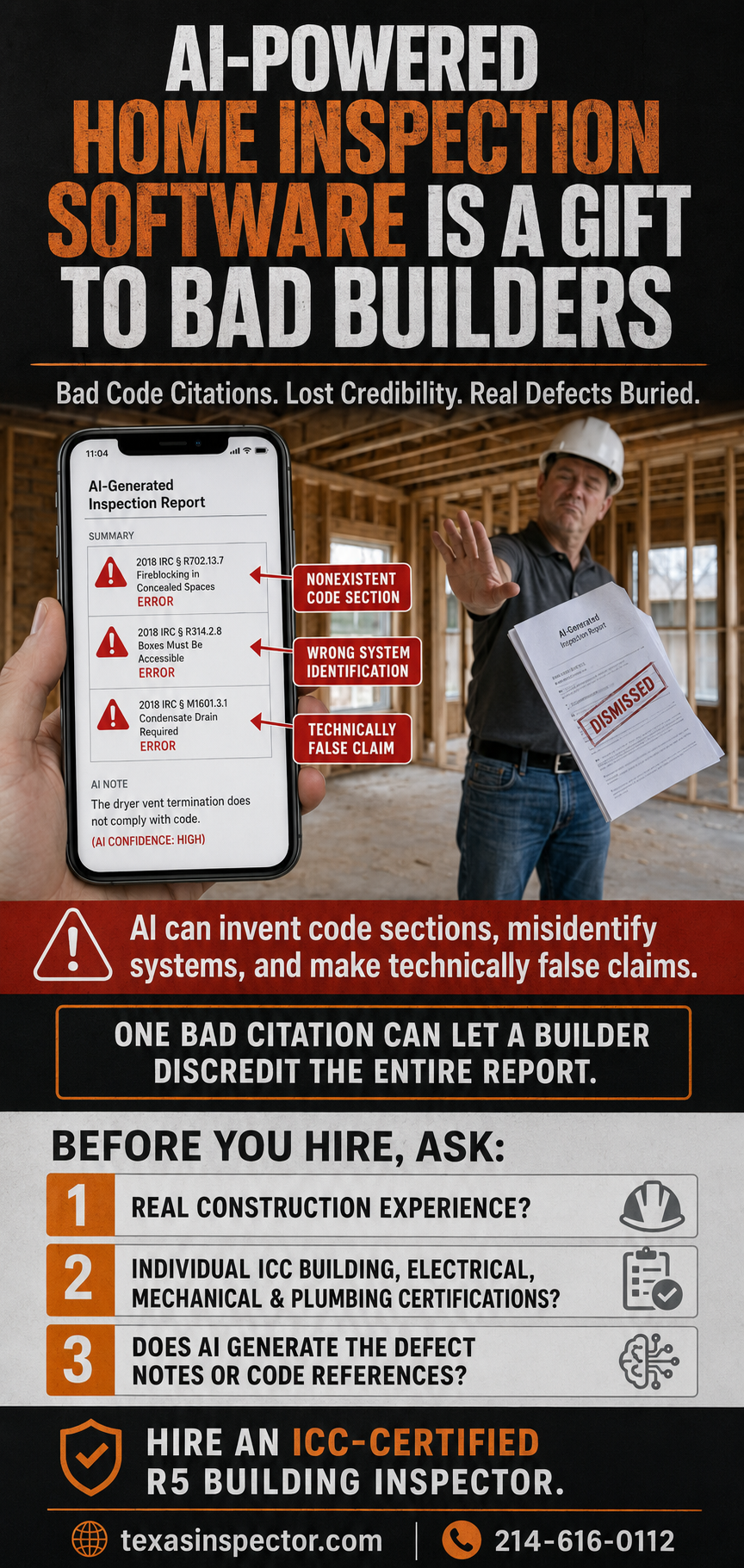
AI-Powered Home Inspection Software Is a Gift to Bad Builders
There is a fresh new plague sweeping through the Texas real estate market, and if you are currently buying a home, you should be terrified. Tech hustlers and software pushers have officially discovered home inspection, aggressively pitching “AI-powered” reporting platforms to licensed inspectors who are all too eager to outsource their thinking to an algorithm.
The sales pitch is as lazy as it is alluring: snap a quick phone picture of a defect, let a computer vision algorithm evaluate it, and watch as an app auto-generates code citations, formats comments, and completes a full inspection report before the inspector even walks back to their air-conditioned truck. Inspectors love it because it lets them pretend to be technical experts without opening a book, while real estate agents love it because it keeps deal-killing defects off the radar. Homebuilders are practically throwing parades in its honor.
The “Human-in-the-Loop” Myth
Software vendors often defend these tools by claiming that AI is merely an “assistant” and that inspectors remain “in the loop” to verify every line before sending the final report. But this defense collapses under the slightest technical scrutiny: you cannot verify what you do not already know.
When an inspector lacking actual building code training receives an authoritative-sounding AI narrative, they do not fact-check it against the codebook. They blindly click “approve”. Rather than acting as a safeguard, “human verification” becomes a passive rubber-stamping process for algorithmic guesswork.
Follow the Money: The Industry Trade Group Feedback Loop
Why are major inspector membership associations and industry organizations so eager to host summits, virtual learning days, and promotional campaigns urging inspectors to embrace AI? Simply follow the money.
These industry associations are heavily bankrolled by corporate “affiliates” and commercial sponsors—specifically, the software vendors selling recurring AI reporting subscriptions and the Errors & Omissions (E&O) insurance providers who profit from selling claims coverage when things go wrong. Software companies want monthly subscription fees, insurance carriers want higher premiums to cover liability risks, and industry groups collect sponsorship checks to market these platforms to their members.
It is a self-serving financial ecosystem: software pushers build push-button tools, industry associations hype them as “the future of the trade”, and insurance providers stand by with E&O coverage for when hallucinated reports inevitably result in missed defects. The only party left out in the cold is the homebuyer, whose multi-hundred-thousand-dollar investment gets sacrificed on the altar of speed and recurring software fees.
The Systemic Joke of Texas New Construction Inspections
To truly appreciate the comedy of errors happening on new construction sites across Texas, you first have to understand the dirty little secret of the state’s licensing system. The average homebuyer naturally assumes that an inspector licensed by the Texas Real Estate Commission (TREC) is a master of building mechanics, structural framing, and safety standards.
However, TREC’s own official Standards of Practice explicitly declare that licensed inspectors are not required to determine compliance with building codes, are not required to verify code enforcement, and are not required to have a single hour of actual construction experience. It is an absolute masterclass in regulatory irony that Texas allows these code-exempt inspectors to walk around active job sites.
This convenient setup aligns perfectly with decades of aggressive homebuilder trade group lobbying designed to ensure third-party inspections remain harmless and toothless. When you hire a standard TREC inspector for a brand-new build, you are essentially paying for a box-ticking flashlight tour guide who operates under a regulatory framework specifically engineered to keep them completely clueless about the very building codes holding your roof over your head.
Hallucinations on Parade: Asking AI About Building Codes
Because standard real estate licenses require zero code knowledge, software pushers smelled blood in the water and created push-button AI tools to sell the illusion of instant expertise to underqualified inspectors. What these software companies fail to mention in their flashy marketing materials is that today’s artificial intelligence models are absolute hot garbage when asked direct questions about specific building code citations.
If you interrogate an AI model with direct questions about the International Residential Code, it will confidently cite nonexistent code sections, hallucinate requirements from code books that do not exist, and mix up electrical grounding rules with plumbing vent ratios without missing a beat. Building code compliance is a complex science involving structural load paths, continuous tie-down systems, regional municipal amendments, and manufacturer installation specifications that hold legal weight under IRC § R102.4—none of which can be comprehended by a pattern-matching algorithm guessing pixel clusters.
When AI software takes a photo of an electrical panel or gas line, it simply generates impressive-sounding text, handing the inspector a made-up code section to stick in their official document. This creates a false sense of authority for the buyer while laying the groundwork for total failure.
Anatomy of a Hallucination: How AI Discredits Your Report
- The AI Claim in Report: “2018 IRC § R702.13.7 — Fireblocking required in concealed spaces behind drywall.”
- The Builder’s Response: “IRC Section R702 ends at R702.7. Section R702.13.7 doesn’t exist anywhere in the codebook. Your inspector made this up, so we are rejecting this entire report.”
- The Code Reality: Fireblocking requirements are actually governed by IRC § R302.11. Because the app hallucinated a fake section number, a genuine fire hazard gets completely ignored, and the builder walks away clean.
Why Builders Are Laughing Their Way to the Bank
If you are buying a multi-hundred-thousand (or multimillion) dollar new home, you might feel warm and fuzzy receiving a sixty-page inspection report jammed full of AI-generated code citations. However, to a volume homebuilder, that report is the best news they could possibly receive.
When a builder’s jobsite superintendent gets handed an inspection report produced by a phone app, they do not panic or call out trades to fix structural defects. They gather the crew, point at the page, and wipe tears of laughter from their eyes.
Because the AI model inevitably invents wrong code citations, misidentifies mechanical equipment, and makes wildly incorrect technical assertions, the builder instantly seizes on those glaring errors to demolish the inspector’s credibility in front of the buyer. The superintendent points to the hallucinated code reference, tells the buyer that their inspector clearly has no idea what they are talking about, and uses that single mistake to justify throwing the entire report directly into the dumpster.
By relying on push-button software to act like code gurus, lazy inspectors give bad builders the ultimate get-out-of-jail-free card. This allows serious framing, plumbing, and electrical hazards to get buried behind drywall forever.
Real Code Authority vs. Smartphone Button-Pushers
Snapping photos with a smartphone and tapping a screen is not an inspection, no matter how much money software companies charge for their subscriptions. An app can take a picture of a breaker panel, but it takes an ICC-certified combination building inspector—someone who has spent years buried in code books, passing brutal national examinations, and working actual construction—to know if the overcurrent protection matches the conductor gauge, if the neutral and ground buses are properly isolated, or if the arc-fault breakers match the exact code edition enforced by that specific municipality.
Artificial intelligence doesn’t know construction, doesn’t understand physical reality, and cannot smell gas leaks, feel loose subfloors, measure drain slopes, or spot improper HVAC ducting. When home inspectors let an app dictate their technical findings, they aren’t performing a professional service, but rather executing a lazy performance art piece that exchanges buyer money for empty digital fluff.
The Homebuyer’s Battle-Test Checklist
The real estate industry loves AI inspection software because it is fast, cheap, and completely frictionless, producing pretty PDF reports that never dare to disrupt a closing date or threaten an agent’s commission check. If you are preparing to buy a new home, you need to stop falling for glossy software templates and start interrogating the actual human holding the flashlight.
Before hiring any inspector, put them through this three-part battle test:
- Do you have hands-on, ground-up construction experience?
- Red Flag: “I’m licensed by the state.” (State licensing explicitly requires zero actual build experience).
- Do you hold individual ICC certifications in building, electrical, mechanical, and plumbing codes (or an ICC Residential Combination Inspector R-5 designation)?
- Red Flag: “State regulations don’t require code certifications.” (Precisely why bad builders love state-licensed inspectors).
- Does your software use AI to auto-generate defect notes or building code citations?
- Red Flag: “Yes, it helps write code references automatically.” (Guarantees the report will contain hallucinations builders can use to dismiss it).
If an inspector admits to using artificial intelligence for technical findings or relies solely on a basic real estate license that exempts them from knowing the code, run away immediately. Hire a real code authority who will write a report so technically airtight that no builder can ever laugh it off.


