
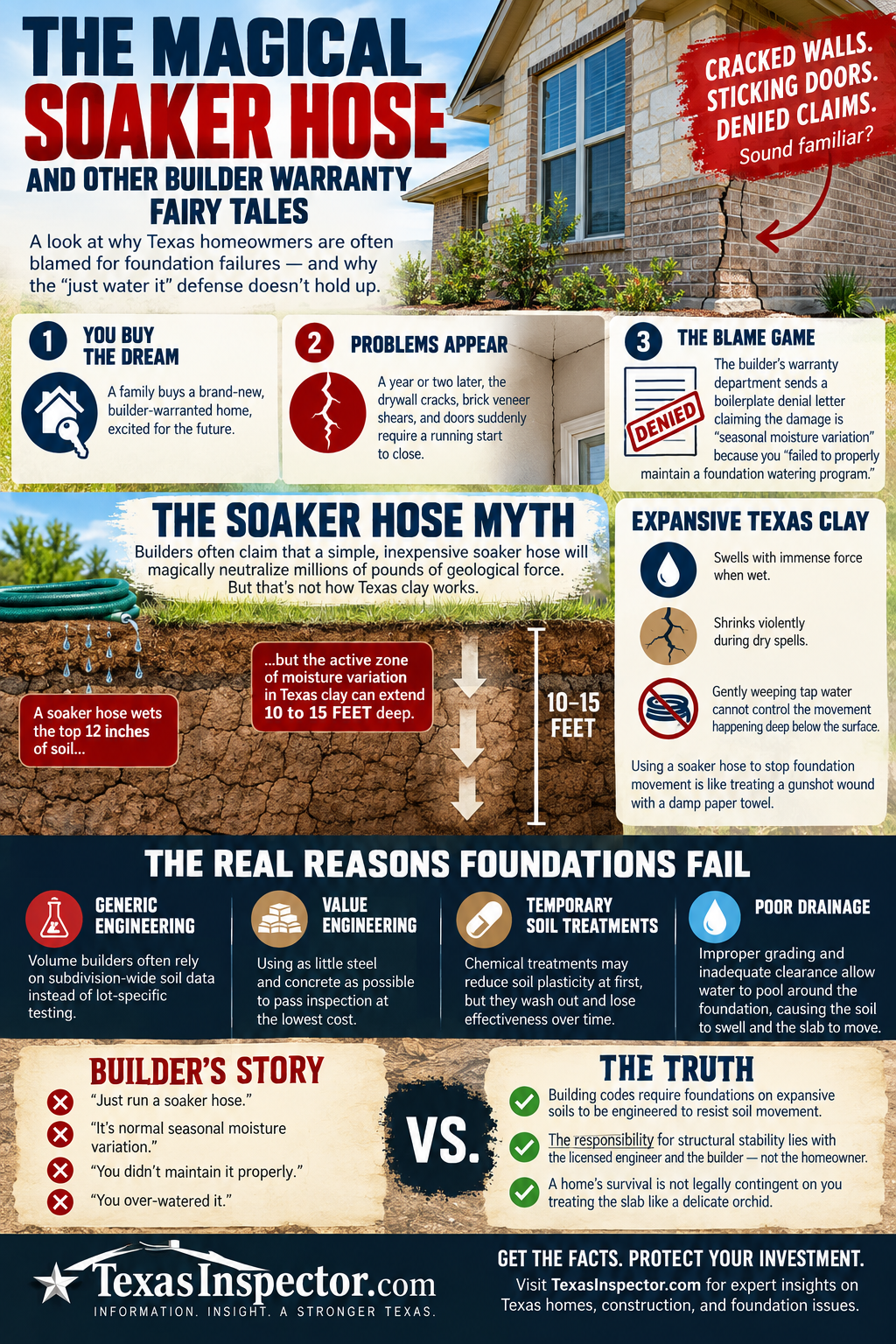
It is a predictably tragic comedy that plays out thousands of times across Texas the moment the rain stops. A family signs their life away for a brand-new, supposedly builder-warranted home, only to watch in horror a year or two later as their largest financial asset tears itself apart. The drywall fractures at the window corners, the brick veneer shears, and interior doors suddenly require a running start to close. Naturally, the naive buyer contacts the builder’s warranty department, expecting an actual structural repair. Instead, they receive a legally sanitized, boilerplate denial letter—likely pulled from a stack they keep next to the coffee machine—explaining that the massive edge heave destroying their house is merely “seasonal moisture variation.” The claim is denied, of course, because the occupant “failed to properly maintain a foundation watering program.” Ah, yes. The corporate builder’s favorite parlor trick: pinning the blame for a criminally thin, under-engineered post-tension slab squarely on the victim’s gardening habits.
To understand why this defense is scientifically laughable, you have to look at the reality of expansive Texas clay. This dirt acts like a massive geological sponge, swelling with immense force when wet and shrinking violently during dry spells. Yet, builders love to look buyers dead in the eye and tell them that running a fifteen-dollar plastic soaker hose from Home Depot around the perimeter of the house will magically neutralize millions of pounds of geological force. The hubris would be funny if it weren’t bankrupting families. During a severe Texas drought, the active zone of moisture variation can extend ten to fifteen feet below the surface. Gently weeping tap water onto the top twelve inches of dirt while the earth fractures fifteen feet down is the structural equivalent of treating a gunshot wound with a damp paper towel. Furthermore, both the International Residential Code and the Texas Engineering Practice Act explicitly require that foundations built on expansive soils be specifically designed to resist the movement of that soil. The law places the burden of structural stability squarely on the licensed engineer’s math and the builder’s execution. Nowhere in the building code does it state that a structure’s survival is legally contingent on an occupant treating a concrete slab like a delicate orchid that requires daily subterranean micromanagement.
The root cause of these catastrophic failures rarely has anything to do with a homeowner’s landscaping routine. It has everything to do with corporate “value engineering”—an industry euphemism for stripping out as much steel and concrete as humanly possible while keeping the house standing just long enough to pass a municipal inspection. Instead of paying for actual, lot-specific geotechnical soil testing, volume builders routinely rely on generic, subdivision-wide engineering data pulled from a zip code three towns over. When called out on these laughably shallow stiffening beams and widely spaced post-tension cables, builders will smugly pivot, claiming the soil was chemically pre-treated to reduce its plasticity. What they conveniently omit is that this chemical baptism is essentially a disappearing act. These treatments routinely wash out, degrade, and lose their effectiveness over time, acting as a cheap, temporary band-aid substituted for adequate concrete and steel. Once the chemical snake oil wears off, the foundation simply lacks the structural rigidity necessary to span the inevitable voids that form when the soil shrinks. Building on Texas clay is essentially building on a fluid, moving target. The foundation must be engineered from day one to withstand that movement, rather than built on a corporate gamble that the dirt will simply never dry out.
The true, breathtaking hypocrisy of the builder’s maintenance defense reveals itself when terrified buyers actually do try to water their foundations aggressively. If the soil heaves upward and cracks the slab in the opposite direction, builder defense experts will instantly pivot, clutch their pearls, and accuse the occupant of over-watering. It is a rigged game of Goldilocks where the dirt is never just right, and the builder is never, ever wrong. This also ignores the inconvenient fact that builders routinely fail to establish proper grading at the time of construction. When builders leave negative drainage or inadequate clearance from the grade to the brick ledge, surface water cannot naturally drain away from the foundation walls as strictly required by building codes. So, the water pools in the moat the builder generously provided, the soil swells, the foundation snaps, and the builder points the finger right back at the buyer for “poor drainage maintenance.”
Defeating this institutional gaslighting in a Residential Construction Liability Act claim requires methodical forensic unmasking of the builder’s initial shortcuts. Litigation attorneys and forensic experts must immediately demand the lot-specific geotechnical report to determine if the builder actually bothered to test the specific soil plasticity index and potential vertical rise for that exact address before pouring the concrete—spoiler alert: they probably didn’t, because why pay for science when you can just guess? Following that, a rigorous audit of the foundation design is necessary to compare the actual depth of the beams against what a legitimate, uncompromised structural engineer would have required. A proper forensic investigation will almost always uncover physical evidence of these initial code violations, revealing structural deficiencies that were baked into the cake long before the first drought ever arrived.
When cornered with actual math and code violations, builders will inevitably send out their own captive engineers—the very same rubber-stamp artists who blessed the inadequate subdivision plans to begin with—to write a report validating the denial. These reports are beautifully formatted exercises in corporate fiction, designed entirely to protect the builder’s bottom line while blaming the weather. But a properly engineered and adequately constructed post-tension slab in Texas is perfectly capable of surviving a long, brutal drought without tearing a house apart. When builders attempt to hide behind the soaker hose myth, buyers and their legal counsel must refuse to play their rigged game. Before allowing a warranty department to quietly drill a few cheap piers and slap some cosmetic mud on the drywall under the guise of a “goodwill repair”—a cynical, clock-killing tactic designed solely to keep you quiet until the statute of limitations runs out—the property must be evaluated by an independent, unbiased construction defect expert. True standard of care is established by rigorous building codes and engineering facts, not by the rehearsed, profit-protecting fairy tales of a warranty department.


