
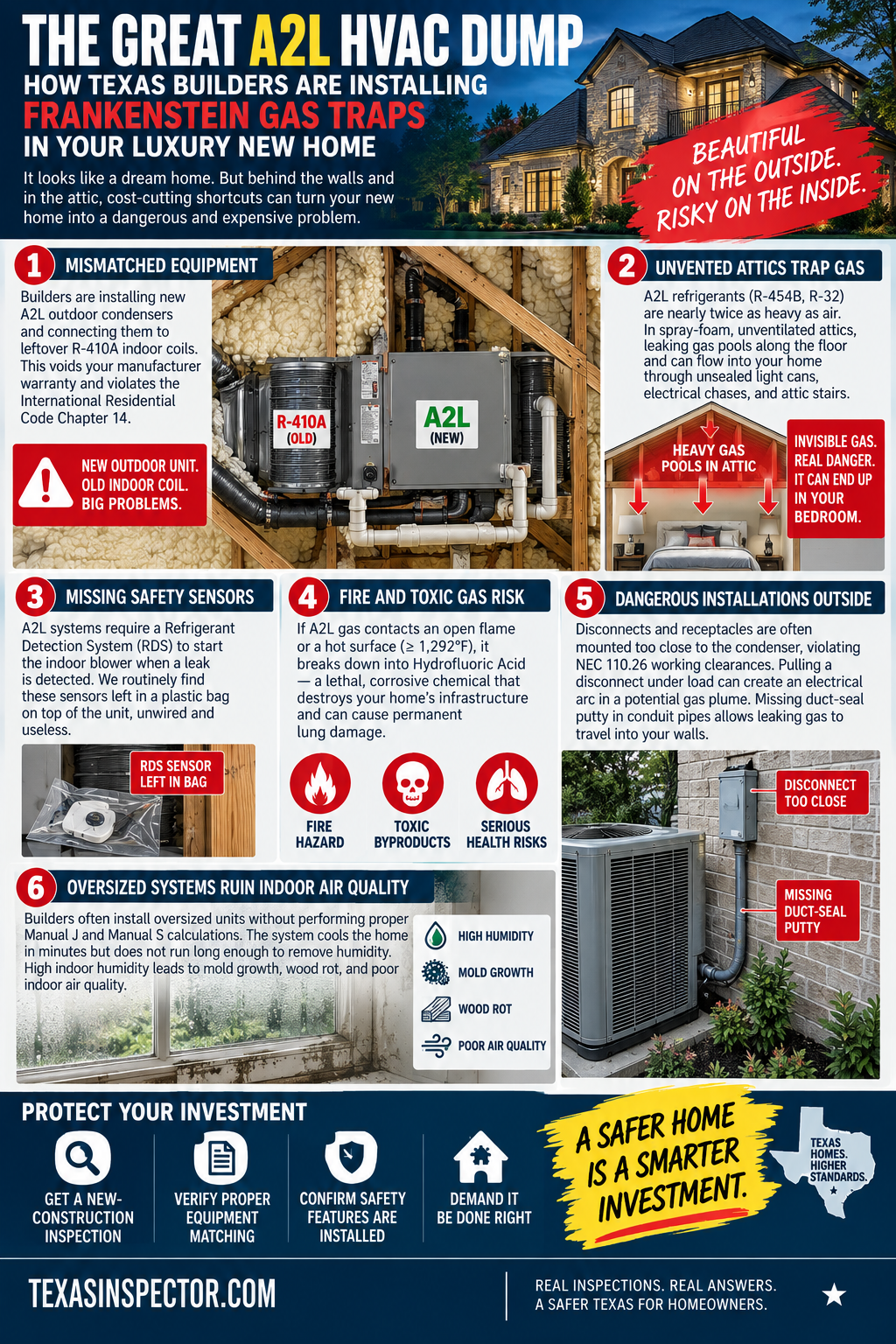
If you actually believe the shiny marketing brochures handed out in pristine model homes, your new Texas subdivision is a sanctuary of precision engineering and artisanal craftsmanship. If you step into your attic or look behind your outdoor condensing unit with half a brain, however, you will quickly realize that corporate builders view modern building codes not as life-safety minimums, but as personal financial slights. Nowhere is this corporate spite more hazardous to your health and bank account than in how high-volume builders are botching the mandatory federal transition from legacy R-410A to low-GWP A2L refrigerants like R-454B and R-32.
Federal bureaucrats envisioned the shift to A2L refrigerants as a clean step toward environmental salvation. Texas volume builders and the bargain-bin HVAC subcontractors they hired off a job board saw it as a terrifying, fire-sale panic over obsolete equipment. To avoid taking a financial loss on outdated inventory, builders across the state have turned half-million-dollar houses into glorified parts dumps. We routinely document Frankenstein mechanical setups where a brand-new A2L outdoor condenser is recklessly wired to a leftover, completely incompatible R-410A indoor coil hidden up in the attic. This penny-pinching trick voids your equipment warranty before the drywall dust settles, violates International Residential Code Chapter 14, and leaves you paying off an uncertified appliance for the duration of your thirty-year mortgage.
What makes this liquidation game truly special is the physical behavior of these new A2L gases. The industry delicately refers to them as mildly flammable, but in the real world, they are nearly twice as heavy as air, behaving almost identically to leaking propane. In modern Texas builds, where sales reps love to brag in their model homes about spray-foam-encapsulated, unventilated attics, a leaking coil becomes an invisible trap. The heavy gas cannot passively escape through non-existent soffit vents; it pools along the attic deck in concentrated, suffocating lakes. When lazy construction crews inevitably skip basic energy-code air-sealing around ceiling penetrations, that heavy gas follows gravity directly into your home, cascading through unsealed recessed light cans and wire chases to quietly fill your master bedroom while you sleep.
Building safety codes mandate that these units feature factory-installed Refrigerant Detection Systems designed to forcibly kick on the main indoor blower the second a leak occurs, whipping the floor-level gas up and diluting it throughout the entire house. Yet, during our inspections, we routinely find these life-saving sensors sitting in a clear plastic bag on top of the air handler, completely unwired because reading an installation manual is apparently asking too much. This laziness turns downright lethal when the builder crams that unvented air handler into an attic right next to an atmospheric gas water heater with an open flame. If leaking A2L gas contacts an open pilot light or a hot surface exceeding 1,292 degrees Fahrenheit, it does not just catch fire; it thermally decomposes into Hydrofluoric Acid, a hyper-corrosive chemical weapon that destroys your home’s infrastructure and causes permanent lung damage.
Step outside into the yard, and the careless hazards continue. Incompetent electrical crews regularly slap unsealed disconnect boxes and standard wall receptacles inches away from the outdoor condenser’s high-pressure service ports, violating National Electrical Code Section 110.26 working clearances and UL safety rules. Pulling an electrical plug or throwing an unsealed disconnect switch under load creates an electrical arc directly inside the potential gas plume of an outdoor leak, creating an instant flash-fire hazard. Worse yet, because lazy installers routinely forget to put duct-seal putty inside the conduit pipes, heavy leaking gas uses the hollow electrical pipe as a private highway, draining heavy refrigerant directly into your wall cavity.
Even if your builder accidentally manages not to set your house on fire or poison the air, they will almost certainly ruin your indoor humidity. Calculating proper HVAC sizing using region-specific Manual J and Manual S engineering load math is treated as a mythical fairytale inside model home sales offices. Subcontractors simply throw in oversized units to avoid hot-call complaints. An oversized A2L system cools your home in eight lightning-fast minutes and shuts off before extracting a single drop of moisture from the air. Your thermostat reads seventy degrees, but your indoor relative humidity quietly spikes past sixty-five percent. Within months, your luxury home turns into an artisanal mold farm where luxury vinyl floors buckle, ductwork sweats through the drywall, and black mold colonizes the dark cavities behind your baseboards.
Do not rely on municipal inspectors who spend four minutes on site, and certainly do not trust the builder’s smooth-talking warranty representative who tells you that moldy baseboards and sweating vents are simply part of a new home settling. Before you sign closing papers or let your 11-month builder warranty expire, insist on an independent inspection by an ICC R5 inspector. An ICC R5 Combination Residential Inspector possesses certified, multi-discipline mastery across building structural, mechanical, electrical, and plumbing codes. They are uniquely qualified to audit AHRI component matching, detect unsealed electrical arcing hazards within three feet of fuel sources, verify active RDS safety interlocks, and use thermal imaging to expose the latent envelope failures builders try to hide. Your health, your family’s safety, and your life savings depend on catching these Frankenstein systems before the builder skips town with your money.


