
The Dallas-Fort Worth metroplex is currently overflowing with two things: absurd amounts of unearned home equity and a seemingly bottomless supply of gullible homeowners who genuinely believe a full kitchen overhaul, master bath remodel, and second-story addition can be executed flawlessly for thirty grand by a guy named “Chad” they met on Instagram. Welcome to the Golden Age of DFW remodeling fraud, where naive residents act shocked—shocked!—when the absolute lowest bidder turns out to be a career grifter who wrecks their house, steals their money, and vanishes into thin air.
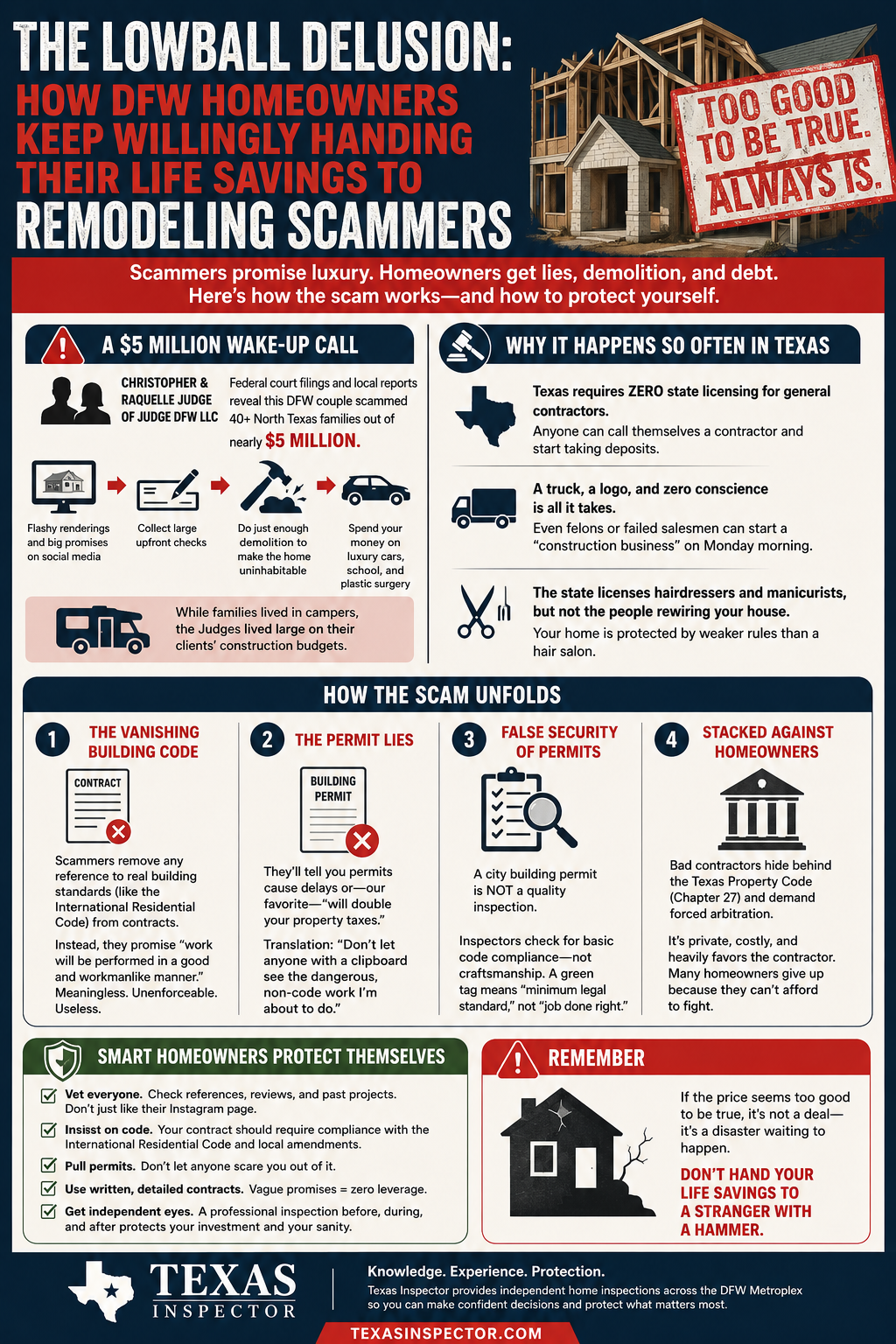
If you think that sounds overly cynical, allow me to introduce you to Christopher and Raquelle Judge of Judge DFW LLC. As detailed in federal court filings from the U.S. Attorney’s Office for the Northern District of Texas and reported by local outlets like WFAA News, this dynamic duo managed to fleece over forty North Texas families out of nearly five million dollars. Their business model was magnificently simple: flash some pretty rendering software on social media, claim to be a licensed architect when you’re absolutely not, collect massive upfront checks, do just enough destructive demolition to render the house totally uninhabitable, and then divert the cash into luxury cars, private school tuition, and plastic surgery. While dozens of homeowners were forced to live in campers over the holidays, the Judges were literally getting cosmetic procedures using their clients’ framing budgets.
How does a disaster of this scale happen so routinely in our area? Because in the Great State of Texas, consumer protection in residential construction is an absolute joke. The state mandates strict state licensing for hairdressers, manicurists, and massage therapists, but if you want to tear out load-bearing walls and re-wire a 200-amp electrical panel, all you need is a leased F-150, a magnet logo for the door, and zero conscience. Texas requires precisely zero general contractor licensing at the state level. Any convicted felon or failed used-car salesman can wake up on Monday morning, declare themselves a “master craftsman,” and start taking deposit checks from eager suburbanites desperate for a bargain.
As I have pounded into readers’ heads for years regarding the infamous “vanishing building code,” the scam almost always starts right there on paper. Shady contractors deliberately wipe any reference to actual building standards—like the International Residential Code—clean out of their contracts. Instead, they write in warm, fuzzy, completely meaningless garbage promising that “work will be performed in a good and workmanlike manner.” What does “workmanlike” mean? It means whatever the guy holding the hammer claims it means on any given Tuesday. Without explicit, legally binding code requirements baked directly into the agreement, you have zero leverage when your brand-new shower drains backwards into your hallway closet.
The deception deepens before a single tool even touches your drywall. Most of these fly-by-night operators aren’t even registered as contractors in the cities where they operate, meaning they couldn’t legally pull a building permit if they tried. So what do they do? They put on their best trustworthy face and start spinning fairy tales to convince you that permits are a big, scary mistake. They’ll tell you that pulling a permit “just slows down the job with government bureaucracy” or, my personal favorite, “it will alert the county tax assessor and double your property taxes overnight.” It’s an absolute line of crap. What they are actually saying is: “Please don’t let anyone with a clipboard see the fire hazards I’m building in your new kitchen.”
And for the love of sanity, stop believing that a municipal building permit is your knight in shining armor. As I’ve explained in my guides on navigating Texas building codes, a city building inspector is not your personal concierge or quality assurance manager. They are overworked city employees who pull up to your driveway, glance out the window for forty-five seconds to make sure your house isn’t actively collapsing onto the sidewalk, drop off a green tag, and zoom off to their next thirty appointments. A city sign-off means you achieved the absolute bare minimum standard required by law to avoid immediate code enforcement—it does not mean your contractor installed your flashings correctly or built anything worth paying for.
When the project inevitably collapses into chaos, homeowners suddenly discover that the legal system is stacked entirely against them. Bad contractors love hiding behind Chapter 27 of the Texas Property Code—the infamous Residential Construction Liability Act—and mandatory arbitration clauses buried in their boilerplate contracts. These clauses are designed to trap you in an endless, soul-crushing cycle of legal notices, cure periods, and private arbitration fees that will drain your remaining life savings before you ever get a day in court. By the time you realize you’ve been taken, the contractor has already dissolved their LLC, formed a brand-new one under a slightly different name, and bought another jet ski or just moved to another state to start the scamming anew.
This shameless grift reaches a fever pitch every time a hail cell rolls through DFW. Within twenty-four hours, a swarm of out-of-state storm-chasers descends upon your neighborhood offering to “absorb,” “waive,” or “rebate” your insurance deductible. The Texas Department of Insurance warns people about this constantly, because it explicitly violates Section 27.02 of the Texas Business and Commerce Code. When you sign up for this little scheme, you aren’t beating the system; you are committing insurance fraud, setting yourself up to have your policy canceled, and handing your roof over to a crew whose idea of quality control is a bucket of tar and a prayer.
If you actually want to survive a remodeling project in North Texas without losing your home or your sanity, stop being so gullible. Stop falling for the lowest bid, because cheap labor is always astronomically expensive in the long run. Demand a contract that explicitly binds the contractor to current adopted municipal codes, not vague promises of “quality.” Never, under any circumstances, hand over massive cash deposits upfront. Tie every single payment draw directly to written sign-offs from an independent, ICC R5-certified third-party inspector who works for you, not the builder. Verify that the contractor is registered with your city, demand proof of active general liability insurance, and have a competent construction attorney review every line of the contract before you sign it. Otherwise, don’t be surprised when your “dream remodel” turns into a starring role on the local evening news.


