
Let us trace the origins of this lunacy back to Washington D.C. a hundred years ago. In 1922, Herbert Hoover’s Commerce Department released the Standard State Zoning Enabling Act, a federal blueprint instructing local politicians on how to mandate single-family neighborhoods and ban multi-family density. Texas cities happily copied Hoover’s homework word for word. Fast forward a century, and after decades of building suburban sprawl, West Coast activists and D.C. bureaucrats decided to flip the script. They began offering shiny federal HUD grant money to any municipality willing to tear down those old zoning rules under the banner of affordable housing.
City councils across the Dallas-Fort Worth Metroplex took the bait. From Fort Worth expanding exemptions for detached units and Arlington allowing backyard structures, to Dallas, Denton, Plano, Frisco, McKinney, and Allen relaxing land-use rules, local politicians quietly swallowed the playbooks drafted by West Coast YIMBYs. Even high-end suburbs like Southlake, Colleyville, Keller, Flower Mound, and Trophy Club got pulled into the orbit, as did exurban hubs like Prosper, Celina, Aledo, Weatherford, and Parker County. City halls patted themselves on the back for solving the housing crisis without spending a dime of municipal money, completely ignoring the fact that they were inviting every tailgate contractor with a rusty pickup and a drill from Harbor Freight to build illegal shanties in suburban backyards.
Welcome to the North Texas Accessory Dwelling Unit gold rush. In working-class neighborhoods, homeowners genuinely believe they can turn fifty square feet of dead St. Augustine grass into a rental empire. In wealthy enclave suburbs, homeowners call them casitas, executive guest suites, or pool cabanas with living quarters to avoid alarming the local HOA. Out in the exurbs, they call them barndominiums. But regardless of whether it costs thirty thousand dollars or two hundred thousand dollars, here is the unvarnished reality that neither local city planners nor your neighborhood handyman will tell you. Almost every single one of these backyard units being thrown together across Metroplex backyards is a structurally terrifying, improperly wired, fire-hazard nightmare waiting for a summer heatwave or a severe windstorm to level the lot.
The Storage Shed and Cabana Delusion
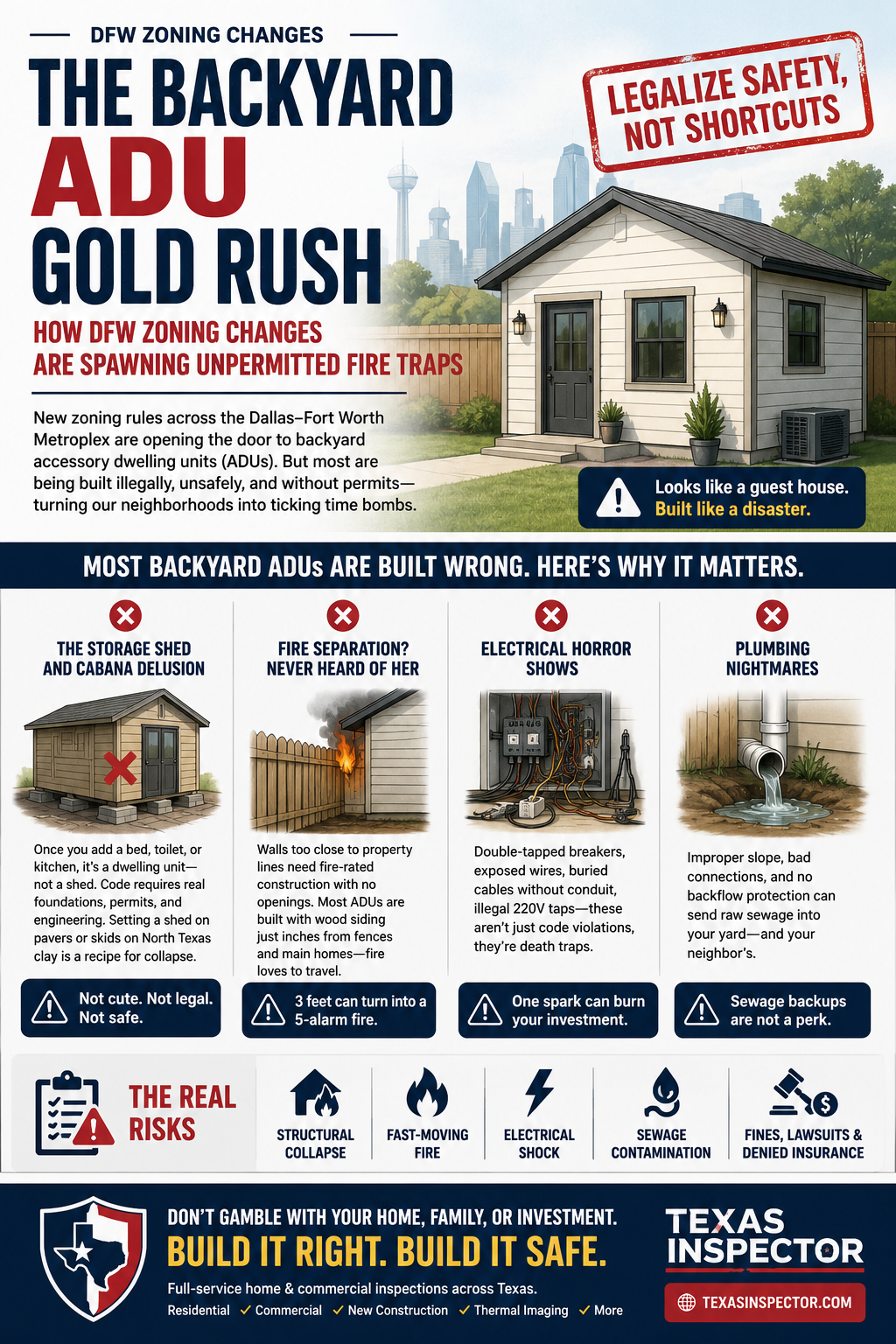
Consider the favorite lie of the modern hack contractor: it is just a big storage shed or a simple pool cabana. The second you put a bed, a hot plate, and a toilet in a box, the International Residential Code stops caring about your cute landlord fantasy and starts treating it as a residential dwelling unit. That requires real foundations, real structural engineering, and actual building permits.
Instead, these backyard visionaries in Dallas, Fort Worth, and Plano are balancing five-hundred-square-foot structures on unreinforced two-inch patio pavers, hollow cinder blocks, or straight-up expansive North Texas clay. In places like Southlake and Flower Mound, contractors pull a basic permit for a detached pool house, pass the concrete slab inspection, and then stealthily finish the interior with illegal, uninspected living quarters. They frame walls out of leftover two-by-threes spaced two feet apart, hold roof trusses together with staples and prayers, and skip hurricane ties because apparently, Metroplex windstorms do not exist in their world. Under Chapter 4 of the building code, exterior walls must extend below the frost line and rest on solid masonry or concrete footings. Sliding a pre-built shed onto skids or dressing up a shed with stone veneer does not make it a legal dwelling unit; it just makes it a temporary pile of expensive, splintered trash.
Fire Separation? Never Heard of Her
In suburban Metroplex neighborhoods where homes are already crammed onto standard residential lots, space is tight. When you try to cram a second or third house into a backyard in Arlington, Frisco, or Denton, Section R302 of the building code steps in to remind you that fire loves to travel. The code explicitly dictates that exterior walls closer than five feet to a property line require a minimum one-hour fire-resistance rating with zero unprotected openings.
Do these tailgate builders care? Not even a little. Behind eight-foot privacy fences, they are slapping untreated pine siding three feet from a neighbor’s wooden fence, running vinyl soffits inches away from the main roof line, and completely ignoring fireblocking in the walls. When your tenant burns a bag of popcorn in their unpermitted shack, you will not have time to call the fire department. The blaze will jump the gap, melt through your eaves, and torch your main house before the dispatcher even answers the phone.
Electrical and Plumbing Horror Shows
If you think the framing is funny, the electrical and plumbing work will make your hair stand on end. Pulling trade permits requires hiring licensed master electricians and plumbers, which costs actual money. So instead, homeowners hire a guy whose chief qualification is that he owns a ladder, a roll of duct tape, and a pair of pliers.
These geniuses are double-tapping main panel lugs, overloading existing breakers, and running illegal two-hundred-and-twenty-volt taps to power unpermitted casita kitchens. Direct-burial wire is shoved three inches deep through flowerbeds without a shred of protective conduit. One enthusiastic afternoon with a garden trowel and you are cooked. Over on the plumbing side, sewage lines are being spliced together with zero understanding of slope or backflow. When the main line clogs, raw sewage does not politely ask for directions; it backs up directly into the shower drain of your new income property.
The Exurban Septic Disaster
Out in the exurbs of Aledo, Weatherford, and unincorporated Parker County, where municipal sewer systems do not exist, this gold rush takes an even dirtier turn. Homeowners are building massive thousand-square-foot secondary casitas and backyard barndominiums on acreage, assuming county land means zero rules.
The immediate disaster here is septic system overload. Contractors routinely tie a new two-bedroom backyard house directly into an aerobic septic system that was only engineered and permitted for the original three-bedroom main residence. An aerobic system designed for four people cannot magically handle eight people washing clothes, taking showers, and flushing toilets at the same time. The moment holiday guests arrive, the tanks overflow, saturating the backyard spray field with untreated effluent. You have not truly experienced North Texas country living until your luxury backyard cabana is surrounded by a pond of raw sewage.
The Resale Nightmare: Code Enforcement Will Have the Last Laugh
The funniest part of this entire charade is watching homeowners pretend they pulled a fast one on the system. They figure they will collect rent under the table or host short-term guests, and the city will never know.
Fast forward to the day you try to sell the house. A competent, independent home inspector walks into the backyard, takes one look at the sagging roof, missing permits, illegal sub-panel taps, and overloaded septic system, and writes a report that reads like a criminal indictment. The buyer’s mortgage underwriter immediately kills the deal because no bank on earth will insure an unpermitted death trap. Then municipal code enforcement gets involved, slapping you with back taxes, massive fines, and a court order to bulldoze your precious passive income stream at your own expense.
The Bottom Line
Zoning reform was meant to create housing, not an excuse for cheapskates and slick contractors to build uninsurable fire hazards in DFW suburbs. Whether you are building a budget cottage in Fort Worth or a luxury casita in Southlake, do it right. Hire a licensed professional, pull every single permit with your local development services department, and pay for third-party code inspections.
If a contractor tells you that permits are just a cash grab by the city, kick their sorry ass to the curb before they ruin your life. You are not beating the system; you are just paying someone to build an explosive, sewage-filled wooden box behind your house.


