
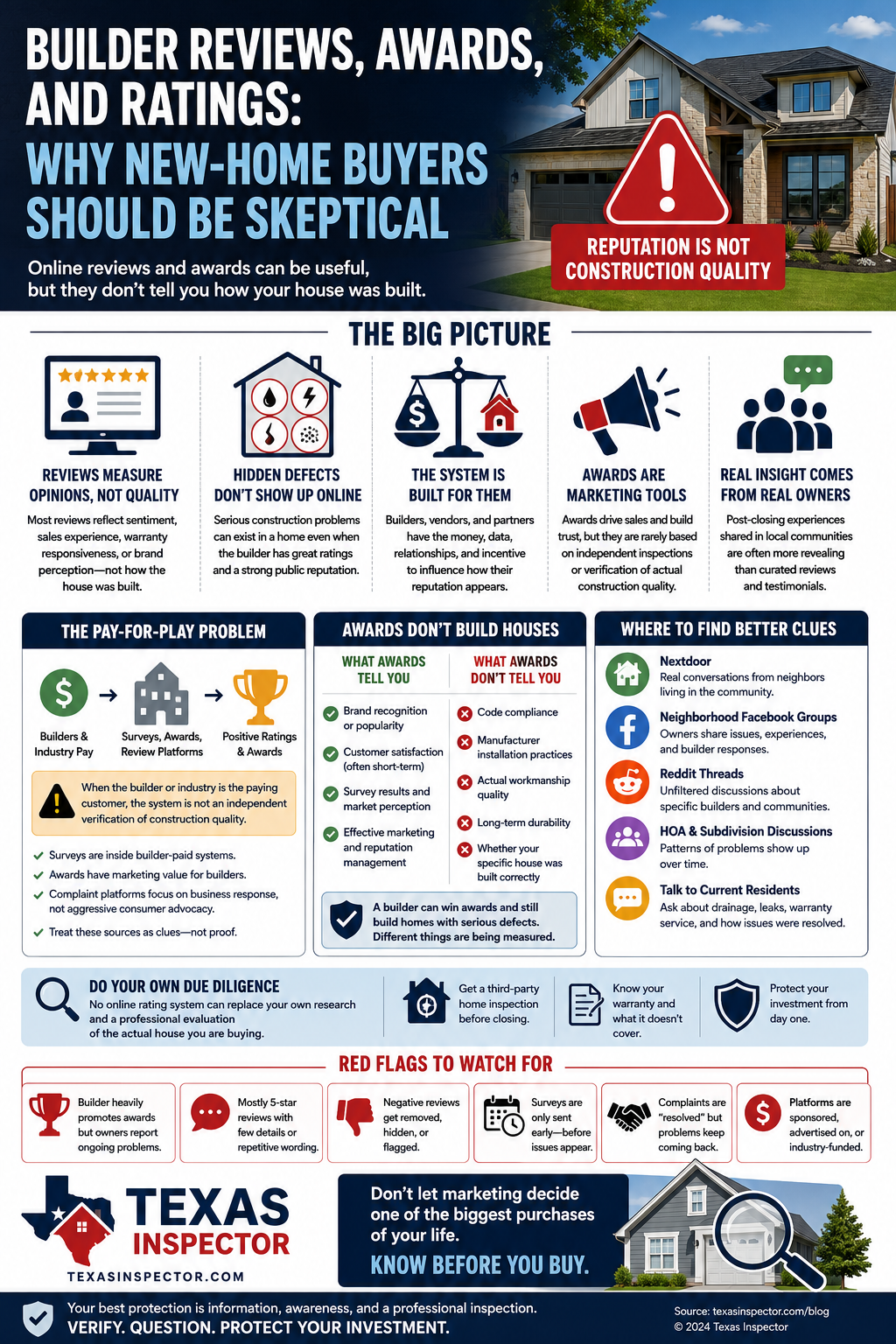
Most people shopping for a new home in Texas start their journey with extensive online research. They scour Google reviews, builder websites, Better Business Bureau pages, award logos, customer-satisfaction rankings, neighborhood Facebook groups, Reddit threads, Nextdoor posts, and local subdivision discussions. While this research is absolutely worth doing, buyers must understand a fundamental problem before they rely on it: much of the builder-review ecosystem is built around corporate reputation management, marketing value, lead generation, business relationships, and post-closing damage control.
This does not mean every review is fake or every award is meaningless. It means the system is structurally biased toward the builder because corporations possess the money, the data, the advertising budgets, the survey relationships, the warranty leverage, and the financial incentive to control how their reputation appears to future buyers. A new-home buyer is usually trying to answer one direct question: is this builder likely to build my house correctly? Most online resources fail to answer that question because they measure customer sentiment, sales center experiences, brand familiarity, short-term warranty responsiveness, or public reputation rather than actual construction quality.
A house can be badly flashed, poorly drained, improperly roofed, incorrectly wired, defectively graded, or built with hidden manufacturer-installation violations while the builder still maintains pristine ratings, attractive awards, and a respectable public-facing image. That is the critical gap Texas buyers need to understand before they rely on any online reputation source.
The Builder-Review System Is Not Neutral
The review system surrounding new-home construction is not a neutral consumer-protection mechanism; it is a sophisticated business ecosystem. The entities with the greatest financial interest in the outcome are the builders, marketing companies, customer-experience vendors, award programs, advertising platforms, and reputation-management platforms. Builders need positive public perception because reputation sells houses. Survey companies need builder participation because builders are their paying customers, award programs need recognizable winners to maintain marketing value, and review platforms need commercial traffic.
This structure matters because a buyer looking for honest information is entering a system that was not primarily built to protect them. It was built to collect feedback, manage brand perception, sell consumer confidence, and keep the housing sales machine moving forward. Because of this, the most useful information often comes from completely outside this formal reputation system. Nextdoor posts, neighborhood Facebook groups, HOA discussions, subdivision group chats, and resident-run forums may be unpolished, but they frequently contain the kind of post-closing, real-world information that builder awards and curated testimonials leave out.
The Subtle Realities of Pay-for-Play and Marketing Awards
The phrase “pay-for-play” does not always mean a builder simply buys a trophy in a crude sense. The real problem is more subtle: many reputation systems exist because builders and participating businesses financially support the ecosystem that produces, displays, promotes, or distributes those ratings. This creates an inherent conflict of interest. When the builder or the building industry is the paying customer, the platform’s relationship is fundamentally different from an independent inspector, engineer, or consultant evaluating the house from the buyer’s side of the transaction. A customer-experience company hired by builders may collect real survey data, but it operates inside a builder-paid system designed to process disputes rather than provide aggressive consumer advocacy.
Similarly, builder awards are explicitly designed to be utilized as marketing assets, and buyers need to read them through that lens. Phrases like “Most Trusted Builder,” “Customer Satisfaction Award,” or “Top Rated Builder” sound highly authoritative because they are designed to sound that way. These awards usually reflect brand recognition, satisfaction scoring, or market perception. They generally do not mean that an independent technical expert inspected the builder’s houses and verified compliance with building codes, manufacturer installation instructions, or proper workmanship. A builder can easily win a prestigious award while still producing individual houses with serious defects, because the award measures public perception while the house requires technical evaluation.
Trust-based awards can be particularly misleading because trust is heavily influenced by massive advertising exposure, name recognition, and consistent community presence. A buyer may trust a builder’s name simply because they have seen their billboards, online ads, model homes, and sponsored content for years. That familiarity does not prove the builder’s current trade crews are performing quality work on a specific lot, nor does it prove that the site superintendent assigned to that house is competent, that the drainage is correct, or that the exterior cladding was built to perform. Brand familiarity is not construction quality, and buyers should never confuse the two.
How the Honeymoon Phase and Review Gating Distort Data
Modern builder survey companies collect massive amounts of customer-experience data, which helps corporate offices monitor sales staff, design centers, and closing satisfaction. The problem is that these platforms are commonly part of the builder’s business-management system rather than independent buyer-protection systems. When a builder participates in a managed feedback system, it helps them identify unhappy buyers, protect their brand, and advertise favorable results. This data is often far too broad to identify subdivision-specific problems, meaning a stellar corporate satisfaction score will not reveal that one specific phase of a community has recurring yard drainage problems or repeated roof leaks that local owners are already discussing online.
This data is further distorted because it is gathered during the honeymoon phase, when the buyer is still close to the closing experience. This early period heavily favors the builder because the house is fresh, the finishes look immaculate, and the warranty department may still be responding quickly to minor cosmetic items. This timing is a major flaw because many serious construction defects do not reveal themselves immediately. Drainage problems require multiple severe Texas rain events to manifest, roof and flashing defects require repeated exposure before interior staining occurs, brick veneer drainage problems can remain hidden for years, and HVAC systems may not fail until they are placed under extreme seasonal load. A buyer who gives a positive review shortly after closing tells the truth about their early experience, but they do not yet know what might be technically wrong with the house.
Furthermore, review gating and reputation filtering pose real risks to unsuspecting buyers. In many industries, happy customers are aggressively encouraged to post public reviews, while unhappy customers are quietly routed into private customer-service channels or internal resolution processes that never produce visible public warnings. This filtering makes the public reputation look significantly cleaner than the actual customer experience. The satisfied buyer becomes public evidence, while the dissatisfied buyer becomes a private service ticket, leaving future buyers completely blind to ongoing structural disputes.
The Limitations of the Better Business Bureau and Google Reviews
The Better Business Bureau can be a helpful tool, but buyers must not misunderstand its purpose. The BBB is not a government agency, a construction-quality authority, or a building-code enforcement body. It is a business-oriented complaint and reputation platform. While it allows consumers to file complaints, its structure is still centered on business profiles and marketplace confidence. A builder with a decent BBB profile can still build defective houses, and a clean BBB history will not tell a buyer whether a specific home has improper drainage, missing flashing, defective brick veneer clearances, or noncompliant HVAC installations. Businesses quickly learn that resolving a complaint administratively improves their profile grade, even if the homeowner feels the underlying structural issue was minimized, delayed, or only partially corrected.
Google reviews can also be useful because they are highly visible and include comments from actual buyers, but they remain notoriously shallow. A five-star review posted right after closing usually reflects excitement, sales satisfaction, a smooth financing process, or a friendly superintendent. It tells you nothing about foundation grading, attic access, or hidden construction defects. Conversely, while one-star reviews can sometimes be overly emotional, repeated complaints about the exact same types of technical defects deserve serious attention. Buyers should always give more weight to specific patterns of complaints than to the average overall star rating.
Uncovering Subdivision-Level Reality Through Social Media
For production builders, neighborhood Facebook groups, Nextdoor, Reddit, and subdivision pages are far more revealing than formal ratings or corporate awards. Homeowners in the same community tend to compare notes on the exact same trade crews, the same warranty representatives, the same construction managers, and the same recurring defects. To leverage these unpolished platforms, buyers should bypass broad brand searches and look for specific, technical keywords paired with the subdivision or builder name. Highly effective search terms include drainage, grading, warranty, roof leak, window leak, foundation, brick clearances, masonry, HVAC, and punch list. The goal is to determine whether the exact same structural problems are being discussed by multiple owners in the immediate area.
This subdivision-level research is paramount because large production builders are not uniform across every development. A builder may perform relatively well in one community but fail miserably in another because different superintendents, trade crews, schedules, and lot conditions produce vastly different outcomes. A broad search for the builder may produce polished corporate marketing results, but a community-specific search is what reveals the structural problems affecting the actual area where you are shopping. The buyer is not purchasing a national brand in the abstract; they are purchasing a specific house built by specific people on a specific piece of Texas soil.
Shifting from Marketing Evidence to Performance Evidence
To navigate this landscape successfully, buyers must actively separate marketing evidence from performance evidence. Marketing evidence includes award badges, builder testimonials, corporate satisfaction scores, star ratings, and “trusted builder” claims. Performance evidence consists of repeated homeowner complaints, documented structural defects, warranty patterns, subdivision-specific histories, third-party inspection reports, and actual conditions observed at the house. A buyer who treats all online information equally will be easily misled, while a buyer who separates reputation management from actual performance will make significantly safer decisions.
When evaluating reviews, buyers should completely discount those written too early in the homeownership process and prioritize comments made after an owner has lived in the house through seasonal shifts, major storms, and intense warranty interactions. Negative reviews should be thoroughly analyzed for technical content rather than emotional venting. A complaint that simply states “terrible builder” is practically useless, but a detailed review explaining that the rear yard drains directly toward the foundation, or that the warranty department closed a water-intrusion ticket without completing a real repair, provides critical intelligence.
Smart Protection: Asking Better Questions and Requiring Documentation
Before signing a contract, buyers often ask sales representatives broad questions that are incredibly easy to answer with reassuring, scripted marketing language. Questions like “Do you stand behind your homes?” produce predictable answers and zero useful information. Buyers must ask highly specific questions based on their subdivision research. Inquire directly about who the site superintendent is, how many homes that specific superintendent is currently managing, what trade crews are working the phase, and whether any nearby lots have required drainage, roofing, masonry, or electrical corrections. When an issue matters, always demand answers in writing, as verbal reassurance is incredibly easy to give and even easier to forget.
Furthermore, buyers should aggressively request physical documentation instead of relying on verbal statements that everything is fine. Ask for the builder’s complete written warranty before closing, manufacturer installation instructions for major building components, engineering letters for any structural modifications, and written confirmation that known defects have been fully corrected. Be deeply cautious if a builder refuses to provide these documents, dismisses technical questions as unnecessary, or claims that your independent review is redundant because they have an award-winning reputation. Builders who are completely confident in their workmanship should never require a buyer to rely solely on blind trust.
Always remember that builder sales language sounds vastly broader than the actual restrictive text of a written warranty. The sales representative may tell you the company stands behind the home forever, but the written warranty will contain strict exclusions, cosmetic tolerances, tight deadlines, and complex dispute-resolution procedures that sharply limit what the corporation is actually required to do later. Read the warranty before closing, not after an expensive defect appears, and preserve all your evidence—emails, text messages, photos of construction stages, and screenshots of community complaints—from the very beginning of the process.
The Bottom Line
The online builder-review system is fundamentally flawed because it operates inside a commercial ecosystem that heavily rewards favorable public perception. Ratings, awards, curated testimonials, and clean complaint profiles are not proof of construction quality; they are tools of modern reputation management. The only definitive solution is to completely stop treating a builder’s public image as a substitute for evaluating the physical house.
A house-specific evaluation focuses on critical structural components that corporate awards can never verify, including foundation grading, roof drainage, flashing details, exterior cladding, attic access, and proper electrical safety installations. Ensuring rigorous, independent, third-party technical inspections at critical milestones—specifically pre-drywall, final walk-through, and the eleventh-month warranty mark—remains the only reliable way to reduce your risk and ensure your new Texas home was actually built correctly.
A builder’s public image may help a buyer decide where to look, but the house itself is what the buyer will live with, maintain, repair, insure, finance, and eventually resell. The buyer’s job is not to find the builder with the best marketing; the buyer’s job is to reduce the risk of buying a defective house.


