
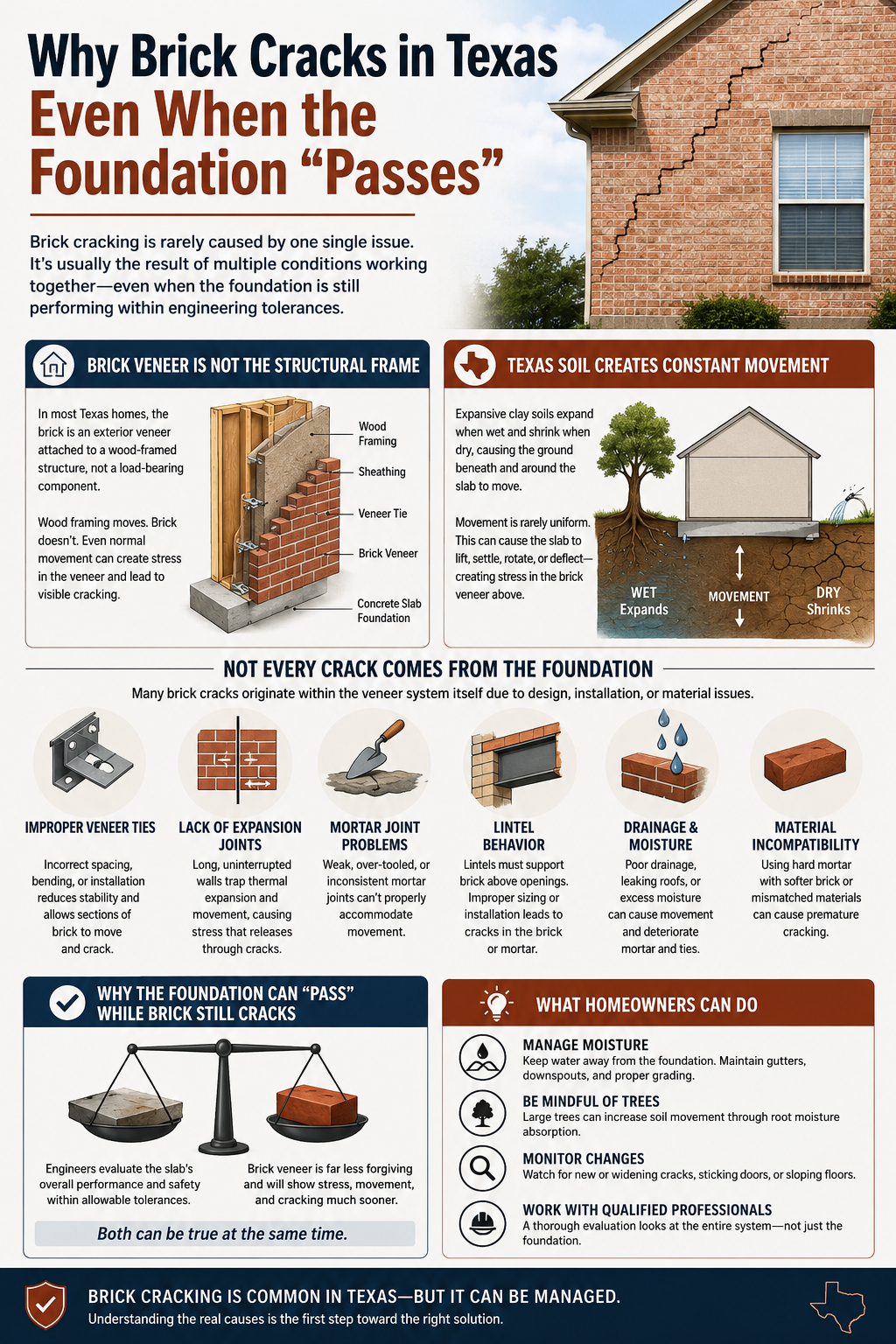
Brick cracking is one of the most misunderstood issues in residential construction, particularly in Texas. Homeowners see stair-step fractures spreading across masonry walls and immediately assume the foundation is failing. Builders often respond by dismissing the cracking as “normal settling” or insisting the foundation remains “within tolerance.” Neither explanation adequately describes what is actually occurring.
The reality is that brick cracking usually develops from multiple overlapping conditions rather than a single isolated defect. Soil movement, slab deflection, thermal expansion, framing shrinkage, drainage conditions, veneer restraint problems, lintel behavior, masonry installation deficiencies, and material incompatibility can all contribute to visible cracking patterns. In many cases, the foundation may technically satisfy engineering performance criteria while the veneer system simultaneously experiences meaningful stress and visible deterioration.
This disconnect exists because homeowners, builders, and even some inspectors often treat brick veneer as though it were the primary structure of the home. Modern brick veneer construction does not function that way. The veneer is a cladding system attached to an underlying wood-framed structure. Understanding that distinction is essential to understanding why cracking occurs.
Brick Veneer Is Not the Structural Frame
In most modern Texas homes, the brick exterior is not supporting the roof or carrying the structural loads of the house. The primary structural system is typically dimensional lumber or engineered wood framing supported by a concrete slab foundation. The brick exists as an exterior veneer tied back to the framing with metal anchors while resting on a ledge at the slab perimeter.
This matters because brick behaves very differently than wood and concrete. Masonry is rigid and brittle. Wood framing expands, contracts, shrinks, and flexes with changes in temperature and moisture content. Concrete slabs move as soil conditions change beneath them. Brick veneer sits on the outside of this constantly shifting structural assembly and absorbs stress from multiple directions simultaneously.
Because masonry handles compression well but tolerates tension poorly, it often becomes the first visible component to reveal movement inside the building system. Small amounts of slab rotation or framing movement that may not significantly affect structural safety can still create visible distress within the veneer.
This is one reason brick cracks frequently appear before homeowners notice interior symptoms such as drywall separation, sloping floors, or sticking doors. The veneer acts as an exterior stress indicator for movement occurring elsewhere within the structure.
Texas Soil Creates Constant Movement Cycles
The expansive clay soils common throughout North Texas create some of the most aggressive movement conditions in residential construction. These soils expand dramatically when wet and contract substantially during dry periods. As moisture levels fluctuate, the soil beneath and around the slab changes volume continuously.
The movement rarely occurs uniformly. Soil near the slab perimeter may dry faster than soil beneath the interior of the structure, particularly during drought conditions. Trees, inconsistent irrigation, poor drainage, excessive surface runoff, and extreme summer heat can intensify these moisture differentials. Portions of the slab may settle, lift, rotate, or deflect slightly as soil conditions change beneath different sections of the structure.
Many homeowners assume foundations either “pass” or “fail” as though structural behavior were binary. In reality, concrete slabs routinely experience measurable movement without reaching the threshold of structural failure. Engineers evaluating slabs often focus on overall performance, allowable tolerances, and the structure’s ability to continue functioning safely rather than expecting zero movement.
Brick veneer, however, is far less forgiving than the slab beneath it. Even moderate differential movement can create enough tension to crack mortar joints, separate brick courses, or create fractures near openings and corners.
This is why homeowners are often frustrated when an engineer states the slab remains within acceptable tolerances while visible cracking continues appearing throughout the masonry. Both observations may be technically accurate at the same time.
Not Every Brick Crack Originates from Foundation Movement
One of the biggest mistakes in residential construction diagnostics is the tendency to blame every brick crack on the foundation. In reality, many veneer failures originate within the masonry system itself.
Brick veneer is a managed assembly requiring proper restraint, support, spacing, drainage, and movement accommodation. If those components are installed incorrectly, the veneer can crack even when slab movement remains relatively minor.
Insufficient or improperly installed brick ties are one of the most common contributors. Veneer ties secure the masonry to the framing while allowing limited differential movement between materials. When ties are spaced improperly, omitted entirely, excessively bent, fastened poorly, or embedded incorrectly into mortar joints, sections of veneer lose stability and become more vulnerable to displacement and cracking.
Large uninterrupted wall expanses create additional problems. Brick expands thermally over time, and long wall sections require properly designed expansion joints to relieve accumulated stress. Many production homes either lack adequate expansion joints or place them improperly. As thermal expansion and structural movement accumulate within restrained wall sections, the stress often releases through visible cracking.
Mortar quality also plays a significant role. Mortar mixed improperly or cured inconsistently may shrink excessively, lose bond strength, or deteriorate prematurely. Weak mortar joints often become the path of least resistance for stress within the veneer assembly.
In newer homes, framing shrinkage behind the veneer can further complicate the situation. Lumber installed with elevated moisture content shrinks as it dries, particularly during the first several years after construction. Differential shrinkage between framing components can transfer stress into the relatively rigid brick veneer, especially near openings and structural transitions.
Improper shelf angles, missing movement joints, inadequate control joints, and poor veneer support geometry can also contribute to distress patterns that are frequently mistaken for foundation-related movement.
The visible crack pattern may therefore reflect several overlapping mechanisms occurring simultaneously rather than a single isolated problem.
Openings and Lintels Create Major Stress Concentrations
Windows, doors, and garage openings are among the most common locations for brick cracking because they interrupt the continuity of the veneer system and concentrate structural stress into relatively small areas.
Brick above these openings must be supported by steel lintels. These lintels carry the weight of the masonry and transfer the load into the adjacent wall sections. The problem is that steel and masonry behave very differently under changing environmental conditions.
Steel expands and contracts substantially with temperature changes. In Texas, where exterior masonry surfaces experience intense solar exposure, lintels undergo constant thermal cycling. South- and west-facing walls are particularly vulnerable because the steel repeatedly heats and cools while restrained by relatively rigid masonry.
As this movement accumulates, cracks often develop diagonally from the corners of windows and doors or appear as stair-step fractures immediately above the lintel line. These patterns are commonly blamed on the foundation even when the primary driver is thermal expansion and differential movement within the veneer support system itself.
Deflection is another major issue. Lintels that are undersized, improperly installed, insufficiently supported, or overloaded can sag slightly under the weight of the masonry above. Even relatively minor deflection can transfer substantial stress into surrounding brick courses.
Garage door openings are particularly vulnerable because they often support large uninterrupted spans of masonry while experiencing substantial thermal loading. Long garage lintels frequently develop cracking at the corners, especially when expansion stresses combine with minor slab movement or framing deflection.
Corrosion can worsen the problem considerably. When flashing details are missing or improperly installed, water may collect around steel lintels. As corrosion develops, the steel expands. Rust occupies significantly more volume than the original steel, which can create outward pressure against mortar joints and surrounding brick veneer. The resulting cracks are often misidentified as evidence of foundation settlement when the actual mechanism originates at the deteriorating lintel itself.
Improper bearing conditions also contribute to veneer distress. Lintels require adequate support at each end to distribute loads correctly into adjacent wall sections. Inadequate bearing concentrates stress near the ends of the lintel and frequently produces cracking near opening corners.
Drainage Problems Quietly Accelerate Veneer Distress
Drainage conditions are one of the most underestimated contributors to brick cracking in Texas homes. Many homeowners focus exclusively on the crack itself without understanding how moisture conditions around the slab influence structural movement.
Poor grading, negative drainage, short downspout discharge locations, trapped water along fence lines, excessive irrigation near the foundation perimeter, and hardscape runoff concentration can all create unstable moisture conditions beneath the slab. Large differences in soil moisture content across the footprint of the structure produce differential expansion and contraction within the supporting soils.
Over time, these recurring moisture cycles place continuous stress on the slab and veneer system. Seasonal movement patterns become more pronounced, and previously repaired cracks often reappear because the underlying movement mechanism remains unresolved.
Drainage defects inside the wall cavity can also contribute directly to veneer deterioration. Brick veneer systems are not waterproof barriers. They are water-managed systems designed to allow moisture intrusion while safely redirecting water back out of the assembly. Improper flashing installation, clogged weep systems, inadequate cavity clearances, mortar bridging, or missing drainage components can trap moisture within the wall system.
As moisture accumulates inside the assembly, metal ties may corrode, mortar can weaken, and veneer stability may deteriorate over time. The resulting cracking may have little to do with foundation performance and far more to do with chronic moisture exposure inside the wall system itself.
Crack Patterns Matter More Than Crack Existence
The mere presence of a crack reveals relatively little by itself. The location, orientation, width, progression, and associated symptoms are far more important diagnostically.
Stair-step cracking through mortar joints commonly reflects differential movement because mortar joints are typically weaker than the brick units themselves. Vertical cracking may indicate thermal expansion stress, shrinkage behavior, or isolated movement patterns. Horizontal cracking can suggest more significant structural displacement, veneer instability, or restraint-related stress. Cracks radiating from windows and doors often reflect concentrated stress around openings, lintel movement, or framing interaction.
Bulging veneer, outward displacement, recurring separation near corners, or progressive cracking near openings may indicate deficiencies within the veneer support system itself rather than slab-related movement alone.
The relationship between symptoms matters as well. A small isolated crack that remains stable for years carries different implications than progressive cracking accompanied by interior drywall separation, sticking doors, measurable slab elevation changes, or repeated cosmetic repairs.
One of the most misleading aspects of veneer distress is that cosmetic appearance does not always correlate directly with structural severity. Some visually dramatic cracks remain relatively stable, while subtle recurring cracks may indicate active movement conditions that continue worsening over time.
Cosmetic Repairs Frequently Ignore the Underlying Cause
Many masonry repairs focus on concealment rather than movement control. Mortar joints are patched, surfaces are caulked, and veneer is cosmetically blended without addressing the mechanisms producing the stress.
These repairs often fail because the underlying conditions remain unchanged. Slab movement continues, drainage deficiencies remain active, restrained wall sections continue accumulating stress, deteriorating lintels remain in service, or deficient wall components inside the assembly remain uncorrected. The veneer simply cracks again in the same location or nearby.
This does not mean all brick cracking represents catastrophic structural failure. Some level of cosmetic distress is expected in structures built on expansive soils exposed to large environmental fluctuations. The critical issue is whether the movement appears stable and manageable or progressive and increasingly destructive over time.
The problem with simplistic explanations such as “all houses crack” is that they ignore the difference between predictable cosmetic movement and ongoing systemic distress. Brick veneer cracking exists in the gray area between harmless cosmetic imperfection and meaningful structural deterioration. Determining where a particular structure falls within that spectrum requires understanding how the entire building system interacts rather than focusing on a single symptom in isolation.


