
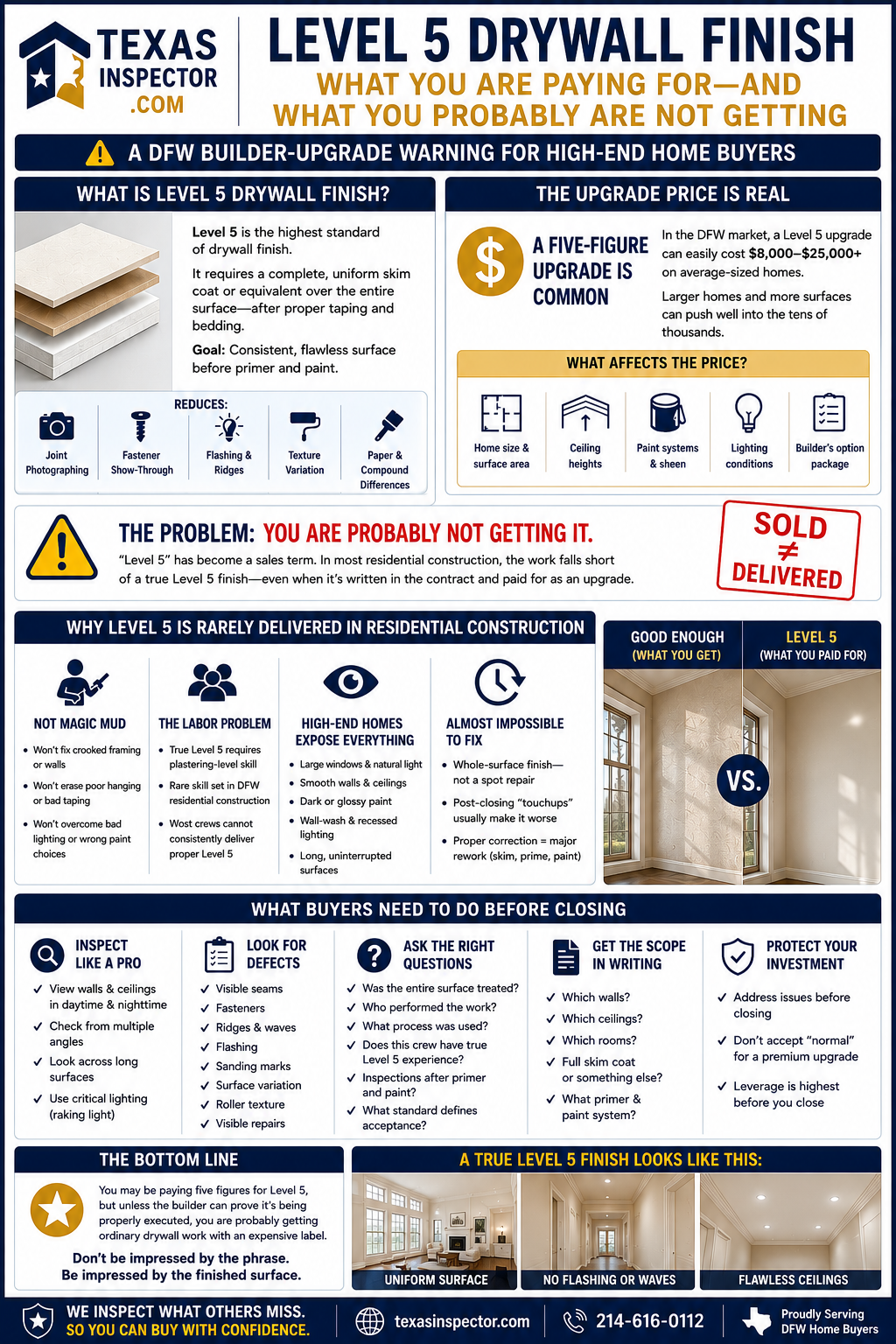
“Level 5 drywall finish” sounds expensive, technical, and impressive, which is exactly why it gets used in upper-end and high-end residential construction. Buyers hear it and think they are getting smooth, clean, premium walls and ceilings. Builders say it because it sounds like a luxury feature. Contracts include it, design centers sell it, and buyers pay for it. The problem is that in residential construction, you are probably not getting it. Not “maybe not,” and not “there could be a few minor workmanship issues.” You are probably not getting a proper Level 5 finish, even if your contract says you are.
That is not because Level 5 is a bad standard. Level 5 is a real drywall finish level with a real purpose. The problem is that almost nobody in the residential field is actually delivering it correctly. A true Level 5 finish is not “smooth walls,” standard tape and bed, extra sanding, a painter spraying a thick coat of primer, someone spot-floating a few bad seams, or a drywall crew saying, “Yeah, we did Level 5,” while doing the same basic work they do everywhere else. A proper Level 5 finish requires the drywall to be finished correctly first, then the entire surface must receive a uniform skim coat or equivalent surface treatment so the wall or ceiling has a consistent surface before primer and paint. The point is to reduce joint photographing, fastener show-through, flashing, texture variation, and visible differences between the drywall paper and joint compound.
That complete process is almost never delivered in residential construction. That is the part buyers need to understand before they get emotionally attached to the phrase. The words in the contract do not skim the walls. The sales presentation does not flatten the substrate. The design center upgrade does not create skilled labor. The invoice does not produce craftsmanship. Someone actually has to perform the work correctly, and that is where the wheels come off.
“Level 5” Has Become a Sales Term
In high-end residential construction, “Level 5” has become one of those phrases that sounds good in a contract and collapses in the field. The builder sells Level 5, the buyer pays for Level 5, and the field work almost never meets Level 5. What gets passed off as Level 5 is often partial treatment, spot treatment, inconsistent skim work, extra mud in the obvious places, primer used like body filler, patches after defects are noticed, and a little sanding here and there while everyone hopes the paint hides the crime scene.
It usually does not. The buyer ends up with visible seams, fasteners, ridges, waves, sanding marks, flashing, uneven sheen, roller texture, shadowing, and surface variation. Then comes the predictable builder response that “this is normal.” If a proper Level 5 finish was contracted for, that answer is not good enough. The question is not whether imperfect drywall exists in ordinary residential construction. Of course it does. The question is whether the buyer was sold and charged for Level 5.
The Upgrade Price Is Real, Even When the Finish Is Not
This is not some throw-in item that accidentally made its way into the brochure. In the DFW market, a Level 5 drywall upgrade in an upper-end home can easily become a five-figure option, and on larger homes it can push well into the tens of thousands of dollars depending on the size of the home, ceiling heights, wall and ceiling areas included, paint selections, lighting conditions, and how the builder packages its options. The exact number varies because builders do not all price it the same way, but the point is not complicated: buyers are often paying real money for a finish they are probably not actually receiving.
That is the part that should irritate buyers. This is not just a technical disagreement between drywall people. This is a paid upgrade, and in many cases it is a significant one. Some builders price it as a whole-house option. Some limit it to selected rooms. Some include ceilings, and some do not. Some bury it inside a “smooth wall,” “premium finish,” or “designer finish” package. Some use the phrase Level 5 loosely enough that the buyer may not even know what surfaces are actually supposed to receive the full treatment.
If the builder is charging $8,000, $15,000, $25,000, or more for a Level 5 upgrade, the buyer needs to know exactly what that money bought. Which walls? Which ceilings? Which rooms? Full skim coat or something else? What primer? What paint system? Who performs the work? Who inspects it? What standard determines acceptance? A buyer should not pay premium money for a finish that exists more clearly on the option sheet than it does on the actual wall.
Level 5 Is Not Magic Mud
Level 5 is often treated like a magic coating that can be thrown over ordinary residential drywall work and somehow turn it into a premium finish. That is nonsense. Level 5 does not fix bad framing, straighten bowed studs, flatten a crooked wall, erase poor drywall hanging, make a bad tape job disappear, solve bad lighting placement, rescue poor paint work, or overcome careless trade damage after the drywall finish is complete.
If the wall is crooked before the drywall is installed, the finished wall will still be crooked. If the drywall is hung poorly, the finish is already compromised. If the lighting rakes across the wall, every small defect becomes a billboard. If the paint has sheen or dark color, the wall gets even less forgiving. Level 5 can improve surface uniformity, but it cannot turn bad construction into good construction. This is why so many expensive homes still have cheap-looking walls: the builder sells the buyer a premium finish, but the underlying process never supports the result.
High-End Homes Make Bad Drywall Obvious
The irony is that Level 5 is most often discussed in homes where bad execution is easiest to see. Upper-end and high-end homes tend to have large windows, tall walls, smooth ceilings, long hallways, open floor plans, dark paint, glossy paint, wall-wash lighting, recessed lighting, stairwells, and large uninterrupted wall surfaces. That design style is unforgiving because a textured wall in a basic house can hide a lot of sins, but a smooth wall in a high-end house hides almost nothing.
Natural light across a long wall will expose waves. Recessed lights near a wall will expose ridges. Dark paint will expose flashing. Satin or eggshell paint will expose surface variation. Smooth ceilings will expose lazy sanding, inconsistent coating, bad patches, and every other shortcut that looked “good enough” before the lights and paint were finished. The cleaner the design, the more brutally it reveals the workmanship.
That is why the “good enough” drywall culture of ordinary residential construction does not work in a home where the buyer paid for premium smooth surfaces. If the builder wants to sell a high-end finish, the builder needs a high-end process and a high-end crew. Most do not have either.
The Labor Problem Nobody Wants to Admit
Here is the part that almost nobody wants to say out loud: proper Level 5 finishing requires a skill set that is rare in residential construction here. This is not regular drywall finishing with a fancier name. True Level 5 work is closer to plastering-level craftsmanship because it requires finishers who understand whole-surface uniformity, skim coat consistency, sanding discipline, surface preparation, primer compatibility, paint sheen, critical lighting, and how the wall will actually look after the house is finished.
That is not the normal residential drywall labor pool. We do not have a broad workforce of union plasterers doing this work in these houses, and we do not have enough highly trained finish contractors who can consistently deliver proper Level 5 work at scale. Unless the builder brings in the right crew from somewhere else or hires one of the very rare local crews that can actually do it, the odds are simple: the buyer is not getting a true Level 5 finish.
The contract may say Level 5. The upgrade sheet may say Level 5. The superintendent may say Level 5. The sales team may say Level 5. None of that matters if the people doing the work cannot actually produce it. In most residential construction, they cannot, and that is not being rude. That is the field reality.
Once It Is Done Wrong, It Is Nearly Impossible to Fix
The worst part is that a failed Level 5 finish is not easy to fix. In many cases, once it is done wrong, it is nearly impossible to correct properly without major rework. This is not like replacing a scratched appliance panel or adjusting a door. Level 5 is a whole-surface finish system, which means the wall or ceiling has to be treated as a complete surface. When the original work is wrong, the defect is not just one little spot. It is built into the finished surface.
That is why post-closing repairs are usually a joke. Someone comes back and sands a ridge, and then the sanding mark shows. Someone floats a joint, and then the patch flashes. Someone sprays primer, and then the sheen changes. Someone repaints one area, and then the roller texture does not match. Now the buyer has the original defect plus a visible repair. That is not correction. That is damage control.
Spot repairs are usually the wrong answer to a failed Level 5 finish because the problem is surface uniformity. You cannot create whole-surface uniformity by chasing defects one patch at a time. That is how walls turn into a quilt of repairs. A proper correction may require sanding, re-skimming the full surface, re-priming, and repainting under controlled conditions. In a finished or occupied home, that means dust, masking, moving furniture, protecting floors, disrupting the house, and hoping the same labor pool that failed the first time somehow gets it right the second time.
This is why the issue must be addressed before closing. Once the buyer closes, moves in, and the builder starts offering little touchups, the buyer has already lost most of the leverage. Everyone will want the buyer to accept “good enough,” but “good enough” is not what the buyer paid for.
“Normal” Is Not the Same as Contracted
Builders love the word “normal” when finish defects appear. Visible seams are called normal. Waves in the wall are called normal. Flashing, sanding marks, fastener locations, ridges under angled light, and visible patching are all called normal. That argument misses the point because the question is not whether these defects occur in ordinary residential drywall work. The question is whether the buyer was sold and charged for Level 5.
If Level 5 was contracted for, ordinary residential drywall appearance is not the standard. The builder does not get to sell a premium finish and then defend a basic finish as “normal.” That is the bait-and-switch buyers need to watch for. The sales side uses premium language, the field side delivers ordinary work, and the warranty side then tries to normalize the defects. That may be common, but it is not acceptable.
What Buyers Need to Do Before Closing
Buyers need to stop accepting “Level 5” as a magic phrase and start treating it like a deliverable. Look at the actual walls and ceilings under finished lighting, during the day, at night, from multiple angles, and across long surfaces. Pay close attention to large windows, stairwells, entries, great rooms, smooth ceilings, hallways, and any area with wall-wash lighting or dark paint. Look for seams, fasteners, ridges, waves, flashing, sanding marks, inconsistent sheen, roller texture, and visible repairs.
Ask whether the entire surface was treated, not just the bad spots. Ask who performed the work, what process was used, whether the crew has actually delivered true Level 5 finish on comparable homes, whether the surface was inspected after primer and after paint, and what standard the builder is using to accept or reject the work. Ask these questions before closing, because after closing the odds of getting a failed Level 5 finish properly corrected drop hard. The builder will want to minimize the issue, the repair crew will want to patch, the painter will want to blend, and everyone will want the buyer to accept less than what was sold.
Buyers also need to ask for the upgrade scope in writing. If the builder charged for Level 5, the buyer needs to know whether that means all walls, selected walls, ceilings, high-visibility areas, or only certain rooms. The buyer also needs to know whether the builder is promising a true Level 5 process or simply using the term as shorthand for “smooth wall finish.” Those are not the same thing, and the difference matters when real money is attached to the upgrade.
The Bottom Line
Level 5 drywall finish is real, and it matters in upper-end and high-end homes with smooth walls, critical lighting, large windows, dark paint, glossy paint, and large uninterrupted surfaces. The problem is that proper Level 5 finish in residential construction is a rarity. Most buyers who pay for Level 5 are not going to receive a true Level 5 finish unless the builder has the right crew, the right supervision, the right schedule, and the right quality-control process. That usually means unusually skilled labor, not the standard residential drywall pipeline.
The buyer needs to understand the risk plainly: you may be paying five figures for Level 5, but unless the builder can prove it is being properly executed, you are probably getting ordinary drywall work with an expensive label. Once that ordinary work is buried under primer and paint, fixing it is not simple, and it may never be made right without major whole-surface rework. Do not be impressed by the phrase “Level 5,” and do not be impressed by the price attached to it. Be impressed by the finished surface. If the walls still show joints, waves, ridges, flashing, sanding marks, surface variation, and visible repairs, then the label does not matter. You did not get Level 5. You bought Level 5, and got sold something else.


