
For the last several years, DFW builders got spoiled by a market where buyers behaved like contestants in a survival game show. People waived inspections, ignored obvious defects, panic-signed contracts, and convinced themselves that paying obscene amounts of money for rapidly assembled houses with gray vinyl flooring and decorative words like “luxury” and “executive” attached to the listing somehow counted as making a sound financial decision. Builders became completely addicted to that environment because buyers stopped scrutinizing construction quality and started treating basic competence like an optional bonus feature.
Now the market is shifting, and builders are discovering that buyers become significantly less cooperative when monthly payments start resembling hostage demands.
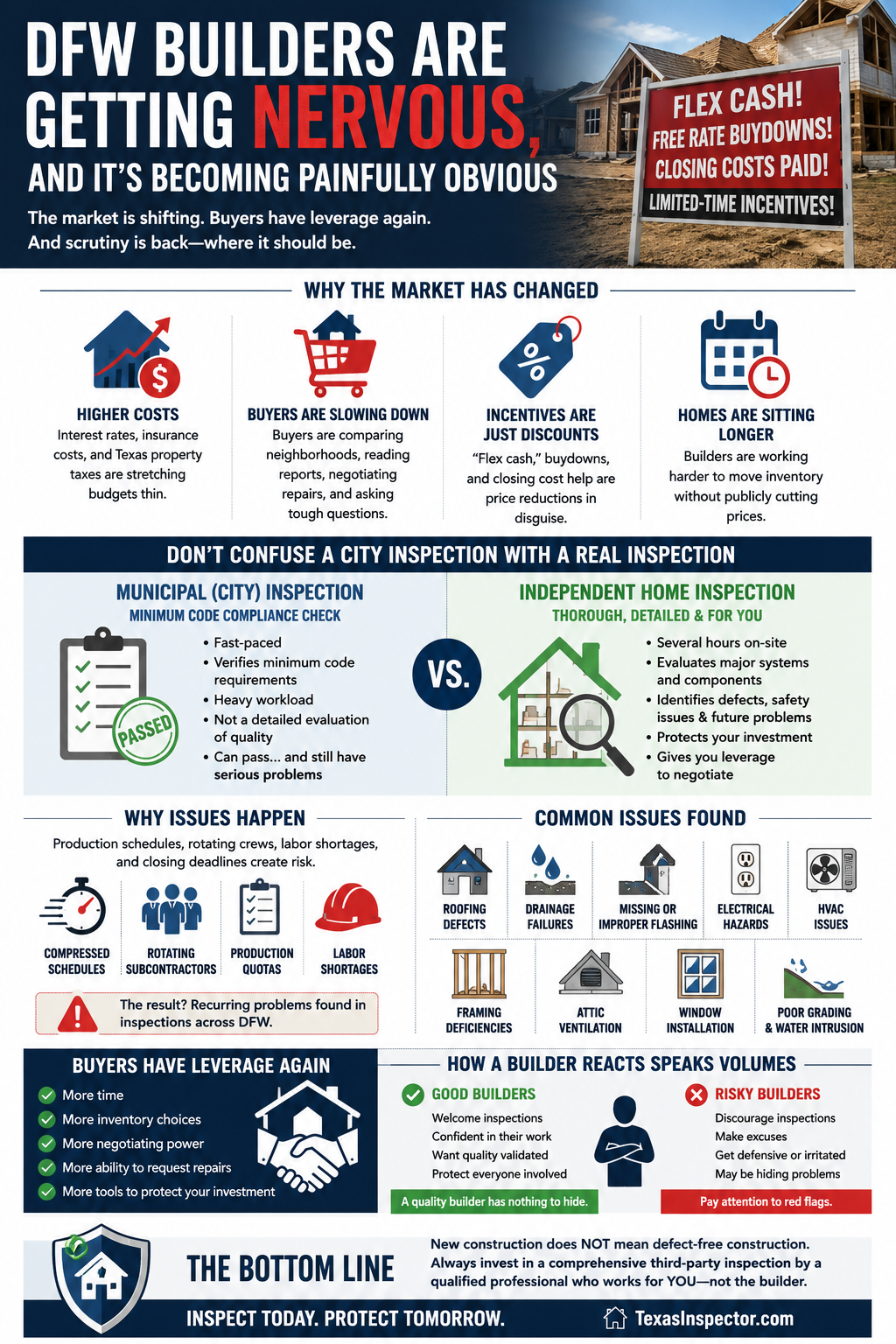
Interest rates remain painful, affordability is getting hammered, insurance costs are climbing, and Texas property taxes continue their long-running campaign against disposable income. Buyers are slowing down long enough to actually evaluate what they’re purchasing, which creates a serious problem for production builders who spent the last several years prioritizing speed above literally everything else. Suddenly buyers are comparing neighborhoods, reading inspection reports, negotiating repairs, and asking uncomfortable questions instead of sprinting into contracts like somebody just announced the apocalypse was coming for available inventory in Frisco.
That’s why every subdivision in North Texas suddenly looks like a liquidation sale at a failing furniture store. Everywhere you turn there are giant screaming banners advertising “FLEX CASH,” “FREE RATE BUYDOWNS,” “CLOSING COSTS PAID,” and “LIMITED-TIME INCENTIVES,” which is hilarious because every single one of those things is just a price reduction wearing a fake mustache and pretending to be something more sophisticated. Builders refuse to publicly slash prices because they don’t want to damage comps or make the subdivision look weak, so instead they bury the discount under layers of marketing language and hope buyers are too distracted by the free refrigerator to notice the house has been sitting unsold longer than a Facebook Marketplace treadmill.
But nothing reveals builder anxiety faster than the growing effort to steer buyers away from third-party inspections, because that’s where the polished sales pitch starts breaking apart under even minimal scrutiny. More buyers are hearing the same carefully rehearsed lines about how inspections are unnecessary on new construction because the home already passed city inspection, the superintendent walks every property personally, the builder has a robust quality-control process, and everything is covered under warranty anyway. The entire pitch depends on buyers not understanding the gigantic difference between a municipal code inspection and a comprehensive independent inspection.
Municipal inspections are generally fast-paced compliance checks intended to determine whether a property broadly satisfies minimum code requirements under significant workload pressure. Minimum code is not the same thing as exceptional workmanship, meticulous construction quality, or “someone actually gave a damn while building this house.” A city inspector is not spending four hours inside your future home tracing electrical defects, evaluating attic ventilation performance, inspecting roof installation details, documenting framing deficiencies, or analyzing drainage behavior after a North Texas thunderstorm dumps three inches of water into the backyard. Production builders absolutely love when buyers confuse “passed inspection” with “built well,” because those two concepts are nowhere near interchangeable.
Meanwhile these homes are being assembled under compressed schedules with labor shortages, rotating subcontractors, production quotas, and enough deadline pressure to make an Amazon fulfillment center feel emotionally balanced. Entire crews are sprinting from house to house trying to keep closings on schedule while sales offices continue advertising “luxury lifestyle communities” with the confidence of somebody selling counterfeit designer handbags out of a storage unit. Then everybody acts shocked when independent inspectors continue finding the same recurring problems: roofing defects, drainage failures, missing flashing, unsafe electrical work, HVAC performance issues, framing deficiencies, attic ventilation problems, improperly installed windows, and grading setups that convert backyards into mosquito hatcheries every time DFW gets a decent thunderstorm.
The real issue for builders is that buyers finally have leverage again, and leverage creates scrutiny. During the frenzy years, buyers ignored defects because they thought they had no alternative. Builders became accustomed to speed overruling quality concerns, and now that buyers are slowing down long enough to actually inspect the product, some builders are discovering that cosmetic upgrades stop looking impressive the moment somebody opens the attic hatch and realizes the workmanship resembles a group project assembled entirely by exhausted raccoons running on nicotine and gas-station energy drinks.
And honestly, the harder a builder pushes you to skip an independent inspection, the more aggressively you should insist on getting one, because competent builders do not fear third-party inspections. Builders who consistently produce quality work understand that another set of eyes validates their process and protects everyone involved. The builders who become defensive, irritated, dismissive, or visibly uncomfortable the moment an independent inspector enters the picture are usually telling you far more than they intended to, and smart buyers would be wise to pay very close attention to that reaction.


