
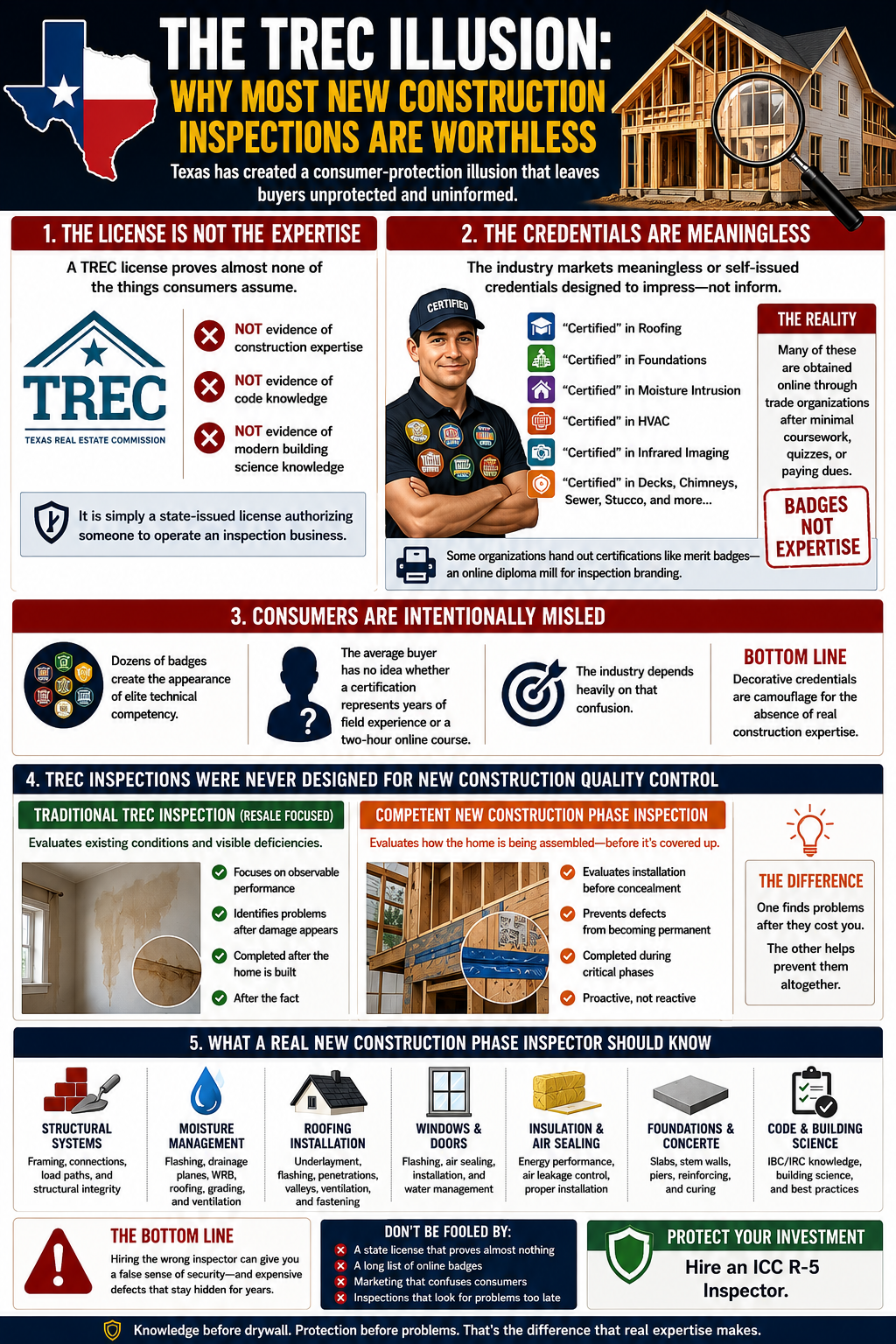
Texas has created one of the most deceptive consumer-protection illusions in the residential construction industry, perhaps inadvertently (you can decide). Every day, buyers are encouraged to believe that hiring a “licensed TREC inspector” for a new construction inspection means they are hiring someone qualified to determine whether a home is actually being built correctly. In many cases, that belief is completely detached from reality. The average consumer hears the word “licensed” and naturally assumes the State of Texas has verified that the inspector possesses substantial expertise in residential construction, structural systems, moisture management, flashing details, roofing installation, and modern building science. The public assumes these inspectors understand how homes are properly assembled because the state allows them to inspect homes under construction. In reality, the TREC license proves almost none of those things.
A TREC license is not evidence of construction expertise. It is not evidence of code knowledge. It is not evidence that the inspector understands modern residential building practices. It is simply a state-issued license authorizing someone to operate an inspection business under TREC’s real-estate-oriented inspection framework. Texas has allowed consumers to confuse a business license with actual technical competence, and that confusion benefits everyone except the buyer.
The deception does not stop with the state license itself. Much of the inspection industry has built an entire marketing ecosystem around meaningless or self-issued “credentials” specifically designed to impress consumers who have no idea how to evaluate actual construction expertise. Inspectors cover their websites with colorful certification badges, logos, seals, patches, and acronyms intended to create the appearance of elite technical competency. Many of these certifications are obtained through online trade organizations that will effectively certify a person in almost anything after completing minimal coursework, clicking through quizzes, or paying membership dues.
Consumers routinely encounter inspectors advertising themselves as “certified” in roofing, foundations, mold, stucco, HVAC, moisture intrusion, thermal imaging, sewer systems, energy efficiency, deck inspections, and virtually every other specialty imaginable. Some inspectors accumulate dozens upon dozens of these badges and display them like military decorations. The entire presentation is engineered to overwhelm the consumer with the appearance of authority. In many cases, the practical value of these certifications is somewhere between negligible and laughable.
Some inspector organizations have turned this into an industrialized marketing machine. An inspector can collect certifications the way a child collects merit badges at summer camp. One week they are “certified” in moisture intrusion. The next week they are “certified” in deck inspections. Then chimney inspections. Then infrared imaging. Then septic systems. Then structural issues. At some point the entire process starts resembling an online diploma mill for inspection branding rather than meaningful technical education.
Some of these organizations hand out certifications with such reckless enthusiasm that the entire industry has begun to resemble a Boy Scout sash for middle-aged men with laser printers. Inspectors accumulate endless online badges certifying them as roofing experts, structural consultants, moisture-intrusion specialists, forensic investigators, HVAC authorities, drainage analysts, and whatever other title sounds impressive enough to frighten consumers into assuming competence. In many cases, the process appears to involve little more than opening a laptop, clicking through a slideshow, answering a handful of obvious questions, and paying dues to an organization financially incentivized to certify as many people as possible. The result is an industry saturated with self-awarded acronyms and decorative clip-art credentials that often function less as evidence of expertise and more as camouflage for the absence of it. Consumers see fifty certification badges on a website and assume they are looking at a construction expert, when in reality they may simply be looking at someone with an internet connection, a printer, and a yearly membership subscription.
None of this means that every inspector holding these certifications is incompetent. Some inspectors pursue continuing education seriously and possess substantial real-world experience. The problem is that consumers are intentionally encouraged to mistake decorative credentials for genuine expertise. The average buyer has no idea whether a certification represents years of field experience and rigorous testing or a two-hour online course followed by a printable PDF certificate. The industry depends heavily on that confusion.
The deeper problem is that TREC inspections were never designed to function as true construction quality-control inspections. Traditional TREC inspections are resale-oriented visual evaluations intended to identify visible deficiencies and functional concerns in existing homes. They focus primarily on observable performance conditions at the time of the inspection. A proper new construction phase inspection is something entirely different. A competent phase inspector must evaluate whether the home is being assembled correctly before the defects become concealed forever behind drywall, roofing materials, brick veneer, stucco, insulation, and concrete.
That requires an entirely different level of technical knowledge than performing a resale walkthrough on a completed structure. A resale-oriented inspector may identify evidence of water intrusion after staining appears on drywall. A competent construction inspector understands whether the flashing systems, drainage planes, weather barriers, masonry interfaces, and roof-to-wall transitions were installed correctly before the first leak ever occurs. A resale-oriented inspector may report signs of structural movement after cracking develops. A competent construction inspector understands load paths, framing assemblies, fastening schedules, foundation reinforcement, and structural sequencing during the framing and foundation stages. One profession largely reacts to symptoms after failures emerge. The other identifies the causes before the house is closed up and the evidence disappears forever.
Texas has intentionally blurred those distinctions until the public no longer understands the difference. The state allows inspectors with wildly different levels of competence to operate under the exact same license designation while consumers are left assuming all “licensed inspectors” possess equivalent qualifications. In practice, one inspector may have decades of construction and code-enforcement experience while another may possess only superficial knowledge of residential building systems. The license itself tells the consumer almost nothing about which type of inspector they are hiring.
The most alarming part of this arrangement is that Texas does not require TREC inspectors to possess meaningful expertise in the residential building codes before marketing themselves as new construction inspectors. They are not required to demonstrate substantial competency in the International Residential Code, structural framing practices, flashing systems, roofing assemblies, drainage design, or modern building-science principles. Many have never built homes, supervised construction projects, or worked in any form of code enforcement, yet they are legally permitted to market themselves as qualified new construction inspectors to Texas consumers.
That is not consumer protection. It is regulatory theater designed to create the appearance of oversight without imposing the difficult standards that real construction oversight would require. The state gets to claim it regulates inspectors. Buyers get the comforting language of “licensed professionals.” Builders get an inspection environment where many inspectors lack the technical expertise necessary to identify serious latent construction defects before they become permanently concealed.
The obvious question is why Texas continues allowing this arrangement to exist. The answer becomes fairly clear once you examine the incentives involved. Large production builders have absolutely no interest in a system requiring highly trained, code-literate, independent construction inspectors. Competent phase inspectors create friction. They identify defects before concealment. They delay closings. They force repairs. They document systemic workmanship problems. They increase liability exposure and create expensive paper trails that builders would prefer never exist.
By contrast, loosely qualified resale-style inspectors are far less threatening because many simply do not possess the technical expertise necessary to recognize serious construction defects during active construction. From the standpoint of large-volume builders, that is an ideal arrangement. The buyer feels protected because an “independent licensed inspector” walked the property, while the actual level of technical scrutiny often remains shallow. The inspection becomes part of the sales process rather than a serious layer of construction oversight.
At the same time, TREC benefits from maintaining a broad inspection licensing structure. More inspectors mean more licenses, more fees, more continuing education revenue, and greater regulatory reach. The system allows the state to claim it regulates the inspection industry while carefully avoiding the politically difficult task of establishing rigorous construction-specific standards that would dramatically shrink the pool of eligible inspectors. Whether this arrangement resulted from direct coordination between TREC and the Texas Association of Builders or merely from aligned economic interests is almost irrelevant at this point. The practical outcome is unmistakable. Texas has created a regulatory environment where appearance matters more than competence, and where consumers are encouraged to trust credentials that often reveal very little about actual construction expertise.
The consequences are visible throughout the state. Improperly flashed windows disappear behind cladding systems. Structural deficiencies become buried behind drywall. Roofing defects remain hidden until leaks emerge years later. Foundation reinforcement errors vanish permanently beneath concrete. HVAC systems are installed improperly yet continue functioning just well enough to survive the builder warranty period. Buyers move into homes believing the construction was independently evaluated by a qualified expert when, in many cases, the inspection amounted to little more than a superficial walkthrough performed by someone with limited construction knowledge.
The cruel irony is that many buyers assume new homes require less inspection expertise than older homes. In reality, the opposite is true. Proper phase inspections require some of the highest levels of technical competency in the residential industry because the inspector must understand not only whether a system currently functions, but whether it was built correctly before the evidence disappears forever.
For that reason, buyers should stop asking whether an inspector is merely “licensed” and start asking whether the inspector possesses actual code and construction credentials. At a minimum, consumers seeking serious new construction inspections should be looking for an ICC Residential Combination Inspector certification, commonly referred to as the ICC R-5 designation. Unlike the superficial marketing certifications flooding the inspection industry, ICC certifications are directly tied to demonstrated competency in the residential building codes and actual construction disciplines. An ICC R-5 inspector has proven knowledge in residential building, electrical, plumbing, mechanical, and energy code requirements—the very systems that determine whether a home is being built correctly in the first place.
That distinction is enormous. A TREC license merely authorizes someone to operate a real estate inspection business. An ICC Residential Combination certification demonstrates actual technical competency in the codes governing residential construction. One is largely regulatory paperwork. The other is evidence of substantive construction knowledge.
This is precisely why buyers hiring inspectors for new construction phase inspections should seek out inspectors who possess substantial construction backgrounds combined with legitimate ICC code credentials, such as Texas Inspector. Unlike ordinary checkbox-ticking, resale-oriented inspectors performing checkbox-ticking flashlight tourism behind decorative certification badges and marketing gimmicks, an ICC R-5 inspector is evaluating the house through the lens of actual construction requirements, code compliance, structural integrity, and long-term building performance. That is the level of scrutiny buyers mistakenly believe they are already receiving when they hire an ordinary TREC inspector.
In reality, almost without exception, they are not.


