
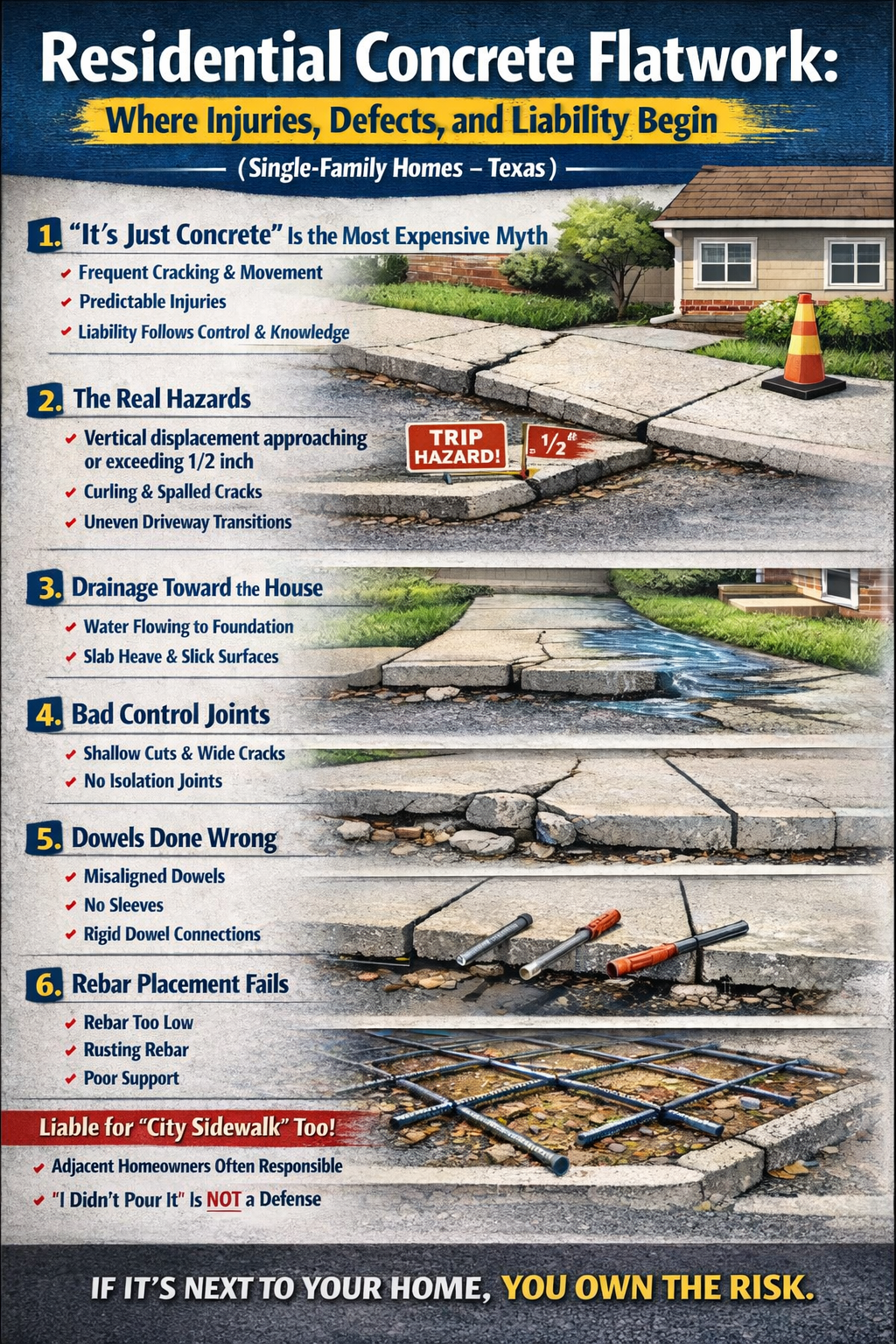
At residential houses, concrete flatwork—driveways, sidewalks, patios, walkways, steps, and approach slabs—is routinely dismissed as simple, low-risk construction. That belief is wrong. In Texas, defective residential flatwork is a predictable source of personal injury, drainage failures, slab movement, insurance disputes, and homeowner liability.
This discussion applies only to residential properties. No commercial sites. No industrial slabs.
What Counts as Residential Flatwork
- Driveways and driveway extensions
- Sidewalks and private walkways
- Patios and exterior slabs
- Steps, landings, and porch slabs
- Service walks and similar site concrete
Flatwork is not a foundation, but it is still regulated by residential building codes, drainage requirements, and Texas premises-liability law. When it fails, liability almost always follows control and maintenance, not who originally poured it.
The Primary Residential Flatwork Failures That Create Liability
(Sections on trip hazards, drainage, joints, dowels, and rebar remain as previously written and apply equally here.)
Critical Addition: Liability Exists Even When the Sidewalk Is “City-Owned”
One of the most dangerous misconceptions homeowners have is this:
“That’s the city sidewalk — not my problem.”
In Texas, that assumption is often legally wrong.
Ownership vs. Responsibility (They Are Not the Same)
While many residential sidewalks are located within the public right-of-way, abutting property owners are frequently responsible for maintenance and hazard correction, either by ordinance, common law, or both.
Key legal realities:
- Cities commonly place maintenance responsibility on the adjacent homeowner
- Homeowners may be required to repair, replace, or remove hazards
- Failure to do so can expose the homeowner to shared or primary liability
A sidewalk does not have to be privately owned for a homeowner to be legally exposed.
How Homeowners Get Pulled Into Sidewalk Injury Claims
Homeowners are routinely named in lawsuits involving sidewalk injuries when:
- The hazard is adjacent to their property
- The condition is long-standing or visible
- Tree roots, drainage, or settlement from the lot contributed
- The homeowner knew or should have known of the condition
Vertical displacement, spalling, cracking, or ponding water adjacent to a residence can establish constructive notice—even if the city technically owns the concrete.
Typical Residential Sidewalk Defects That Trigger Liability
- Vertical offsets from settlement or heave
- Cracked panels with spalled edges
- Tree-root uplift originating from the yard
- Driveway-sidewalk interface displacement
- Water flowing across sidewalks and freezing or algae growth
Once a condition is visible and persistent, the argument that the homeowner had “no responsibility” becomes weak—especially if the defect is tied to site drainage, landscaping, or flatwork modifications on the lot.
“The City Should Have Fixed It” Is Not a Defense
In premises-liability litigation, courts do not stop at ownership. They examine:
- Who controlled the adjacent property
- Who benefited from the sidewalk
- Who knew or should have known
- Who failed to act
A city’s failure to repair does not automatically absolve the homeowner. In many cases, liability is shared, and the homeowner becomes the easier target.
Insurance Reality for Sidewalk Claims
Homeowners insurance may:
- Deny coverage if the condition was known
- Reduce payouts due to long-term neglect
- Subrogate against the homeowner after settlement
Once cracking, displacement, or tree-root uplift is obvious, insurers expect action—regardless of whose name is on the right-of-way map.
Why Flatwork Defects Escalate Faster at Sidewalks
Sidewalks experience:
- Constant pedestrian traffic
- Guests, delivery drivers, postal carriers, children
- Visibility from the street (easy plaintiff photos)
Combine that with:
- Improper dowels
- Misplaced rebar
- Poor jointing
- Drainage from the lot
…and a “minor” sidewalk defect becomes a high-exposure injury condition.


