
A Real Example from a North Texas Home
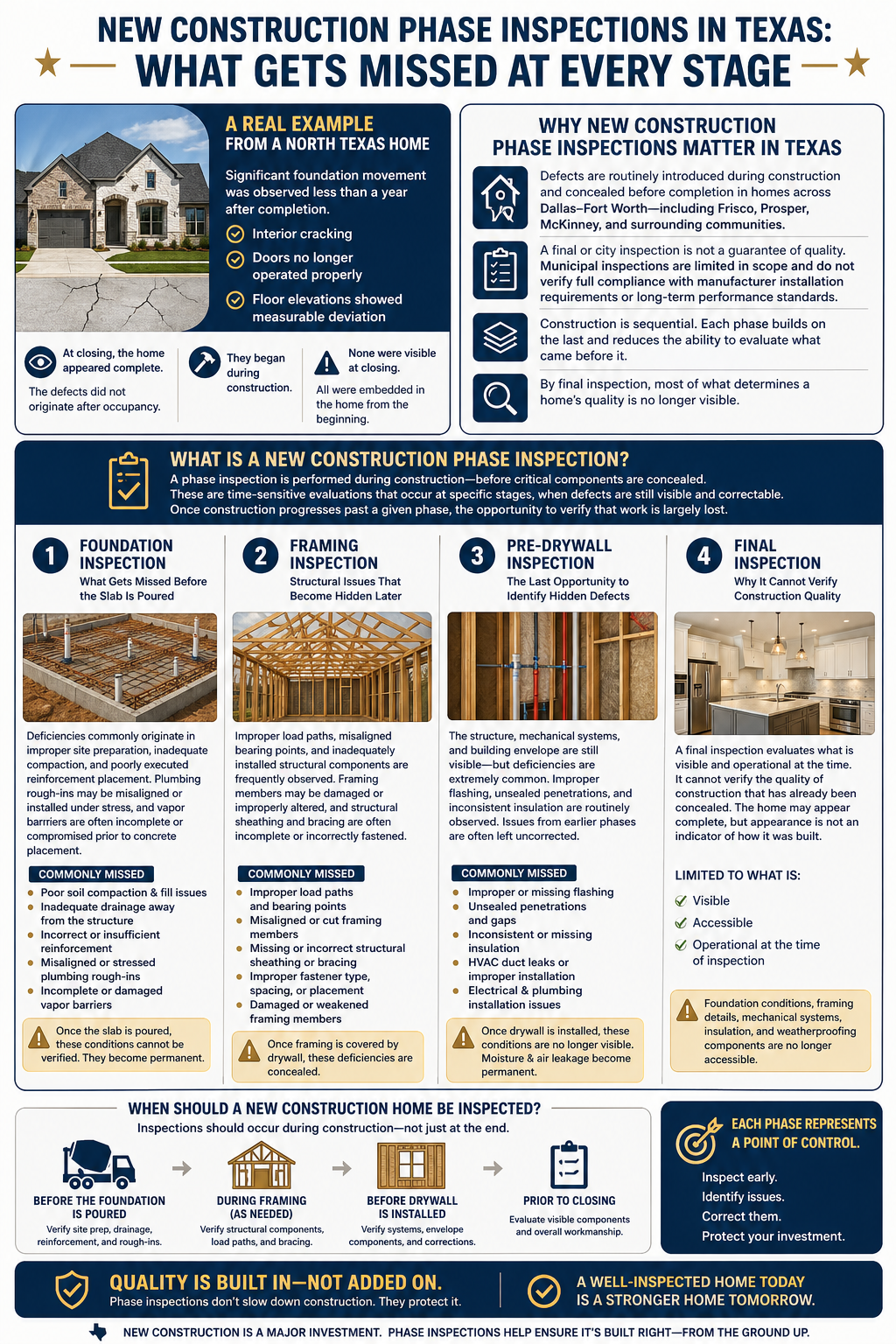
In a recently constructed home in North Texas, significant foundation movement was observed less than a year after completion. Interior cracking had developed, doors no longer operated properly, and floor elevations showed measurable deviation.
At closing, the home appeared complete. The finishes were clean, systems were operational, and no major concerns were identified during the final walkthrough.
The defects did not originate after occupancy.
They began during construction.
Site preparation had been insufficient. Drainage conditions were not properly established prior to the foundation pour. Reinforcement placement was inconsistent, and slab elevation provided minimal tolerance for water movement away from the structure.
None of these conditions were visible at closing.
All of them were embedded in the home from the beginning.
Why New Construction Phase Inspections Matter in Texas
The sheer number of deficiencies routinely missed at each stage of residential construction in Texas is staggering.
Across the Dallas–Fort Worth area—including Frisco, Prosper, McKinney, and surrounding communities—new construction homes regularly contain defects that are introduced during construction and concealed before completion.
A common assumption is that if a home passes a final inspection or a city inspection, it was built correctly. That assumption is often misplaced.
Municipal inspections, where they occur, are limited in scope. They are not comprehensive evaluations of construction quality, and they do not verify full compliance with manufacturer installation requirements or long-term performance standards.
Residential construction is sequential. Each phase builds on the last, and each phase reduces the ability to evaluate what came before it.
By the time a home reaches final inspection, most of what determines its quality is no longer visible.
What Is a New Construction Phase Inspection?
A new construction phase inspection is performed during construction—before critical components are concealed.
These inspections are not redundant. They are time-sensitive evaluations that occur at specific stages, when defects are still visible and correctable.
Once construction progresses past a given phase, the opportunity to verify that work is largely lost.
Foundation Inspection: What Gets Missed Before the Slab Is Poured
The foundation stage is one of the most critical phases of construction, yet it is rarely observed by buyers.
In new construction homes across North Texas, deficiencies commonly originate in improper site preparation, inadequate compaction, and poorly executed reinforcement placement. Plumbing rough-ins may be misaligned or installed under stress, and vapor barriers are often incomplete or compromised prior to concrete placement.
These conditions are frequently missed because the work occurs quickly, often within a narrow window, and inspections—where they occur—are limited in scope. In some areas, particularly unincorporated regions, there may be no meaningful Authority Having Jurisdiction overseeing residential construction at all.
Once the slab is poured, these conditions cannot be verified.
They become permanent.
Framing Inspection: Structural Issues That Become Hidden Later
The framing stage establishes the structural integrity of the home, but it is also where deviations from plans and standards commonly occur.
Improper load paths, misaligned bearing points, and inadequately installed structural components are frequently observed in new builds throughout the Dallas–Fort Worth area. Framing members may be damaged or improperly altered, and structural sheathing and bracing are often incomplete or incorrectly fastened.
These deficiencies are rarely evaluated in detail. Once framing is covered by drywall, they are concealed.
What remains are symptoms—cracking, movement, and misalignment—that appear later, often without clear attribution.
Pre-Drywall Inspection: The Last Opportunity to Identify Hidden Defects
The pre-drywall inspection is the most important phase for evaluating the home as a complete system.
At this stage, the structure, mechanical systems, and building envelope are still visible. However, deficiencies related to water management and air control are extremely common in Texas homes.
Improper flashing, unsealed penetrations, and inconsistent insulation are routinely observed. Issues identified in earlier phases are often left uncorrected.
This phase moves quickly, particularly in production building environments across North Texas. Once drywall is installed, these conditions are no longer visible.
Moisture intrusion pathways are concealed. Air leakage becomes permanent. Opportunities for correction are significantly reduced.
Final Inspection: Why It Cannot Verify Construction Quality
The final inspection is the most common inspection performed by buyers—and the most misunderstood.
A final inspection is valuable, but it is inherently limited. It evaluates what is visible and operational at the time of inspection. It cannot verify the quality of construction that has already been concealed.
By this stage, foundation conditions, framing details, mechanical systems, insulation, and weatherproofing components are no longer accessible.
The home may appear complete, but appearance is not an indicator of how it was built.
When Should a New Construction Home Be Inspected?
Inspections should occur during construction—not just at the end.
The most effective timing includes evaluation before the foundation is poured, before drywall is installed, and again prior to closing. Depending on the project, additional inspections during framing or system installation may also be appropriate.
Each phase represents a limited window.
Once that window closes, the ability to evaluate that work is significantly reduced.
What Gets Missed Most Often in New Construction Homes?
Across Texas, the same categories of deficiencies appear repeatedly.
Foundation preparation issues, framing defects, improper flashing, air sealing failures, and mechanical system installation problems are among the most common findings.
These are not rare conditions. They are recurring issues that develop during construction and are often concealed before they can be identified.
Can Defects Be Corrected After Closing?
Some can.
Most become more difficult to address.
Once a home is complete, access to underlying systems is limited. Corrections may require removal of finishes, disruption of occupancy, and negotiation with the builder under warranty conditions.
The most effective time to identify and correct deficiencies is during construction—before they are concealed and before closing reduces leverage.
Conclusion: What This Means for Buyers in Texas
The deficiencies that matter most in residential construction are not the ones visible at the end.
They are the ones missed along the way.
Each phase of construction presents a limited opportunity to evaluate work while it is still visible, verifiable, and correctable. Once that opportunity passes, the defect remains and the cost of resolution increases.
Most buyers assume that if a home passes inspection at the end, it was built correctly.
That assumption is often incorrect.
Because by the time construction is complete, you are no longer evaluating how the home was built.
You are living with the result.
Schedule a New Construction Phase Inspection in North Texas
If your home is currently under construction, it can still be evaluated—but timing is critical.
Texas Inspector performs new construction phase inspections throughout the Dallas–Fort Worth area, including Frisco, Prosper, McKinney, Plano, and surrounding communities.
Phase inspections are designed to identify deficiencies while they are still visible—before they become permanent conditions within the home.


