
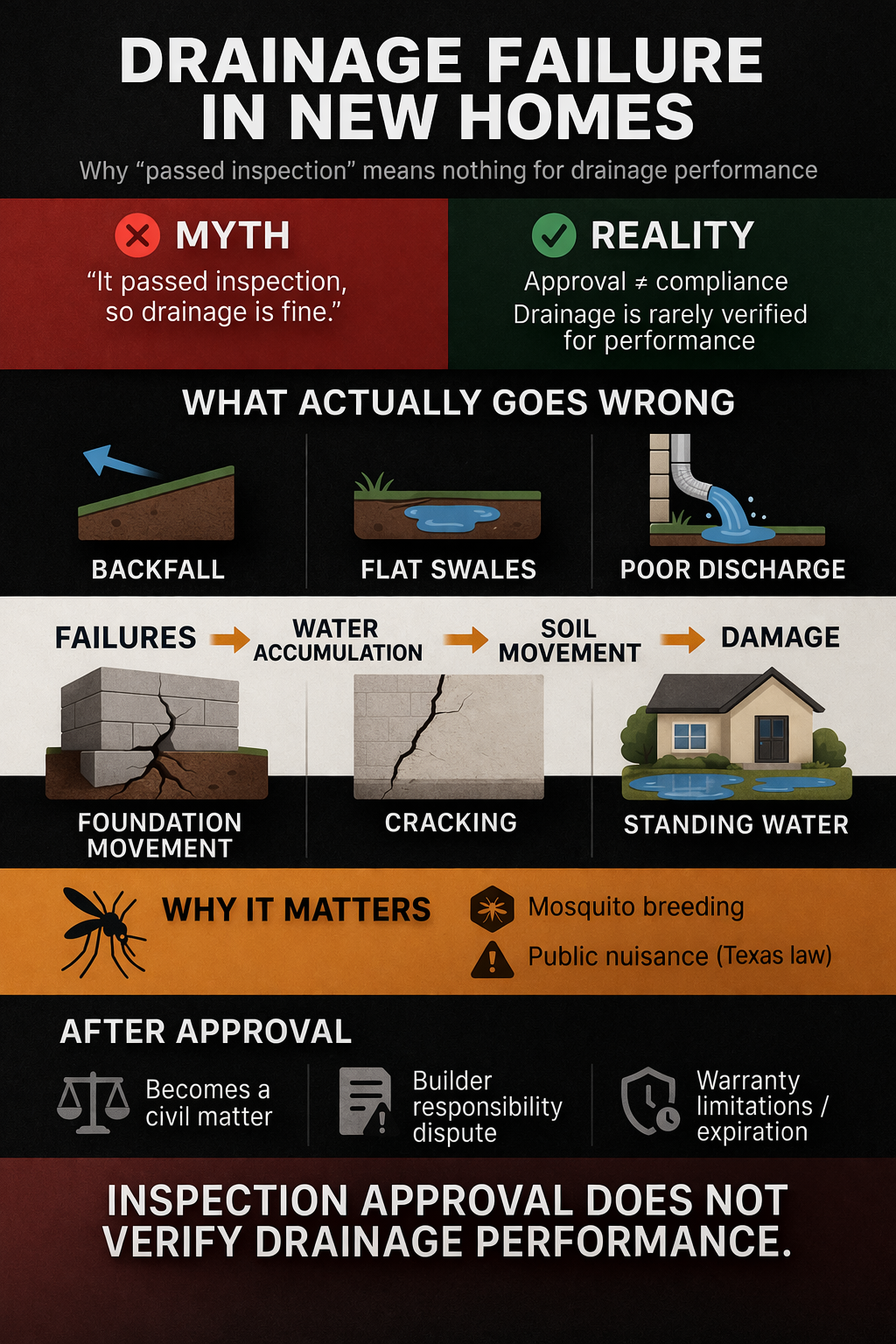
There is a persistent belief among homeowners that if a property “passed drainage,” then the lot was properly designed and constructed to move water away from the house. That belief is wrong.
What most people do not understand is that a municipal approval or final inspection does not establish that the lot actually met the minimum standard required by the code. In many cases, it only means the inspection was limited, hurried, perfunctory, or failed to identify what was plainly there. That distinction matters because a lot can receive a signoff and still have inadequate slope, ineffective swales, poor discharge locations, and drainage conditions that direct water toward the foundation rather than away from it. When that happens, the issue is not that the code allowed the failure. The issue is that the failure was missed, ignored, or passed over during the inspection process.
When a lot is graded and approved, many homeowners assume that means the drainage was proper. It does not. In many cases, it means the deficiency was not identified, not challenged, or simply tolerated in the field. That is selective code enforcement. The code establishes a minimum drainage standard, but that standard is not always meaningfully enforced. Instead, approval is sometimes based on a quick visual pass that allows noncompliant conditions to move forward as though they were acceptable.
What makes the problem worse is what happens after final approval. Once the municipality has signed off on the lot, it will typically refuse to revisit the drainage issue in any meaningful way. Homeowners who complain about standing water, negative drainage, or water collecting near the foundation are often told the same thing: the project has already been approved, the city is not going to intervene, and the matter is now a civil dispute. At that point, the homeowner is effectively pushed out of the code-enforcement process and told to contact an attorney. In other words, the municipality may fail to enforce the minimum standard on the front end, then decline responsibility on the back end after the damage becomes apparent.
In many North Texas subdivisions, lots are graded as flat as possible. This is done to maximize usable yard space, simplify construction, and increase density. Flat lots also make it easier to sell the appearance of a clean, level yard. However, flat grading combined with expansive clay soils creates a condition where drainage performance is highly sensitive to even minor deviations.
Minimal slope is often relied upon to carry water away from the structure. In practice, that slope may be marginal from the outset. Once you introduce settlement, irrigation, landscaping, and normal use, the original grading intent is easily compromised. What may have been barely adequate on the day of inspection becomes inadequate shortly thereafter.
The consequences go well beyond a soggy yard. Poor drainage directly affects foundation performance because it creates inconsistent soil moisture conditions around the structure. In expansive clay soils, that matters. When soils adjacent to the foundation become excessively wet while other areas remain comparatively dry, the result is differential movement. One portion of the foundation may heave while another settles or remain relatively stable. That uneven support is what translates into cracking, distortion, and long-term structural distress. Poor drainage is therefore not merely a site nuisance. It is often a contributing cause of foundation-related damage.
Poor drainage also creates site conditions that promote mosquito breeding. Water that ponds in swales, low areas, splash zones, and poorly drained side yards does not just sit there harmlessly. It becomes habitat. Under Texas law, mosquito-breeding water is treated as a public health nuisance within municipalities, and breeding areas for disease-transmitting mosquitoes may qualify as a nuisance regardless of location. Municipalities have express authority to require stagnant water to be drained or regulated, and counties may act against unsanitary conditions in unincorporated areas that are likely to attract or harbor mosquitoes. In practice, that means these drainage failures are not just performance issues. They can also create conditions that violate public health standards.
Three recurring failure patterns show up consistently in these conditions. The first is backfall toward the foundation. Soil movement and disturbance frequently result in negative drainage, where water moves toward the structure instead of away from it. This is not an unusual or isolated condition. It is routinely observed in relatively new construction, and it contributes directly to elevated moisture levels at the foundation perimeter.
The second is the presence of swales that do not actually function as drainage paths. Swales are often too shallow or too flat to convey water effectively. They may also be interrupted by fences, landscaping, or adjacent grading that was not coordinated properly. Instead of directing water away, they allow it to collect and infiltrate near the foundation or remain ponded long enough to become a breeding ground for mosquitoes.
The third is improper discharge from downspouts. Even where gutters and extensions are installed, the discharge point is frequently located in an area that lacks sufficient slope to carry the water away. In some cases, the water is simply redistributed around the foundation rather than removed from the vicinity of the structure. That repeated wetting of the soils near the house further undermines foundation performance and worsens already marginal drainage conditions.
Municipal inspections are not designed to function as detailed performance evaluations. They are limited in time and scope and are typically conducted under production pressures. Inspectors are not returning after settlement occurs, and they are not evaluating how the lot performs during actual rainfall events. They are observing conditions at a moment in time and making a determination based on what is readily visible.
This creates a disconnect between approval and performance. A lot can be signed off and still fail to meet the minimum drainage requirements of the code. When that happens, the issue is not theoretical. It shows up in the form of standing water, mosquito activity, water accumulation near the foundation, inconsistent soil moisture, and eventual structural movement.
When homeowners push back, builders often respond with theater rather than substance. One common tactic is to trot out the project surveyor to “bless” the grading and drainage, as though the surveyor’s opinion resolves the issue. It does not. A surveyor may locate elevations or depict site features, but that does not give the surveyor authority to determine whether the lot complies with the code’s drainage requirements or whether the observed performance is acceptable. Another tactic is to recite some invented rule, such as the claim that standing water is not a problem unless it remains for 48 hours or more. That kind of statement gets repeated as though it were a legal standard, when in many cases it is nothing more than a convenient piece of builder folklore (read: bullshit) used to deflect complaints. Neither the surveyor’s blessing nor the builder’s made-up timeline changes the actual question, which is whether the lot drains away from the structure as required.
These problems rarely present as immediate failures. Instead, they develop gradually. Water collects near the foundation, soils expand and contract unevenly, and the structure begins to respond. Interior symptoms such as cracking, door misalignment, and floor irregularities are often the first indicators noticed by the homeowner. Outside, the owner may also notice persistent ponding, muddy side yards, water that remains long after a rain event, and increased mosquito activity in the affected areas.
By the time those symptoms appear, the drainage condition has typically been present for an extended period. The original cause is no longer obvious, and attention is often directed toward cosmetic repairs rather than the underlying issue. Just as important, by the time drainage-related foundation damage becomes sufficiently pronounced to force the issue, the builder is often already beyond the warranty period. Even where warranty coverage technically remains, whether the condition is covered may depend on the severity of the damage and the builder’s warranty language. In practice, that means the homeowner may not discover the true nature of the problem until the builder is out from under the warranty altogether, or until the claim is substantial enough to trigger a coverage fight.
From a defect and litigation standpoint, drainage failures are frequently disputed. Builders often rely on the fact that the lot was approved at final inspection. Municipalities, having already signed off, commonly take the position that the matter is no longer an enforcement issue and instead belongs in the realm of private dispute. The homeowner is then left in the worst possible position: the city treats the approval as final, the builder treats the approval as proof of compliance, and the homeowner is told to hire counsel and fight it out as a civil matter. However, approval does not establish compliance. It only establishes that the condition was not rejected at the time. If the lot does not drain in accordance with the code, then it does not comply, regardless of what the inspection record shows.
Early documentation becomes critical in these cases. If the condition is identified and recorded before significant homeowner modification, it is much easier to demonstrate that the deficiency originated with the original grading and construction. Once landscaping changes, irrigation patterns, and other alterations occur, the argument becomes more complicated.
The underlying issue is not that the code permits these drainage failures. The code requires that drainage direct water away from the structure. The problem is that deficient work is often allowed to proceed through superficial inspection processes and later defended with the claim that approval equals compliance. Once the municipality has washed its hands of the issue and recast it as a private civil dispute, the burden shifts almost entirely to the homeowner to prove what should have been addressed at the outset.
Modern residential drainage systems are not failing unpredictably. In many, if not all, cases, they are never functioning properly to begin with. The failure is simply delayed long enough that it is no longer associated with the original construction, even though the damage, nuisance conditions, and consequences were built into the lot from the start.


