
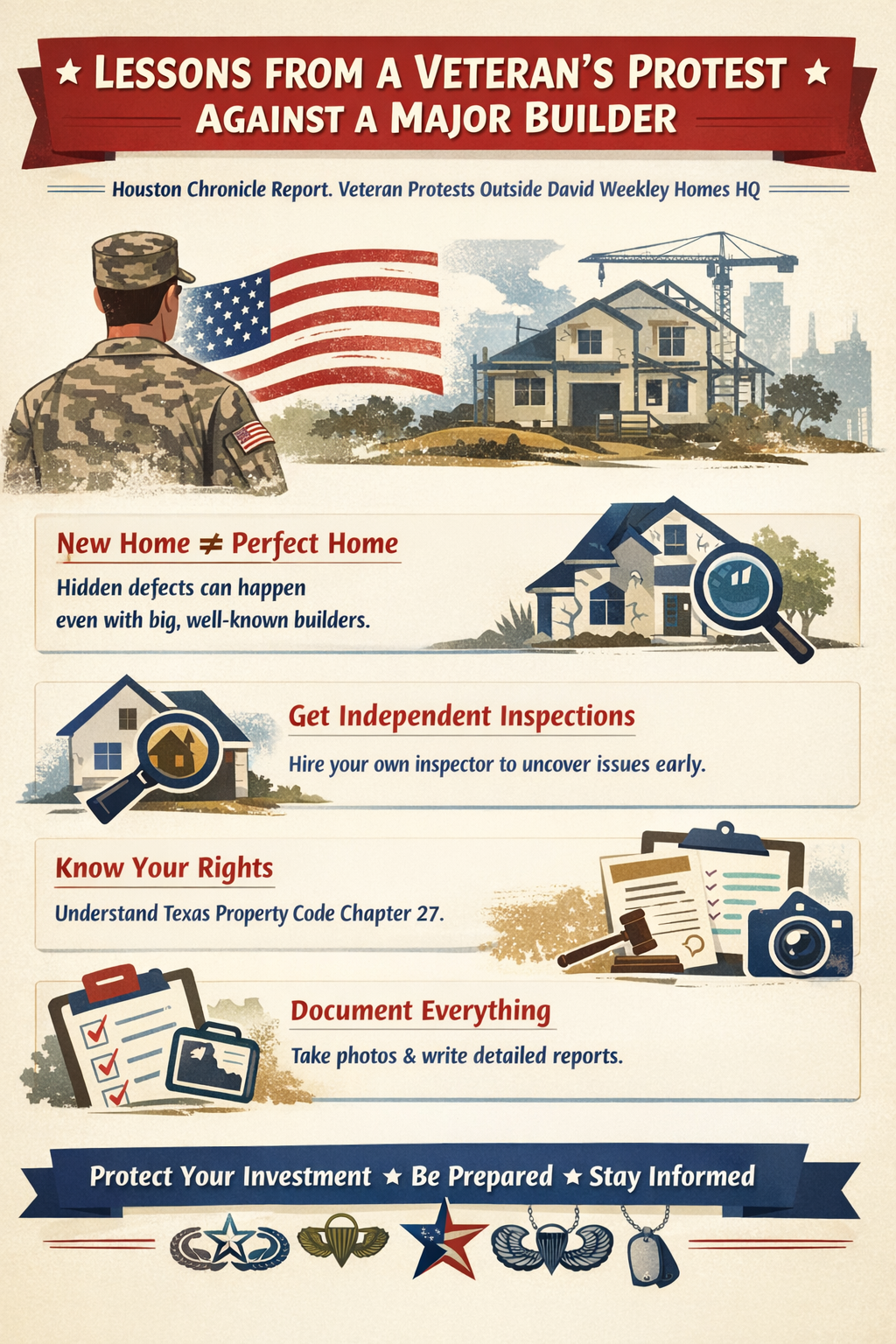
A recent Houston Chronicle report described a Texas military veteran who protested outside the headquarters of David Weekley Homes, alleging serious defects in his newly constructed home and unresolved warranty issues.
Regardless of where the ultimate facts land in that specific dispute, the larger lesson is not about one builder.
It is about risk.
When a homeowner-especially a veteran who served this country-feels compelled to stand outside a corporate office with a protest sign, something in the dispute resolution process has broken down.
New-construction buyers in Texas should pay attention.
New Home ≠ Perfect Home
There is a widespread assumption that “brand new” means:
- Fully compliant
- Properly supervised
- Carefully inspected
- Structurally sound
In reality, most production homes are built in compressed timelines using rotating subcontractor crews. High volume increases variability.
Even reputable, nationally recognized builders rely on dozens of independent trades working under scheduling pressure.
Defects are not rare. They are predictable.
Why Municipal Inspections Are Not Enough
In Texas, city inspectors enforce the locally adopted version of the International Residential Code. Their role is limited to verifying minimum code compliance at specific inspection stages.
They do not:
- Perform forensic moisture analysis
- Remove finishes
- Verify every manufacturer installation requirement
- Represent the homeowner
A green sticker from the city means the house passed a limited inspection at a moment in time.
It does not mean the home is defect-free.
The Types of Problems That Lead to Escalation
When disputes escalate to public protest, the issues are usually not cosmetic.
They often involve:
- Water Intrusion
Improper flashing, drainage, or cladding details that allow moisture into wall systems.
- Structural Concerns
Improper framing connections, settlement concerns, or load path deficiencies.
- Electrical Safety Issues
Improperly protected branch circuits, panelboard defects, or missing AFCI/GFCI protection.
- Site Drainage Failures
Improper slope away from foundations leading to ponding and foundation risk.
These are not “punch list” items. They affect safety, durability, and long-term value.
Why Warranty Processes Sometimes Fail
Most production builders have structured warranty departments. When defects are reported:
- The builder inspects.
- The builder decides the scope.
- The builder chooses the repair method.
- The builder documents the resolution.
That structure is not inherently improper-but it is not independent.
If a homeowner believes the root cause is not being addressed, trust erodes quickly.
Under Texas Property Code Chapter 27 (Residential Construction Liability Act), homeowners must:
- Provide written notice of defects.
- Allow the builder to inspect.
- Allow the builder an opportunity to offer repairs.
If either side mishandles that process, conflict escalates.
Public protest is usually the last step-not the first.
What Buyers Should Do Instead of Waiting for Crisis
The lesson from this protest is not “avoid large builders.”
The lesson is “protect yourself early.”
- Inspect Before Drywall
This is the only time framing, plumbing routing, electrical runs, and structural components are visible.
- Inspect Before Closing
Do not rely on a final walkthrough alone.
- Inspect Before Warranty Expiration
Many defects manifest within the first year.
- Document Everything
Photographs. Dates. Written communication.
Technical documentation creates leverage. Emotion does not.
Systemic vs. Isolated Defects
When a dispute involves a production builder in a subdivision, two possibilities exist:
- The issue is isolated to one home.
- The issue reflects a repeated construction method across multiple homes.
If systemic, neighbors may be experiencing similar issues without knowing it.
That is when disputes gain traction-and sometimes media coverage.
The Larger Reality
The veteran in the Chronicle story felt unheard.
No homeowner-veteran or otherwise-should feel that public protest is the only avenue left.
But the reality is this:
- Construction is imperfect.
- Oversight varies.
- Documentation protects you.
- Independent inspection reduces escalation.
Your home is likely the largest investment you will ever make.
Treat it like one.


