
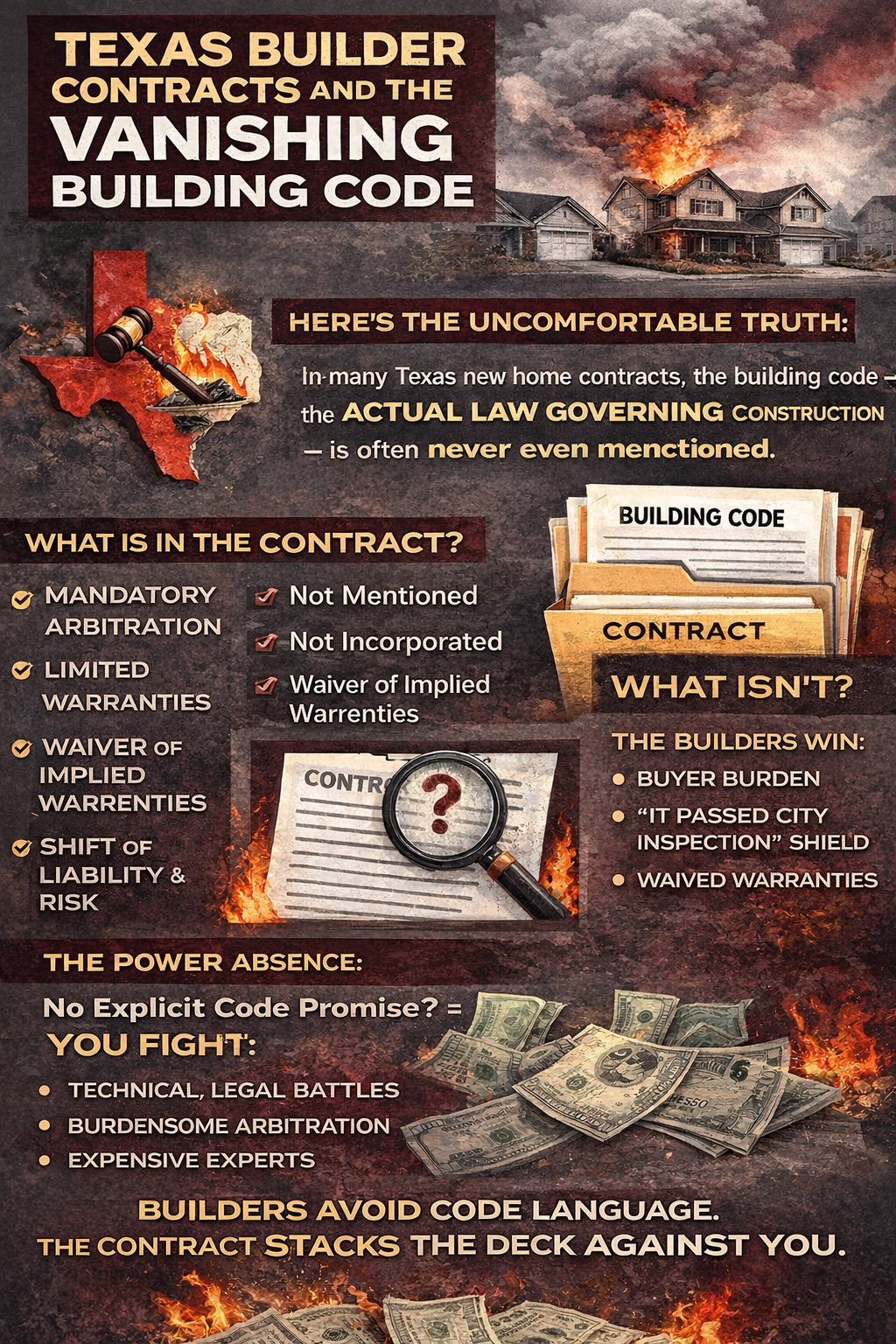
Here’s the uncomfortable truth:
In many Texas new home sales contracts, the building code — the actual law governing construction — is never even mentioned.
Not incorporated.
Not referenced.
Not promised.
Gone.
The Law Exists. The Contract Pretends It Doesn’t.
In Texas, once a municipality adopts a building code under:
- Texas Local Government Code § 214.212 (municipal authority), or
- § 233.153 (county authority in certain areas),
that code is law.
For one- and two-family dwellings, that typically means:
- 2021 International Residential Code (IRC)
- 2021 International Energy Conservation Code (IECC)
- 2023 National Electrical Code (NEC), where adopted
These are not suggestions.
They are minimum legal requirements.
And yet—open up the typical Texas production builder contract and try to find a clear sentence stating:
“Builder shall construct the home in strict compliance with all applicable building codes.”
You won’t find it.
Not because it was forgotten.
Because it was avoided.
What the Contract Does Say
It will say:
- Arbitration is mandatory.
- Warranties are limited.
- Implied warranties are disclaimed to the maximum extent permitted.
- Liability is restricted.
- Delays are excused.
- Risk is shifted.
- You waive things.
- You initial things.
- You sign things.
But the single most important performance standard in residential construction?
Silence.
Why This Is Not an Accident
If the contract expressly incorporates the adopted building codes:
- Code violations become straightforward breach-of-contract claims.
- Enforcement becomes objective.
- “Substantial compliance” arguments get weaker.
- Homeowners have leverage.
If the contract does not incorporate the codes:
- The fight shifts to implied warranties.
- The builder argues “good and workmanlike.”
- The builder argues “it passed city inspection.”
- The burden becomes technical, expensive, and uphill.
That is not poor drafting.
That is risk management.
“It Passed Inspection” — The Favorite Shield
Municipal inspections are limited-scope regulatory checks.
They are not:
- Forensic reviews
- Performance certifications
- Structural audits
- Energy compliance verifications beyond spot checks
- Warranty guarantees
Inspectors do not open walls after drywall.
They do not re-engineer framing.
They do not redesign HVAC loads.
They do not certify long-term performance.
Passing inspection means one thing:
It was not red-tagged that day.
That is not the same as code compliance.
And it certainly is not the same as contractual compliance.
The Game
Here’s how it works:
- The law requires code compliance.
- The contract avoids promising code compliance.
- The warranty limits remedies.
- Arbitration restricts procedure.
- The buyer assumes “of course they have to build to code.”
That assumption is doing a lot of heavy lifting.
The Sentence That Should Be There
A contract that is serious about legal compliance would say:
“Builder shall construct the Home in strict accordance with all applicable federal, state, and local building, electrical, mechanical, plumbing, and energy codes adopted by the authority having jurisdiction as of the date of permit issuance.”
If that sentence is not there, ask yourself why.
If a builder is fully confident in strict code compliance, incorporating that obligation should be easy.
If it’s avoided, that tells you something.
This Is About Leverage
Before closing:
- You have negotiation leverage.
- You can demand inspections.
- You can demand documentation.
- You can request plan review.
After closing:
- You have warranty procedures.
- You have arbitration.
- You have experts.
- You have invoices.
Those are not the same thing.
Hard Truth
The building code is the minimum legal standard.
If the sales contract does not explicitly incorporate it as a contractual duty, you are relying on:
- Public enforcement,
- Limited warranties,
- And the hope that nothing was missed.
Hope is not a construction standard.
Bottom Line
If you are signing a Texas new home construction agreement and the document:
- Carefully limits liability,
- Carefully narrows warranties,
- Carefully requires arbitration,
- But does not clearly promise strict compliance with adopted building codes—
That omission is not accidental.
It is structural.
And you should treat it that way.


